The Strategy
Fixing Keyword Cannibalisation
Many of the product and category pages on the client’s website were unable to reach their ranking potential due to keyword cannibalisation.
This is when multiple pages on the same website compete against each other for the same keyword.
You can find cannibalised keywords via Ahrefs’ Organic keywords report. Filter the results so that you’re only looking at keywords ranking outside of the first page.
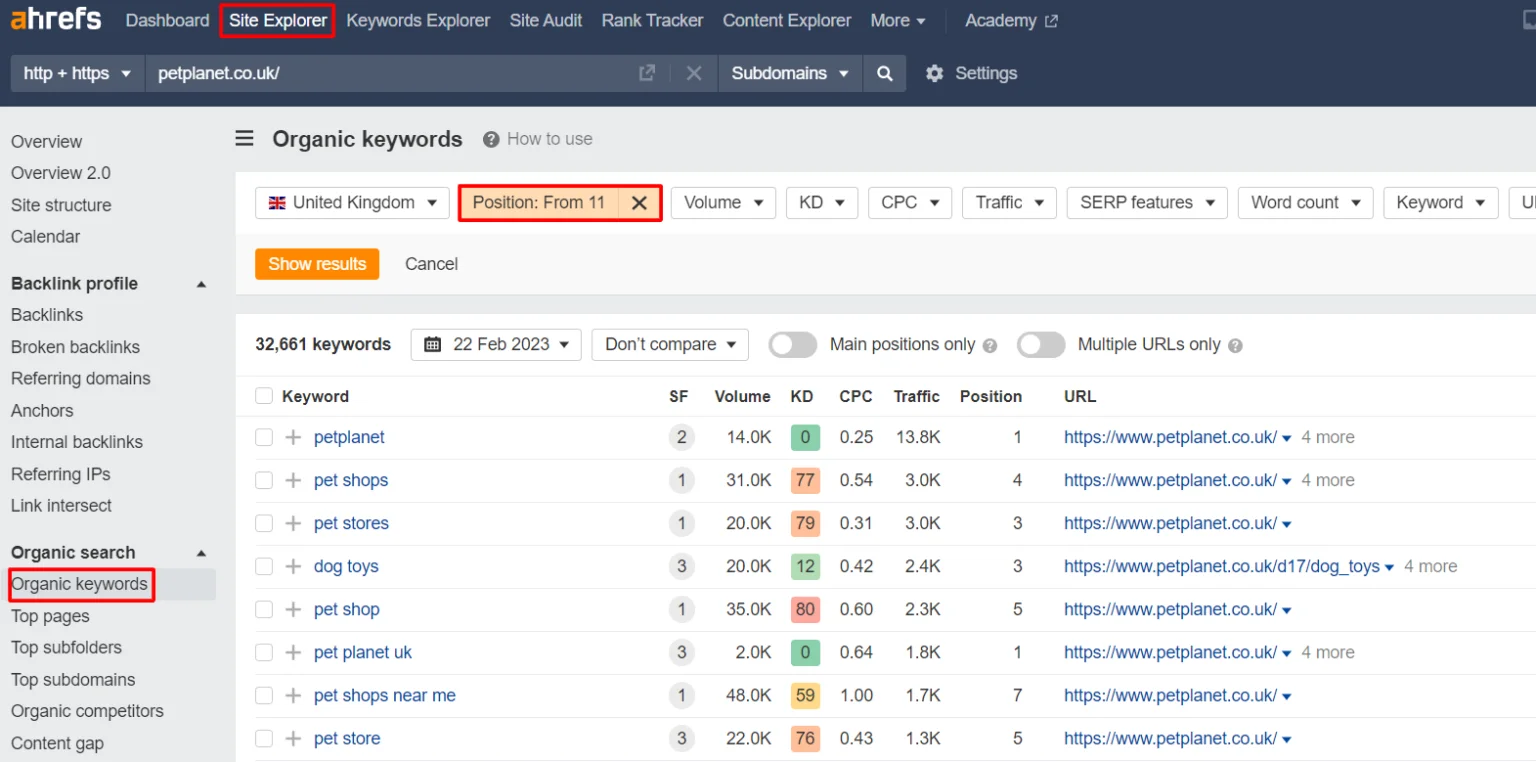
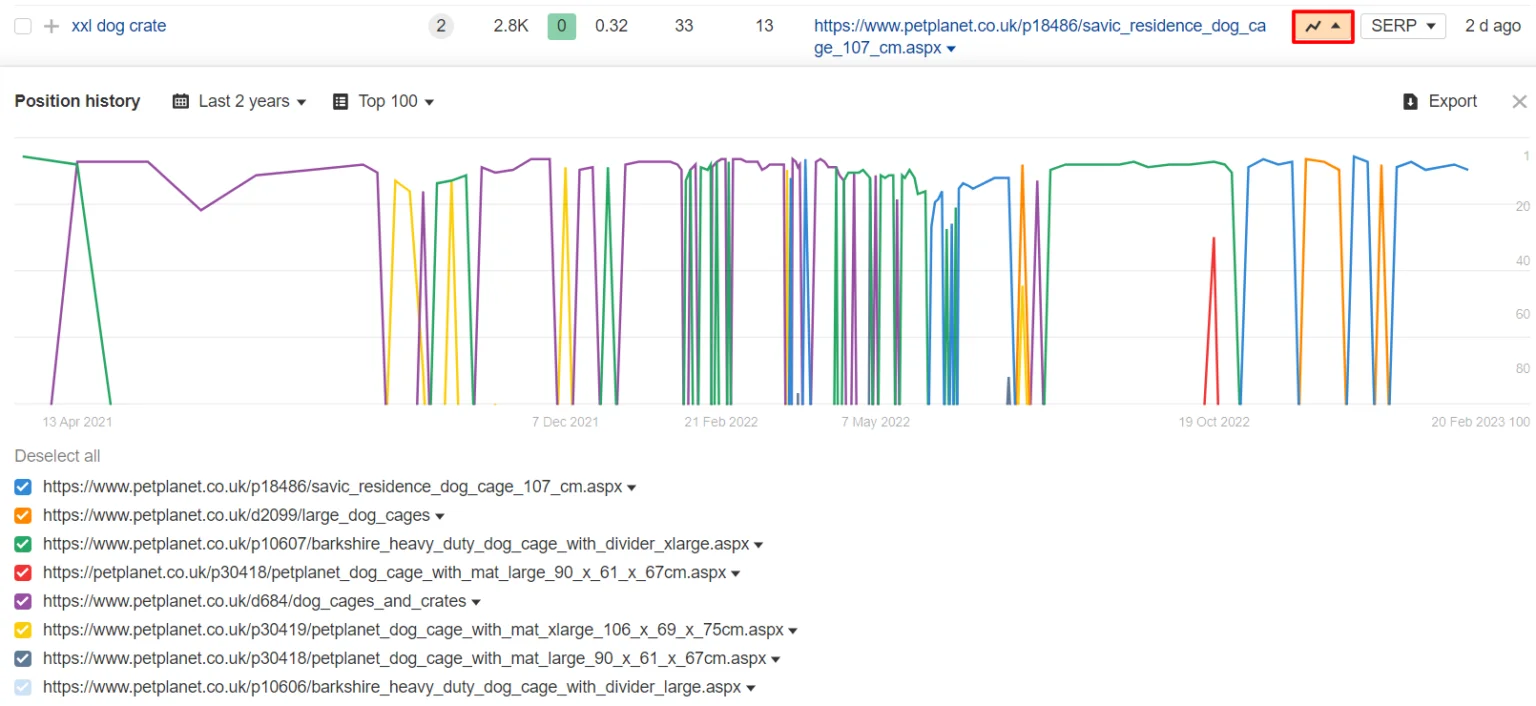
Go through the keywords by clicking on the graph icon – this’ll show you how your website has ranked for the selected keyword over time.
Each line on the graph represents a unique URL that Google has ranked for the target keyword. In the example below, you can see that Google has switched between many URLs, and as a result, none of the site’s pages have been able to break into the first page of the search results.
This issue can be fixed in several ways:
- De-optimising irrelevant pages and optimising the main page that you want to rank
- Adding a canonical tag from the irrelevant pages to the main page that you want to rank
- Implementing a 301 redirect from irrelevant pages to the main page that you want to rank
- Adding an internal link from the irrelevant pages to the main page that you want to rank
Each case of cannibalisation may require one or a combination of the above solutions to ensure that the right page is picked up by Google.
You can find out more about keyword cannibalisation here.
Publishing Regular Blog Content
Whilst focusing on optimising product and category pages for transactional keywords (i.e. “pet food for dogs”) is a priority for eCommerce websites, it’s also important to diversify your SEO strategy by identifying keywords of varying intents.
This way, the pages you create can target users at different stages of the customer journey. For example, some users may be at the beginning of their search journey and are looking for information about a specific product or topic, which means that your content should be optimised for search queries that match this user intent.
A great way to do this is to publish informational articles on your blog. Doing so also has additional SEO benefits:
- Builds Topical Authority – show Google and your readers that you’re the go-to source of information within your industry
- Internal Linking Opportunities – allows you to guide users towards your key pages i.e. product and category pages for eCommerce websites.
- Increases Keyword Visibility – start ranking for more keywords and bringing in more traffic to your website
- Content Freshness – Google strives to present users with content that is relevant and fresh, so regularly publishing new content on your blog serves as a signal that you are up to date with trending topics within your industry.
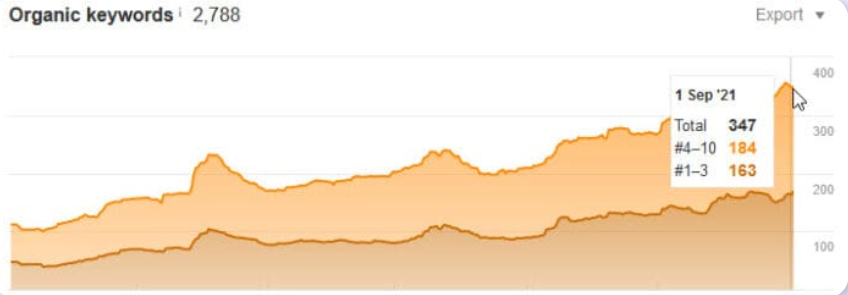
Below is a screenshot taken from Ahrefs showing the site’s keyword visibility growth within the top 10 positions of Google’s search results from 102 to 347 keywords in 12 months.
Improving Navigation Through Internal Linking
As mentioned above, internal linking (hyperlinking one page on your website to another) is an effective SEO tactic that helps you to improve site navigation by guiding visitors who land on your blog posts towards the main pages on your website.
It also helps Google to understand the relationship between your web pages, making it easier for the crawler to discover and index your content.
When it comes to internal linking, here are some things to consider:
- Only add internal links to relevant pages – to maintain a smooth and meaningful user experience, make sure that the internal links that you add make sense i.e. if you have a blog post about how to set up a recording studio, a relevant internal link would be to a category page that lists all of the microphones that you sell.
- Add more internal links to your most important pages – this serves as a signal to Google that the page being linked to is of high value, but also ensures that users are more likely to land on these pages.
- Choose the right anchors – this is the textual part of your content that you add your link to. Use a variety of anchors to link towards your pages i.e. branded, generic (click here, more information etc), keyword-rich (microphones, recording studio).
Check out our guide on how to implement an effective internal linking strategy.
Boosting Rankability for Product Pages With Backlinks
The final step in the strategy was to boost the rankability of the product pages that were cannibalised with niche-relevant backlinks.
In order to do this, we put together a prospect list by identifying niche-relevant domains that were linking to the client’s direct competitors, but not to the client. It’s important to focus on securing backlinks from websites that are relevant to yours as backlinks from irrelevant domains can be seen as unnatural by Google.
A great tool to find link prospects by reverse engineering your competitors’ link profiles, is Ahrefs’ Link Intersect tool.








![How to Sell GEO: The Agency Playbook [Webinar]](https://susodigital.com/wp-content/uploads/2026/10/Webinar-How-to-Sell-GEO-The-Agency-Playbook-920x920.webp)