Focused on Niche Relevant Link Building
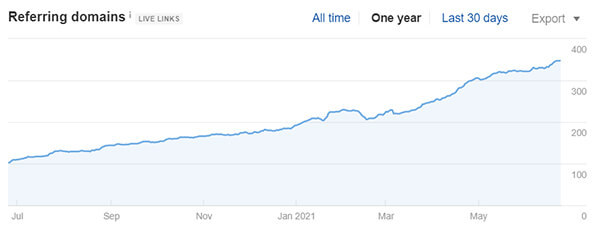
When compared to the competition, our client’s site was falling behind in terms of authority. Having completed an initial backlink review of the site’s backlink profile, we identified that the client didn’t have many niche-relevant backlinks. Therefore, we focused our attention on securing links in the home and cooking niches, using infographics and pillar pieces of content to serve as linkable assets to help build its authority. Over the course of the past year, the number of referring domains (i.e. websites linking to the client) has seen steady growth.
Internal Linking
Internal linking is a powerful SEO technique that benefits both users and search engines. It helps users navigate your website more effectively and helps search engines like Google understand the relationships between pages. This site had many core landing pages that had 0 internal links pointing towards them. We divided these pages into batches and periodically added internal links from other relevant pages on the website i.e. from product pages to category pages or blog posts to product pages etc.
Apart from identifying pages with no internal links, we also spotted that there were many product pages that did have internal links, but were pointing to irrelevant search pages of the product brand. In this case, we updated the Shopify code so that the product pages are now linked to the brand collection pages. This not only helps create a better experience for the user, but also gives Google an insight into the relevance between the products and collections.
Category Page Restructuring
Crafting content based on the user’s search intent for the core keyword you want to rank for is paramount in modern SEO. We saw that our client’s competing domains had included their category descriptions at the bottom of the page, whereas the client had added their content towards the top. This issue becomes especially apparent on mobile devices where the user has to scroll an unreasonable amount to even know products were on the page in the first place.
With this in mind, not only did we shorten the category descriptions on our client’s pages, we also moved them below the products to help the user experience in locating the products they desired.
Multiple Versions of URL by Category
Having multiple versions of the same pages should be avoided at all costs as it’s one of the things that can result in a Google penalty. We found that the product pages on the client’s site were set up so that each product had multiple URLs depending on the category it appeared in.
For example, the site had the main product URL like this:
/product/product-name-1
But also had multiples others like this:
/collection/collection-name-1/product/product-name-1
/collection/collection-name-2/product/product-name-1
/collection/collection-name-3/product/product-name-1
For every product page where we found this duplication, we changed the code on Shopify so that the site served the /product/product-name-1 link directly.
Duplicated Headings
Another issue that we encountered was the fact that the Shopify site had automatically created multiple versions of the same headings across the pages. We located and removed these headings which weren’t visible to the user but were picked up by crawlers. It’s worth noting that including hidden content on your site may be seen as manipulative by Google.
Redirects
During our initial technical audit of the site, we noticed that all of the 607 products that appeared in the /collections/all section of the site were all redirecting to the /products/product-name pages. This is incredibly inefficient as it adds an extra request to the server to be made, which in turn, increases the time it takes to load the desired page. To solve this, we removed the redirect and again changed the code to directly serve the appropriate link in the ‘all’ collection.







![How to Sell GEO: The Agency Playbook [Webinar]](https://susodigital.com/wp-content/uploads/2026/10/Webinar-How-to-Sell-GEO-The-Agency-Playbook-920x920.webp)