
I went to make a coffee. When I came back, a complete off-site SEO dashboard was ready for review. Claude had pulled the data, identified the top competitors automatically, and populated every section of the report. Five minutes. Twenty-nine cents.
The technology behind it is MCP (Model Context Protocol). Every agency will tell you AI saves them hours. But that’s not the story here. We rebuilt SEO delivery around MCP because it lets us mine years of SEO expertise and campaign data for the patterns and tactics that actually work, and apply them with the specialists who know how to implement them. The result is better work, not just faster work.
This is a practical account of the stack, the workflows, and where human judgment remains the product.
Key Takeaways
- MCP is an open standard that connects AI models like Claude directly to external tools and data sources, removing the manual data-gathering layer from SEO workflows.
- SUSO’s current MCP stack includes Semrush, Screaming Frog, Otterly, Majestic, and Windsor.ai.
- SUSO runs dozens of MCP-powered workflows in production, including off-site SEO audits, keyword research, content planning and briefs, GEO and digital PR audits, and website performance analysis.
- Every output still requires expert review: MCP changes where analysts spend their time, not whether they are needed.
- The advantage is quality, not just speed. Saving hours with AI is table stakes. What cannot be copied is years of SEO expertise and campaign data, mined for the patterns and tactics that work, implemented by specialists who know how.
- The hours saved on data-gathering are reinvested in strategy, QA, and client thinking. Clients do not get a cheaper deliverable; they get more senior time applied to the same campaign.
- Individual analyses that previously took hours now run in minutes, at a cost of a few cents in API credits.
What MCP Is and Why It Matters for SEO Teams
MCP stands for Model Context Protocol. It is an open standard, developed by Anthropic, that lets AI models connect directly to external tools and data sources.
In practice: instead of logging into Semrush, running a crawl in Screaming Frog, pulling backlink data from Majestic, and exporting everything into a working document before any real analysis can begin, you tell Claude what data you need and from which tools. Claude pulls it, combines it, and surfaces the key findings.
The reason this matters specifically for SEO is that SEO insight has always been fragmented. A thorough analysis draws on keyword data, crawl data, backlink databases, analytics, and increasingly, AI visibility data. Getting all of it into one place has historically meant significant manual work before a single strategic decision can be made. MCP removes that layer.
One thing worth being clear about upfront. Claude Desktop, the application we use, runs locally on your machine. The model inference (the actual processing of your prompts and the data you feed in) runs on Anthropic’s servers. “Connected” is a more accurate description of this setup than “local.” That distinction matters for data security, which we address in its own section below.
The Problem This Stack Was Built to Solve
SEO data lives in too many places. That is not a shortcoming of any specific tool; it is simply how the landscape has evolved. Semrush, Screaming Frog, Otterly, Majestic, Google Search Console, Google Analytics: each provides something the others do not, and all of them feed into a complete picture.
The manual cost of pulling that picture together is real. Before an experienced analyst can do the work that requires judgment (identifying opportunities, setting priorities, building strategy), they first have to collect, combine, and format data from multiple sources. That process takes time, and it does not require the experience they bring.
The question that drove this build was simple: what if analysts could spend all of their time on the work that requires their judgment, and let the data-gathering layer run on its own?
This is what agentic SEO means in practice. Not a chatbot that helps draft copy, but a connected system where AI moves across multiple data sources to complete a task, and the human steps in to review, challenge, and decide.
An important point to raise at this stage: this is not a cost-cutting exercise, and speed was never the only goal. Clients get more senior strategist time applied to the same campaign, because the hours that used to go into collecting and formatting data now go into analysis, challenge, and strategy. And the work itself gets better.
Every workflow draws on years of SEO expertise and campaign data, surfacing patterns and tactics a manual process would never have the time to find, then puts them in front of specialists who know how to implement them. The economics of the workflow changed. The impact and quality both got stronger.
Our Current MCP Stack
Claude Desktop sits at the centre. Connected to it via MCP:
- Semrush: keyword data, competitor analysis, domain metrics
- Screaming Frog: site crawl data, technical audit inputs
- Otterly: AI visibility and GEO data
- Majestic: backlink and off-site data
- Windsor.ai: Google Analytics 4 and Google Search Console
Each connection takes around 15 minutes to configure. The Screaming Frog connection requires Claude Desktop specifically and does not work via the browser-based interface.
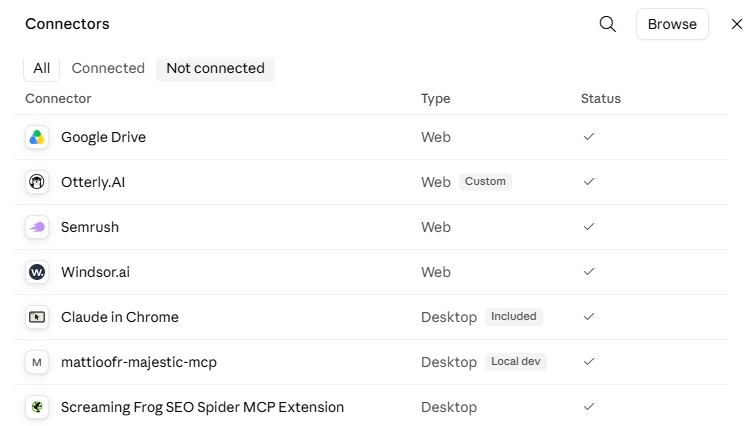
We are also building SUSO MCP, which will give Claude direct access to select internal project files, campaign-specific context, and our prompt library. Currently, that context is attached manually when a campaign’s project is set up. Removing that step is the next significant milestone.
MCP SEO Use Cases
Here are 4 examples of workflows that the SUSO team has rebuilt using MCPs. What follows is an account of each of them in their current form: what goes in, what comes out, and what the analyst still does.
Off-Site SEO Audits (Semrush + Majestic MCPs)
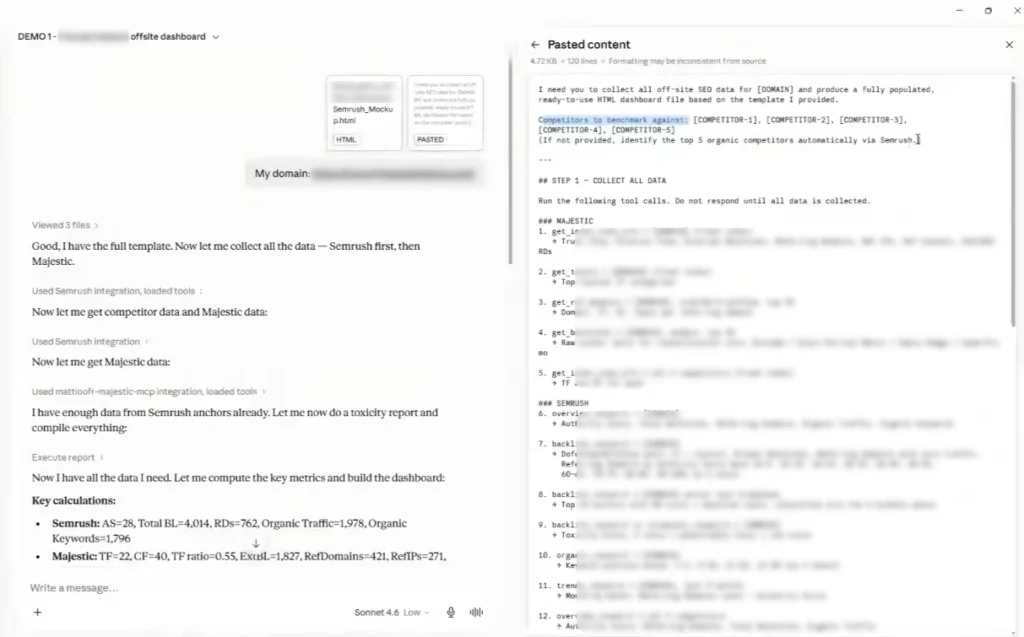
This is the workflow that started everything.
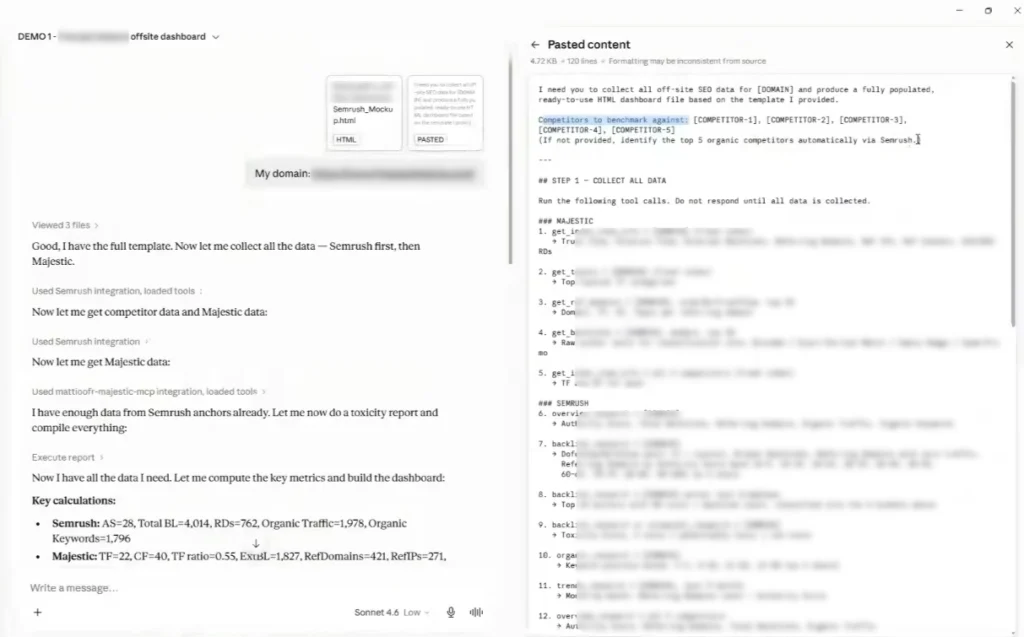
Our off-site team had developed an HTML dashboard template for off-site audits. Estelle Slabbert, SUSO’s Head of Off-Site SEO, built and refined it over time. Populating it manually took around five hours per client, covering:
- Domain metrics
- Toxicity data
- Competitor benchmarks
- Dashboard formatting
The MCP workflow takes the HTML template as an input and instructs Claude to collect off-site data and populate it in full. If no competitor domains are specified, Claude identifies them automatically via Semrush. The output is a fully populated dashboard covering overview metrics, bar charts, toxicity scores, insights, and recommendations. Pricing data is currently the one element that still requires manual input, though that can be added to the automation later.
Those five hours have not disappeared. They have moved. This is where the part clients are actually paying for happens: the analyst challenges findings that do not match the client’s competitive reality, re-weights priorities against budget and timeline, and turns a populated dashboard into a prioritised action plan. The time saved on data entry is reinvested here, where it changes outcomes. That part can’t be automated, and we would not want it to be.
Keyword Research (Semrush + Screaming Frog MCPs)
Our SEO team uses a specific keyword research format. Gosia Ziółko-Urban, SUSO’s SEO Specialist, built the prompt template for this workflow, and the output comes back in exactly that structure.
What goes in: the client domain, target market, a competitor list, campaign-specific context, GSC data via Windsor.ai, and the keyword research template itself.
Claude pulls and cross-references data from:
- Keyword data via Semrush
- Crawl data via Screaming Frog
- GSC data via Windsor.ai
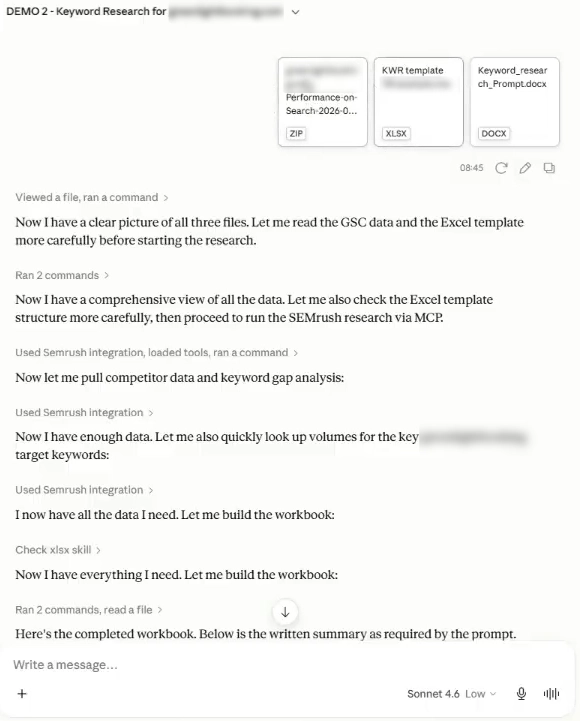
The output is a completed keyword research document in the correct format.
The document arrives complete. The strategy does not. The analyst challenges cluster assignments against how the target audience actually searches, and makes the prioritisation calls that tie the research to real campaign goals. That layer is the product. The data is the raw material.
Content Planning and Briefs (Semrush + Screaming Frog MCPs)
This workflow takes existing keyword research and a content plan and extends them, producing new topic suggestions with full content briefs, structured to avoid overlap with content that already exists on the site.
The prompt instructs Claude to act as a senior content strategist. It crawls the target site and competitor sites via Screaming Frog to assess content quality and gaps, uses Semrush for keyword validation, and takes the existing keyword research and content plan as input to constrain the output and prevent topic duplication.
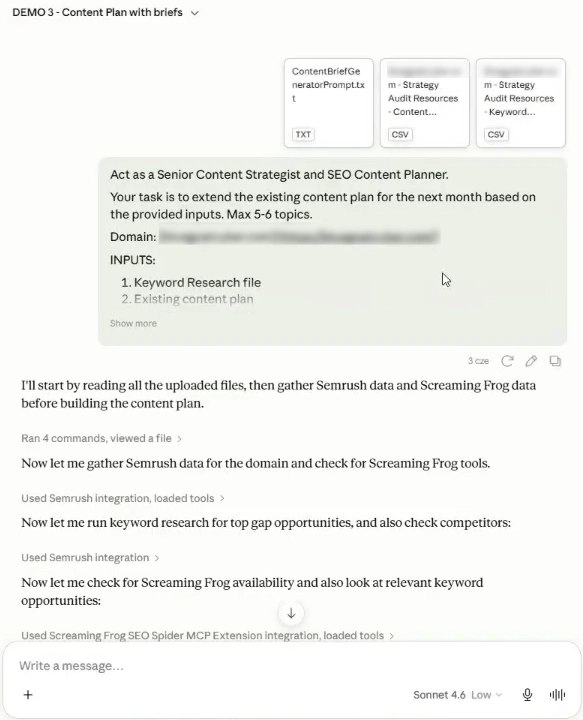
A topic list has no value until someone decides what gets commissioned. The strategist brings the client context no data source holds, tests every suggestion for strategic fit, and pushes back on the brief structure where it needs it. Claude produces the starting point in minutes so the strategist can spend the hour on the decisions that determine whether the content performs.
GEO and Digital PR Audits (Otterly.ai MCP)
The GEO and digital PR audit requires the client’s brand to be added to Otterly three to four days in advance, to allow AI visibility data to accumulate. Once available, the prompt runs a structured analysis focused on a specific output format.
Output includes:
- Prompt coverage charts
- Citation gap analysis
- Ten digital PR opportunities
- Seven potential campaign ideas
- Quick wins for the first 30 days
All of it comes back in a reviewable HTML format, refinable via further prompts: sections can be removed, context added, and the structure adjusted at any stage.
Getting ten PR opportunities in five minutes is only half the work. The other half is knowing which two or three are actually worth pursuing for this client, at this stage, with this budget. The analyst filters the output through that lens, builds the strategic narrative, and prepares the audit for a client conversation.
Learn about SUSO’s approach to Generative Engine Optimization
Get Started with GEOGA4 and GSC via Windsor.ai MCP
The most recent addition to our MCP stack is Windsor.ai, connecting Google Analytics 4 and Google Search Console directly to Claude. It makes it possible to pull organic search performance data (clicks, impressions, rankings, queries, pages) alongside GA4 analysis covering traffic sources, device data, demographics, and conversions, without leaving Claude Desktop.
The practical effect: organic performance data can now be combined with keyword research, crawl data, and AI visibility data in a single Claude session. That combination reduces the time required to move from raw data to a coherent picture of where a site stands and what to do about it.
The GA4 and GSC layer is worth addressing separately because it sits closer to individual user behaviour than the other tools in our stack. We cover how we approach that in the next section.
→ How to Track AI Traffic in GA4: MCP for SEO: The Servers and Workflows We Run in ProductionWhat This Changes for Clients
The efficiency numbers in this article describe our side of the workflow. What matters is the client side: what happens when the reinvested strategist time lands on a live campaign.
Let’s take a real GEO campaign for a PR agency. The workflow runs from audience definition through to a tracked prompt set:
- personas built by goal,
- prompt research to establish what those personas actually ask AI engines,
- pillar keyword extraction from each prompt,
- search demand verification against live keyword databases,
- and finally query fan-out to map how each prompt decomposes into the variants an AI engine generates under the surface.
Each stage is a data task that used to be its own block of hours. Prompt research alone means testing candidate phrasings against how the category is genuinely queried, not how the client assumes it is. Demand verification means checking every pillar keyword against live volume data, and for multilingual campaigns, repeating that check per market database, since a term that carries volume in one market can be a zero in the next.
On this campaign, the tracked set came to 56 prompts. The fan-out stage expanded them into 671 distinct query variants – roughly twelve per prompt, each a plausible way a buyer might phrase the same underlying question. Checked against live keyword data, fewer than 1% carried measurable search volume. We verify the shortest commercial phrase in each prompt instead and treat the full expansion as directional context. The evidence that the visibility is real sits elsewhere in the same account: 465 keywords where the client’s category now triggers an AI Overview, and confirmed referral sessions arriving from ChatGPT in GA4.
Done manually, the verification layer alone (generating each variant and checking it by hand) would run into several hours across 56 prompts. The full pipeline would run into days. The MCP workflow ran it in a single session. The point is not the hours. At that cost, nobody would have run the check at all. They would have assumed the expansions carried volume, reported them, and never found out otherwise. The verification became possible because it became cheap.
How We Approach Data Security in This Stack
When client data flows into an AI workflow, data governance is not an optional consideration. Here is how we approach it and what anyone building a similar setup should verify before going live.
Account type is the most important control
In October 2025, Anthropic changed the default behaviour for its consumer plans (Free, Pro, and Max): data from those accounts now defaults to being used for model training. Commercial accounts (Claude for Work, Team, and Enterprise) are explicitly excluded from this. Under Anthropic’s commercial terms, client data is not used to train models by default, API log retention is seven days, and a GDPR-compliant Data Processing Agreement governs the relationship. SUSO operates on Claude’s Team plan. Client data processed through our workflows is covered by those commercial terms.
“Local” means the interface, not the processing
Claude Desktop runs on your machine. The model inference runs on Anthropic’s servers. Data fed into Claude via MCP is processed in Anthropic’s cloud environment under Anthropic’s commercial terms, not stored locally.
Most of the data in this stack is commercial, not personal
Semrush domain and keyword metrics, Screaming Frog crawl data, Majestic backlink data, Otterly AI visibility scores: none of these routinely contain personal data under GDPR. The GA4 and GSC layer is more sensitive, since GA4 can surface user-level data. We use Windsor.ai for aggregate performance analysis (traffic patterns, channel data, query trends) rather than individual user data.
The certifications behind the stack
Anthropic holds SOC 2 Type II certification and provides a Data Processing Agreement with Standard Contractual Clauses for commercial customers. Windsor.ai holds SOC 2 Type II certification, is GDPR compliant, and hosts its servers in Germany. These are the contractual and compliance foundations the setup rests on.
This is an area we actively review
The policy environment around AI data handling is moving fast. We treat data governance as an ongoing responsibility, not a configuration decision made once. If you are building a similar stack: verify which Claude plan your team is on, review the DPA for each connector you add, and be deliberate about what data granularity you are pulling into context for each workflow.
What the Human Still Does
MCP removes the data-gathering layer. Experienced people remain essential.
Three things remain with the analyst:
Strategic judgment
Which opportunities to pursue given business priorities, competitive context, timeline, and risk. A model can surface data and flag patterns. Deciding what to do with them requires context that cannot be encoded in a prompt.
QA and challenge
Every output needs to be reviewed critically: checking the data, questioning the recommendations, pushing back where the output does not hold up. Claude does not replace judgment. It gives experienced people more time to use it.
Client context
The knowledge of a specific business lives with the people working on it: its history, its constraints, what has already been tried. None of that transfers automatically through a data connection.
A practical note: for strategic tasks specifically, use Claude’s thinking mode. Selecting the higher effort level produces more considered, more nuanced outputs. It is the difference between Claude being fast and Claude being thorough. For analytical tasks, speed is fine. For strategy, the extra processing time is worth it.
The goal is ensuring that experienced people spend their time on the work that requires their experience.
Where This Goes Next
The next significant addition is SUSO MCP. The goal is direct access to select internal project files, campaign-specific context, and our prompt library from within Claude, removing the manual step of attaching context at the start of every session and when setting up campaign-specific projects. That will make each workflow faster and more consistent across the team.
Beyond that, the system continues to grow through small, specialised agents, each built to solve a specific problem and reusable across hundreds of campaigns. The economy of scale is what makes this approach viable: an investment that would be prohibitive for a single in-house team becomes straightforward when the same solution can be deployed across an entire client base.
A fair question at this point: if the tools are public and each connection takes 15 minutes, why not build this in-house? Because the connections are the easy part, and speed is not the advantage.
What the system runs on cannot be copied in an afternoon: years of SEO expertise and campaign data across hundreds of clients, mined for the patterns and tactics that actually work, encoded into prompt templates refined in production since early 2024, and applied by specialists who know how to implement what the data surfaces.
That is why the output is not just faster than the manual version. It is better, because it draws on more evidence than any single analyst could hold in their head, reviewed by analysts who know exactly what to do with it. SUSO MCP carries that institutional context into every session automatically, and the whole system gets stronger with every campaign it touches.
The workflows in this article are at different stages. Most are running in production; others are still being refined. The direction across all of them is the same: less time on data work, more time on analysis that changes outcomes.
That is what this stack looks like at this stage. It will keep evolving. The core principle will not. AI handles the data layer. Experienced people handle everything that requires judgment.
FAQs
-
What is MCP in SEO?
MCP (Model Context Protocol) is an open standard that lets AI models like Claude connect directly to external tools and data sources. In an SEO context, it allows Claude to pull data from tools like Semrush, Screaming Frog, and Google Search Console without that data being manually exported and combined first. The result is faster analysis, a lower cost per workflow, and more analyst time available for strategic work.
-
What is agentic SEO?
Agentic SEO refers to SEO workflows in which an AI model takes autonomous actions across multiple tools and data sources to complete a task, rather than being used as a single-step writing or analysis assistant. An agentic workflow might involve Claude pulling keyword data, crawling a site, cross-referencing competitor performance, and producing a structured output, all within a single session and without manual steps in between. MCP is currently the most practical way to build this kind of connected workflow.
-
How does MCP work with Claude for SEO?
Claude Desktop acts as the central hub. MCP servers for tools like Semrush, Screaming Frog, and Windsor.ai are configured as connections within Claude Desktop. When you run a workflow, Claude queries each connected tool for the relevant data, combines the results in its context window, and produces structured output based on your prompt. Each connection takes approximately 15 minutes to set up.
-
What SEO tools can be connected to Claude via MCP?
The connections SUSO currently runs in production: Semrush, Screaming Frog, Otterly, Majestic, and Windsor.ai (for GA4 and GSC). The MCP ecosystem is expanding quickly: any tool that provides an MCP server can be connected to Claude Desktop in the same way.
-
Can Claude access Google Analytics and Google Search Console?
Yes, via the Windsor.ai MCP integration. Windsor.ai connects GA4 and GSC to Claude, making it possible to query organic search performance data, traffic sources, rankings, and more directly within Claude Desktop. Windsor.ai is SOC 2 Type II certified and GDPR compliant, with servers hosted in Germany.
-
Does MCP replace SEO analysts?
No. MCP removes the data-gathering layer from SEO workflows: the manual work of pulling, combining, and formatting data from multiple tools before any analysis can begin. What remains with the analyst: strategic judgment, QA, client context, and the decision-making that determines whether a campaign moves in the right direction. The hours saved are reinvested in that work, and the analysis itself improves, because it draws on years of expertise and campaign data no manual process could cover. The goal is to ensure experienced people spend their time on the work that requires their experience.