
Last week, I did something that absolutely terrified me. I spoke on a panel for the very first time in my life.
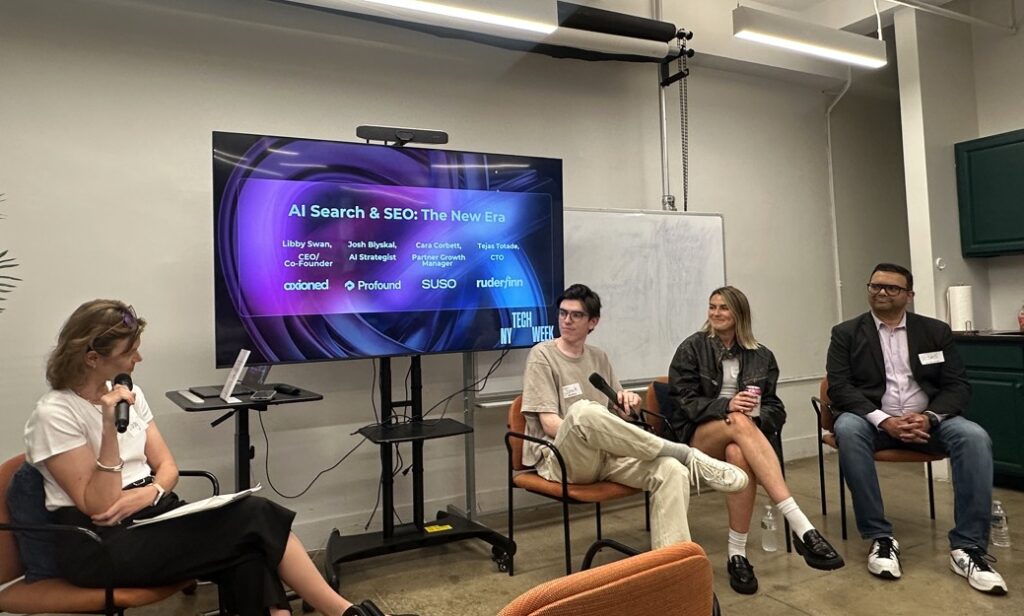
And it wasn’t just any panel; It was a New York Tech Week event all about AI Search and its impact on SEO. And while I was genuinely excited to join the conversation alongside some seasoned industry pros, I’d be lying if I said I wasn’t nervous.
But spoiler alert: it turned out to be one of the most energizing professional experiences I’ve had so far. Here’s how I prepared and some of the things I learned along the way.

The Buildup: Learning, Testing, and Talking to Every Single Person in the Room
In true perfectionist fashion, I started preparing weeks in advance, because if I was going to speak on this topic, I wanted to really know my stuff.
I (ironically?) used LLMs like ChatGPT and Perplexity to study everything from the latest advancements in AI Search, to even learn how LLMs retrieve and summarize content.
I fell down rabbit holes on things like the query fan-out, tested out Google’s new “AI Mode” using an American VPN (cause it’s not yet readily available for this Canadian gal), and followed every advancement and statistic I could find about how generative engines decide which brands/websites to feature and cite.
I also practiced talking about it a lot—in the shower, in my living room, with my friends. Knowing my key points was key to my feeling confident enough to own the room.
At the event, I also decided to talk to pretty much everyone in the room one-on-one before the panel started. This wasn’t just for networking points (though hey, that’s a bonus) but to remind myself that we were all just humans looking to nerd out on this exciting topic.
Everyone was there to learn and hear my unique perspective. That simple act, along with that mindset, grounded me and made the actual panel feel more like a conversation than a performance.
Here are the main takeaways from the panel:
The Search Landscape is Shifting at a Rapid Pace (From Keywords to Intent)
One of the biggest themes of the panel was how quickly the search ecosystem is evolving.
We’ve moved from a world of manual keyword-based searches to one where LLMs are doing the heavy lifting for you.
With traditional search, Google’s bots crawled the web through links, read (and indexed) what was on each page, and then served and ranked results based on how closely the content matched the searched keywords.
But with LLMs, the process looks very different.
Instead of indexing pages like a search engine, LLMs are capable of understanding what the user is really asking (the intent).
Based on that, they generate a well-rounded answer based on their own training models.
We’re also seeing search expand to multimodal and agentic methods as well.
For example, ChatGPT’s Image Search feature helped me figure out how to turn on my confusing Airbnb washing machine in Greece a couple of weeks ago, and Google’s Agent, Project Mariner, will soon be able to help users find and make purchases for things like concert tickets right within the interface.
As Ruder Finn’s Tejas Totade said, the traditional marketing funnel has been shrunk into one unified experience. It’s an exciting time to be on the internet, folks.
Not All AI Search Is Built the Same
A big aha moment from the event was hearing from Profound’s Josh Blyskal on how differently each platform operates under the hood. While the term “AI search” sounds monolithic, the engines powering it are wildly different:
- Google’s AI Mode and AI Overviews are the most “classic” — built on top of its existing search index, pulling from its trusted ranking signals and proprietary data that it already has.
- ChatGPT uses Bing as its web retrieval layer, and its results can vary a lot depending on the model, the context, or the plugins used.
- Perplexity doesn’t use a traditional search index at all. Instead, it uses its own dataset and relies on this thing called vector search (which is essentially a way of matching ideas and meanings, rather than exact words, by converting text into numbers that represent their context and similarity).
This makes visibility in LLMs more fragmented than we’re used to with traditional search, and we need to tailor our strategies effectively to the different tools that people are using.
Businesses who want to be visible in AI Search need to remember that it’s no longer about ranking #1, it’s about being visible in the right context, at the right time, for the right type of question.
Let’s Talk Tactics
When you have a technical SEO Agency, a PR and Communications Agency, and an AI Visibility SaaS platform on a panel, each of the panelists brings a unique perspective on how to get clients to show up more prominently in AI Search.
Ultimately, we reached a unanimous agreement that the highest priorities are to:
- Build a recognizable and reputable brand—LLMs often reference known entities and look at what people are saying about that brand on the web (e.g., Reddit, reviews, etc.).
- Strengthen your technical backend so that LLMs can access your content— Implement LLMs.txt, ensure fast site speed, use correct structured data to help the crawlers know what the content is and how to use it, and prioritize HTML over JavaScript, as LLMs have a hard time reading the latter.
- Format content in a way that LLMs prefer and add your unique perspective. In order for LLMs to confidently summarize, cite, and use a piece of content as a reliable source, it needs to be formatted correctly. This means writing clearly, answering the questions early on in the content, and using bulleted lists and proper headings to make it more digestible.
- Add your unique perspective —There are a million pieces of content on the internet right now saying the same thing, so make sure to add your own perspective for an even better chance at getting referenced. Think unique quotes, proprietary insights, and first-party data and research.
What About E-commerce?
We also touched on what AI search means for e-commerce, and the TL;DR is that things are changing there, too.
LLMs are already starting to recommend products, summarize reviews, and even act as shopping concierges.
Right now, there are early ways to submit product data to platforms like ChatGPT, but it’s still murky and far from guaranteed.
Josh mentioned we might see a “middle layer” emerge, where there will be a more direct way for brands to feed structured product data into LLMs. That would help level the playing field and make AI-driven product discovery more transparent and reliable.
But for now, we can do things the old-fashioned way and continue to add that product schema markup.
So… Is SEO Dead?
No. Absolutely not.
People will always have questions and search for answers. Brands will always want to be the ones to give an answer. However, the way those answers are delivered and the tools people use for search are changing fast.
As SEOs, marketers, and brand builders, we need to quickly adapt to these changes.
This means staying curious, testing constantly, reverse-engineering, and leaning into tools and platforms that help us understand how LLMs see our brands.
And if you’re curious about that last part…
Bonus: Want to See How AI Sees Your Brand?
As a follow-up to the event, my team is offering a free AI Visibility Audit — a custom report that shows how your brand is being perceived across LLMs like ChatGPT, Perplexity, Claude, Google’s AI Overviews, and more.
If you’re wondering, “Do these tools even know who we are?” This audit is a great place to start.
Claim your free AI visibility audit here
I’m so grateful to everyone who made this panel such a great experience — from the organizers to the speakers to every curious person who showed up. I learned a ton, faced a big fear, and left more energized than ever about where search is going.