Google AI Mode fundamentally changes search, shifting the battle for visibility from algorithms to established authority. Built on Gemini, AI Mode accelerates the move to zero-click answers (92-94% of searches), making citations, not clicks, the key metric. Success now depends on providing original, high-quality content that satisfies the AI’s Query Fan-Out process, combined with technical excellence and entity building across the web to solidify your brand as a trusted, machine-readable source. SEO didn’t die – it demands a smarter, authority-first strategy.
In March 2025, Google introduced AI Mode, and search hasn’t looked the same since. After two years of experiments with AI Overviews, the company rolled out a full-scale, Gemini-powered search interface that changes every query, not just a few.
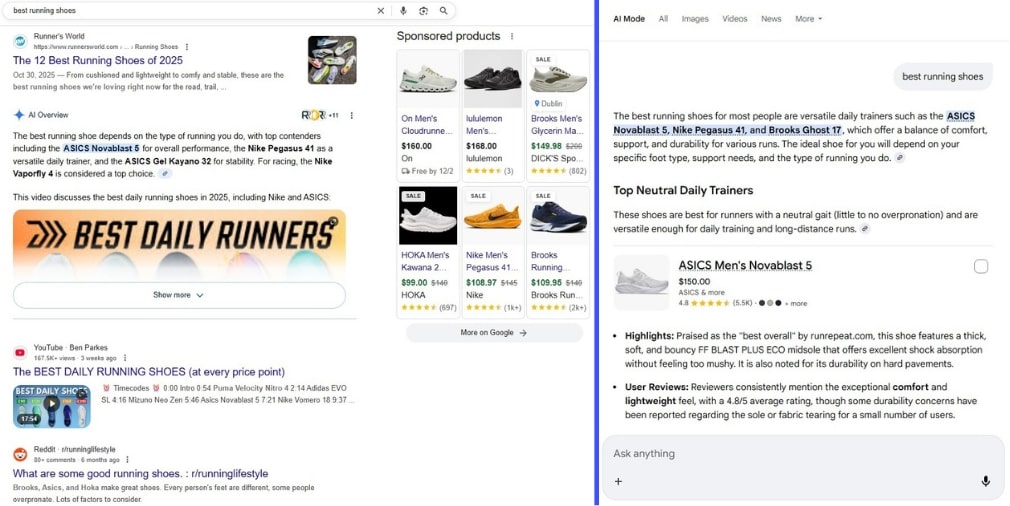
While AI Overviews appeared occasionally at the top of traditional SERPs, AI Mode transforms the entire experience into a conversational, answer-first environment. For publishers, this means one thing: organic visibility now mainly lives inside an AI summary box, not necessarily below it.
This shift has created the biggest redistribution of search attention on Google since the introduction of featured snippets. Traffic patterns have changed, CTRs have dropped, and the definition of “ranking” has lost its meaning. Yet amid the chaos, familiar winners are emerging again – brands, entities, and experts with the kind of authority that cannot be achieved by chasing algorithms alone.
The takeaway? Trust, structure, and brand have become the core currencies of modern search.
What Is Google’s AI Mode?
AI Mode, built on a custom version of Google’s Gemini 2.5 model, is Google’s most advanced AI-powered search experience. Building on AI overviews, it moves further beyond the familiar “10 blue links” to provide comprehensive, conversational responses that synthesize information from multiple web sources.
On November 18, 2025, Google started rolling out Gemini 3 to AI Mode’s Thinking mode, which allows it to tackle more advanced queries and understand user intent even better.
E-commerce Features: Shopping in a Conversational Interface
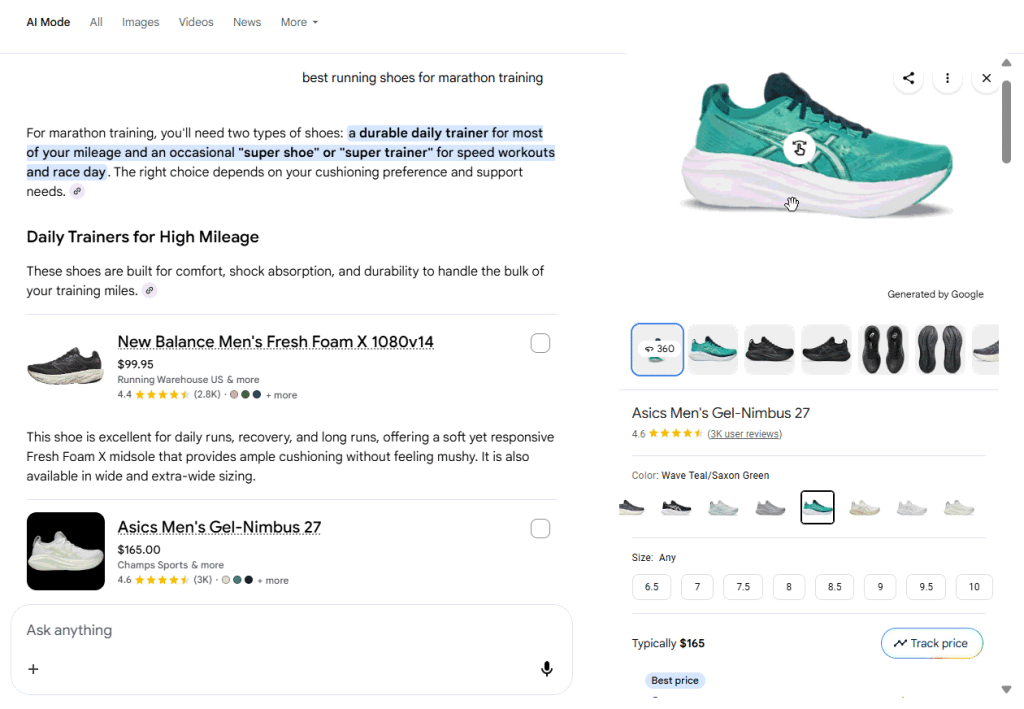
AI Mode integrates rich, transactional features right into the chat by combining Gemini’s reasoning capabilities with Google’s Shopping Graph, which contains over 50 billion product listings, to offer:
- Product listings and carousels
- Comparison tables
- Local inventory checks
On November 13, 2025, Google started rolling out agentic checkout, allowing users to track a specific item’s price, get notified when it reaches the user’s budget and even have Google make the purchase – after the user’s confirmation.
How We Got Here: From Blue Links to Conversational Agents
According to Semrush, AI-driven search is expected to surpass traditional search traffic as a web traffic driver by 2028. The introduction of AI Mode was Google’s strategic response to this fundamental shift in user behavior and the existential competitive threat posed by other Large Language Models (LLMs).
For years, Google owned the search entry point, but the rise of tools like ChatGPT, Claude, and Perplexity created a parallel search channel where users increasingly go for instant, synthesized answers, bypassing the traditional blue links entirely. The move to AI Mode was necessary to maintain market share and keep the search user journey within the Google ecosystem.
The transition began with the limited, experimental deployment of AI Overviews (AIOs) in May 2024, which by late 2025 had appeared at the top of search results for as many as over 50% of all queries. AIOs typically satisfy user intent faster, often leading to zero-click searches. AI Mode further normalizes this search behavior, making the conversational, answer-first interface the default experience.
How AI Mode Works: The Query Fan-Out Technique
AI Mode works by fundamentally changing how Google processes a search. It uses an advanced reasoning method called Query Fan-Out, which transforms a single user query into a comprehensive research mission. Here is how it works:
1. Query Decomposition
The AI breaks the user’s initial query into its component concepts and implied sub-questions (the sub-queries).
2. Parallel Search
It then issues dozens of these related sub-queries simultaneously to the web, the Knowledge Graph, and other Google data systems.
3. Synthesis and Citation
The AI gathers, analyzes, and synthesizes the retrieved information from all searches to create one coherent, cited summary.
This means that your content is now assessed not just on the main keyword, but on its relevance across the entire cluster of related sub-queries that the AI generates. Visibility in AI Mode depends on satisfying this full range of user intent.
Timeline of Google AI Mode Rollout & Adoption Statistics
Google didn’t flip the switch all at once. The rollout started small, scaled quickly, and by fall 2025, it was everywhere.
- March 2025: Launched as a Search Labs experiment in the U.S.
- May 2025: Officially introduced at Google I/O with Gemini-powered enhancements.
- June-July 2025: Broader rollout across the U.S. and India.
- August 2025: Expansion to 180+ countries and territories.
- October 2025: Available in 200+ countries and 35+ languages.
According to Semrush data, in June 2025, two months after the launch of AI Mode in the US, just a bit over 1% of all searches used it. And in Q3 2025, Google reported that AI Mode reached 75 million daily active users globally.
The Impact: Solidifying the Zero-Click Default
AI Mode did not introduce a new behavioral trend, but it formalized and accelerated the shift toward synthesized, zero-click answers that had been underway since the debut of AI Overviews (AIOs) and competitor LLM tools.
Tectonic Shifts Reinforced by AI Mode
The move to AI answers is a larger trend driven by multiple forces, fundamentally altering the calculus of search visibility.
Zero-Click Dominance
AI Mode has pushed zero-click search to its extreme. A study by Semrush shows that 92-94% of AI Mode searches are zero-click. This is significantly higher than the average zero-click rate on the traditional SERP (35-46%).
92-94% of Google AI Mode searches are zero-click.
Semrush data
Besides supporting the overall zero-click trend, this data suggests that users may be opting for AI Mode (and conversational LLMs in general) over traditional search for specific types of queries, such as how-to searches, product research, and others.
For publishers dependent on informational and how-to content, this has meant significant organic traffic drops.
Users Ready to Buy
As brands start tracking their referral AI traffic, many note that it doesn’t make up for the lost organic traffic – but it does convert better. This is supported by research: a study by SuperPrompt found that AI sessions have more than 5X the conversion rate of organic sessions.
Brand Is More Important Than Ever
As clicks drop, citations become the new metric to report on. And SE Ranking research shows that LLMs are likely to cite the same authoritative source repeatedly over a multitude of queries. This underscores the importance of building a trustworthy, recognizable brand that both AI platforms and humans can rely on for high-quality information.
AI Mode: Google’s Path to Search Retention
By integrating Gemini LLM right into the search interface, Google eliminates the need for users to constantly switch between regular search and a standalone AI chat of their choice. It’s now simply a toggle between the traditional SERP and AI Mode within the same app. This helps Google stay competitive despite the introduction of agentic browsers by ChatGPT (Atlas) and Perplexity (Comet).
How to Optimize for AI Mode
Getting visibility in AI Mode is about being useful, recognizable, and machine-readable. It requires a strategy that blends classic SEO fundamentals with brand building, structured content, and credibility across the web.
Optimizing Content for Generative SERPs
There is a reason why Reddit and YouTube get cited often in AI Mode answers: they offer strong POVs with unique perspectives and specificity that generic content lacks. That means:
- Be original and specific: focus on experience-based reviews, unique comparisons, first-person language, and specific data points.
- Go deep: provide content with enough depth and context to answer not just the initial query, but the subsequent ones that Query Fan-Out is generating.
- Incorporate visual and interactive media: high-quality videos, comparison charts, infographics, and even community responses. These assets enrich your content and increase the likelihood of being cited in the multimodal AI summary layer.
Technical Setup Still Matters
AI Mode is powered by machines – and machines need structure. Making your content easily digestible at scale is table stakes for inclusion in generative SERPs.
- Use structured data markup: Product, FAQ, HowTo, Article, and Review Schema help Google understand what your page is about and how to surface it.
- Maintain clean, fast-loading pages: poor Core Web Vitals performance or bloated HTML can knock you out of AI summaries entirely.
- Stick to formats crawlable by LLMs: AI crawlers still struggle with JavaScript and PDFs, so make sure the content you want cited is available in HTML.
- Keep content scannable and clearly structured – with logical H1 to H3 structure, short paragraphs, bullet points and numbered lists. Add TLDR summaries, distinctly formatted definition boxes and quick tips. The easier your content is to scan and extract from, the more likely it is to be reused.
Build Entities, Not Just Pages
Authority now travels with you. If your site (and your brand) is known, mentioned, and trusted across the web, AI Mode will reflect that.
- Get cited beyond your own domain. Press mentions, third-party partnerships, podcast appearances, and active community engagement build the web-wide reputation that AI uses to validate your content.
- Establish and reinforce your entity in the Knowledge Graph. Use consistent brand naming, link your social profiles, and use Schema to tie people, places, and organizations together.
- Make sure your content is clearly attributed to the expert who wrote it. Add author bylines, create author pages detailing their credentials and linking to their LinkedIn and X profiles.
- Own your semantic niche. Consistently cover a subject with clarity, originality, and structured depth, and cross-link related content on your website to better signal topical authority. Over time, the AI learns to associate your domain with the topics you master.
Develop a Smart Off-Site Strategy
Building presence on the right platforms is now more important than ever. Citation data clearly shows that LLMs give preference to some publishers over others, and AI Mode is no different. Here are the platforms you should prioritize in your strategy:
- YouTube: Google gives clear preference to its own domains, and videos enhance the interactive appeal of its AI responses by providing users with another means of consuming content.
- Social media: in a Semrush study of 230K prompts in October 2025, LinkedIn was found to have a 15% citation rate in AI Mode responses, which is much higher compared to ChatGPT and Perplexity. Facebook citations are at over 4%.
- Reddit, as an official partner of Google, keeps its position as the second most cited source in AI Mode, and Quora stayed is another Q&A platforms that gets frequently cited.
- Wikipedia holds around 2% of AI Mode citations – not as high as ChatGPT, but still substantial.
- Medium.com is another publishing platform that is cited in AI Mode responses – over 4% of citations are attributed to its content.
SEO Didn’t Die – It Got Smarter
AI Mode has clarified the future of search: visibility depends on long-term trust, brand recognition, and content that withstands both human and machine scrutiny.
The brands that win in this new system are answering better, signaling stronger, and building the kind of authority that LLMs can recognize.
For agencies and consultants, the focus must now be on:
- Investing in authority: stop chasing algorithm changes and start investing in your brand’s reputation and E-E-A-T.
- Technical excellence: ensuring content is machine-readable through clean code and robust structured data is essential for inclusion.
- Measuring LLM visibility: reporting on the new KPIs of AI Search, such as citations, Share of Voice, verifiable referral traffic, and others, is crucial for proving the value of this strategy.
Authority still wins – it just looks different now.