
For more than two decades, SEO has revolved around keywords. We optimized pages for search engines, fought for rankings, and measured success in blue links and click-through rates. But that era is fading. Today, search is conversational.
Instead of sifting through lists of websites, users increasingly receive curated, natural-language answers – crafted by Large Language Models (LLMs).
This shift marks the rise of AI Search, a world where brands are no longer competing for a position on a page, but for visibility in a model’s generated response. Success here depends on being authoritative, recognizable, and aligned with the way these systems interpret and prioritize information.
More on that below…
LLM Search: From Links to Curated Answers
Traditional search engines organize results into ranked lists – SERPs (search engine results pages) – where you, as the user, decide which link to click:
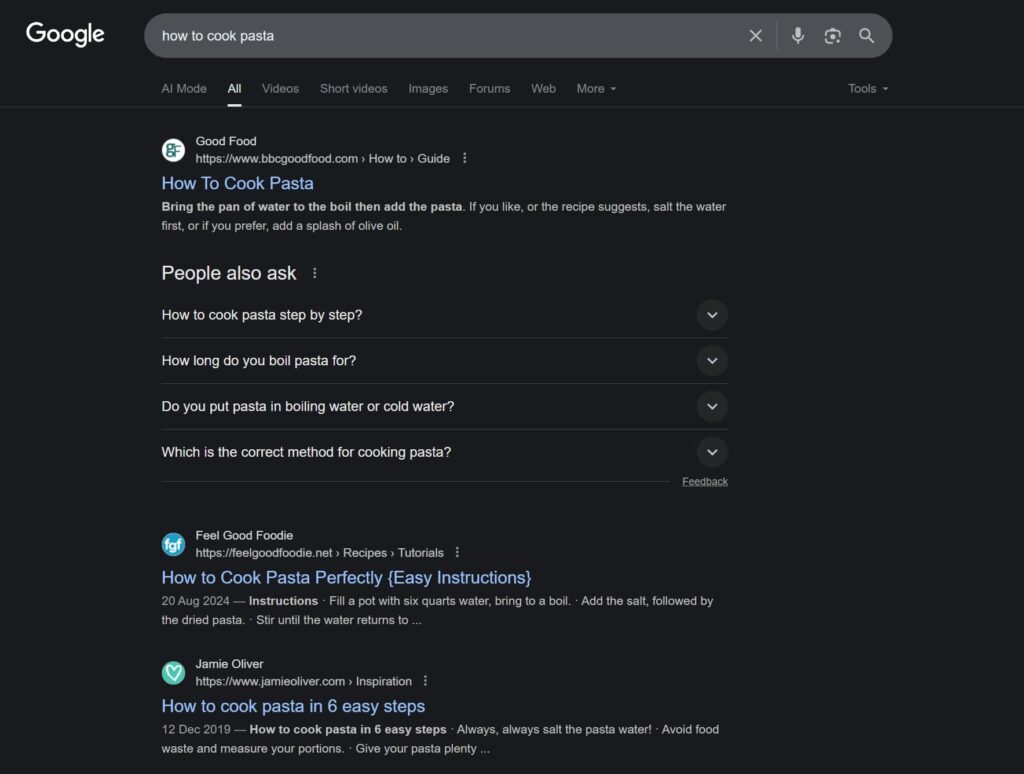
LLMs flip this model. Instead of offering you ten blue links, they synthesize information from multiple sources and deliver a direct answer, written in a human-like voice:
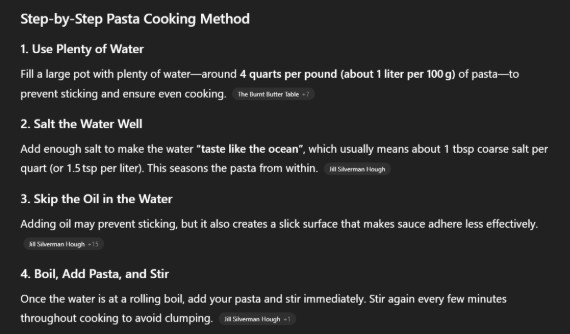
This emerging behavior is sometimes called LLM Search. It isn’t just a new channel; it’s a new baseline.
If your brand isn’t cited, paraphrased, or embedded within those generated answers, you might not exist to the user. For businesses, this is both a challenge and an opportunity: an invitation to think less about chasing algorithms and more about how to become the trusted source that AI systems lean on.
And here lies the central truth: visibility in this space is not one-size-fits-all. Each LLM has its own architecture, training data, and values. To stand out, brands must learn how these systems “think” and adapt accordingly.
What Are LLMs and How Do They Differ?
What is a Large Language Model?
Imagine a massive library and a librarian who’s read every book in there. But instead of giving you whole books, the librarian knows how those books connect – stories, themes, facts, and word patterns. When you ask a question, the librarian quickly assembles the best bits of what they’ve read to form an answer tailored to your question.
An LLM works similarly. It’s a computer model trained on vast amounts of text. Over time, it learns which words, sentences, or ideas tend to follow one another. When you ask it something, it predicts what should come next (in words) based on its training.
Unlike a traditional search engine, it doesn’t just pull up full documents but creates a response that weaves together what it “knows.”
Exploring Key LLM Model Families
LLMs aren’t a single species. They’re families of models, each with different strengths, blind spots, and behaviors. Here is a quick primer.
Foundation Models (Base Layer)

These are the large pretrained models that serve as the backbone for all other categories. Think of them as the raw engine. They are adapted by developers into chat, retrieval, or domain-specific systems.
Example models:
- GPT-4;
- GPT-4o;
- GPT-5;
- Claude Opus;
- LLaMA 3;
- Gemini Ultra.
Conversational / Generative AI

This category is focused on producing natural, flowing language, handling open-ended dialogue, reasoning, and summarization.
Example models:
- Claude (uses Constitutional AI for alignment);
- ChatGPT (in its chat mode);
- Gemini (in its chat mode).
In their pure chat mode, these models don’t fetch live data or citations, though they can be connected to retrieval systems (overlapping with the search-augmented category). It’s important to remember that the underlying model versions shift over time (e.g., GPT-3.5 to GPT-4 to GPT-4o to GPT-5), so their outputs and behaviors can vary across updates.
Search-Augmented / Retrieval Hybrids

These models fetch external documents in real time and ground their responses in citations or sources. They act conversationally while summarizing the content they retrieve—a process known as retrieval-augmented generation (RAG).
Example models:
- Perplexity (with browsing);
- ChatGPT (with browsing);
- Gemini (with browsing);
- Bing Copilot (uses the Prometheus system; historically GPT-4, now also GPT-4.5 and GPT-5 in some modes).
Vendors often route queries across different model backbones (like GPT-4, GPT-4.5, or GPT-5) depending on the task’s cost, speed, and complexity.
Contextual / Ranking / Intent Models
This group doesn’t generate new text. Instead, they are used in the background of search pipelines to interpret queries, match semantics and intent, and rank existing content.
Example models:
- Google’s BERT;
- ELECTRA;
- other encoder-only transformers.
These models are crucial for improving retrieval quality and query understanding. While their architectures are relatively stable, they are often upgraded internally (e.g., systems moving from BERT to PaLM-based encoders).
Domain / Specialist Generative Models
These are generative models trained or fine-tuned on curated, domain-specific corpora (e.g., legal, financial, or medical). They behave like conversational AI but with deep vertical expertise.
Example models:
- BloombergGPT;
- Med-PaLM;
- FinGPT.
Like their general-purpose cousins, they are still prone to hallucinations without retrieval grounding. Their backbones also evolve (e.g., Med-PaLM 2 to 3).
Domain / Specialist RAG-Enhanced Models
This category combines generative AI with retrieval from a curated, domain-specific knowledge base. They blend conversational fluency with domain-restricted accuracy.
Example models: custom enterprise legal/finance assistants or healthcare RAG models.
This overlaps heavily with the search-augmented category but is much narrower in scope. These systems are frequently updated as enterprises plug in newer, more powerful LLMs (like GPT-4, GPT-4.5/5, LLaMA 3, or Gemini Ultra) as they become available.
ChatGPT vs. Gemini vs. Perplexity
These three LLMs top the list of most popular generative AI tools. So the natural questions are, how ChatGPT, Gemini and Perplexity differ from each other, and what does it mean for your brand’s AI Search strategy?
As discussed during SUSO’s webinar on AI search optimization tactics, each of these platforms processes information, utilizes sources, and presents answers in a distinct way. Here’s a breakdown of the main players based on our research.
ChatGPT
- A natural paraphraser, ChatGPT excels at pulling information from multiple sources to create a single, clean, conversational answer.
- Opaque sourcing is the primary drawback, as ChatGPT it often fails to show its sources. This means your content could be used to generate a response without any attribution, name, or website link.
- ChatGPT uses a hybrid index, relying on a SerpApi to pull data from Google or Bing.
Gemini
Gemini is the engine behind both Google’s AI Overviews and the conversational AI mode:
- It leverages Google’s index, which is its great advantage, as Google’s core search index has been perfected over the last two decades.
- It integrates heavily with the entire Google suite, including your search history, Gmail, location, and preferences. This makes it the most personalized LLM, especially powerful for local searches.
- In its conversational AI mode, Gemini uses a method called “query fan-out.” It breaks your prompt into multiple related sub-questions, pulls answers for all of them from different sources, and synthesizes them into one comprehensive response. This is why its answers often anticipate your follow-up questions.
Perplexity
- Perplexity is by far the most transparent LLM, as it consistently and clearly shows its sources for fact-checking.
- It developed its own index, which is smaller than Google’s. However, Perplexity states its focus is on “serving the most popular and high-quality content from sources most likely to be relevant and trustworthy.”
What this landscape of different model families means for brands is that a one-size-fits-all approach is no longer viable. Each type of LLM and each individual LLM values information differently, so you cannot optimize for “AI” as a single entity. Instead, the challenge is to understand which models your audience uses and how those systems decide what information is worth presenting.
Optimizing for LLMs: Strategies for Brand Visibility
Forget about trying to trick algorithms. Adapting to AI-driven search is about making your brand unmistakably relevant, credible, and easy for models to surface.
Think of it as building a digital presence that speaks fluently to both humans and machines. Here’s how to do it.
Shift From Keywords to Intent
Search intent is the heartbeat of SEO. It always has been, but in a world of AI answers, it matters even more, as LLMs are built to respond to intent – the underlying reason behind a search. Here’s a quick reminder of different search intents:
| Intent Type | Query Examples |
|---|---|
| Informational: users are looking for knowledge, explanations, or advice. | What are the best running shoes for beginners? How does cloud storage work? |
| Transactional: users want to take action, such as making a purchase or signing up. | Buy Nike Air Zoom Pegasus Sign up for Adobe Creative Cloud trial |
| Navigational: users are trying to reach a specific brand, website, or service. | HSBC online banking login BBC News homepage |
Brands that thrive are those that match that conversational style. Instead of optimizing for isolated phrases, they create content that answers questions directly and comprehensively. That could be an FAQ page, a long-form guide, or even a blog post written in the same tone a customer might use when speaking to a shop assistant.
💡 Learn More: Decoding the Semantic Web Before the AI Does It For You
Build Authority, Expertise, and Trust
LLMs are trained to prefer credible voices.
That’s why Google’s framework of E-E-A-T (Experience, Expertise, Authority, Trust) has effectively become the playbook for AI as well.
Take the example of a fintech company explaining new UK regulations. A vague 500-word blog won’t cut it. What wins is a deep, well-structured article that shows subject matter expertise, gets picked up by financial news outlets, and sparks discussion on LinkedIn.
That mix of quality content, trusted backlinks, and visible thought leadership signals to models that this is a voice worth amplifying.
Secure Placement on the Right Websites
Speaking of backlinks. Where the AI system pulls its citations from says a lot about what kinds of content it favors.
Nothing is more evident right now in the differences between the infrastructure and underlying fundamentals of each of the answer engines than the top sources that they cite and the way that they cite those sources.
Josh Blyskal, Profound
Here are the top cited sources for the most popular AI tools:
- ChatGPT relies heavily on Wikipedia (10% of all citations) as a “legitimacy layer” for companies. Reddit is its second most cited domain.
- Gemini favors its own ecosystem. It primarily cites Google SERPs (search results pages) and YouTube, uniquely reading full video transcripts to generate answers. Reddit is the third most cited source.
- Perplexity shows a massive bend towards Reddit, which accounts for 6% of citations, 3x more than the second most cited source – YouTube. It is heavily driven by user-generated content (UGC).
On top of what we see from the citation data, it’s worth tracking which publishers different LLMs have partnered with. For example, Reddit, as a top-cited source for the most popular AI tools, has officially partnered with both Google and OpenAI. What that means for AI visibility is that a backlink or even just a mention on certain websites is now a dual-purpose asset, boosting both traditional SEO through a backlink from a high-DR website and GEO.
Here’s a breakdown of the major ecosystems, their partners, and the strategic value of securing placements on those sites:
OpenAI (ChatGPT/Training Data)
Known content partners:
- Reddit;
- News Corp (WSJ, NY Post);
- Axel Springer;
- The Washington Post;
- Financial Times (FT);
- The Atlantic;
- Dotdash Meredith;
- Hearst.
Earning coverage with these publishers promotes brand visibility in the most widely used conversational AI globally. Their content is used for both real-time answers (RAG) and long-term model training.
Google (Gemini/AI Overviews)
Known content partners:
- Associated Press (AP);
- Reddit.
Being mentioned on these sites is critical for brand authority in Google’s ecosystem and makes brands more likely to be cited in AI Overviews, AI Mode, and Gemini responses.
Perplexity (Search/Comet Plus)
Known content partners:
- CNN;
- The Washington Post;
- Conde Nast (Wired, The New Yorker);
- Fortune;
- LA Times.
This provides excellent placement for citation-heavy, transparent AI search. These partners are explicitly compensated and prioritized for high-quality, grounded responses, which provides excellent placement for citation-heavy, transparent AI search.
Microsoft (Copilot/Copilot Daily)
Known content partners:
- Financial Times (FT);
- Reuters;
- Axel Springer;
- Hearst Magazines;
- USA Today Network.
Securing placement with these publishers leverages Microsoft’s massive enterprise reach and may help get included in features like Copilot Daily and in responses targeting a professional/business audience.
One more publisher deserves to be mentioned here – Wikipedia. According to Profound, Wikipedia leads ChatGPT’s citations, with a share of 7.8%, while the second most cited source, Reddit, trails far behind with just 1.8%.
Use Structured Data and Write Conversational Content
Unlike people, machines don’t infer meaning. They need signposts. Schema markup, headings, and bullet points provide the structure, while a conversational tone keeps the content natural and engaging.
Picture an e-commerce brand launching a new product line. Adding schema markup tells a model what the product is, its price, and key attributes. Pair that with an FAQ that answers real questions (“Is it sustainable?” “How does sizing compare?”), and suddenly, the brand isn’t just listed online but also quotable by an LLM.
Branding Is Non-Negotiable
Consistency is everything. If your brand promise isn’t articulated clearly and echoed across different platforms, LLMs won’t recognize it. Or worse, they’ll misrepresent it.
Think of a sustainable fashion label. It can’t just bury its values in a mission statement; those commitments need to be visible on the product pages, reinforced through social content, and repeated in press coverage.
Done right, an LLM will highlight the brand’s ethical positioning as part of the answer instead of just mentioning its name.
💡 Learn More: Building Agency Brand Awareness
Tailoring Your Content to Different LLMs
Different models perceive and interpret content and produce responses in different ways. ChatGPT may favor longer, comprehensive, narrative answers, while Bing Copilot will deliver specific, verifiable information and put more emphasis on the recency and credibility of the sources it pulls from. A domain-specific LLM will filter out irrelevant data and focus on accurate, expert-level content.
Conversational/Generative AI
Examples include ChatGPT, Claude, and Gemini in chat mode.
What they value:
- coherent flow;
- safety alignment;
- clarity;
- engagement.
How to tailor content:
- use dialogue-style FAQ and a human tone;
- avoid ambiguous statements;
- maintain a consistent branding voice;
- focus on narrative and storytelling;
- craft responses that engage users in a conversational, relatable way.
Search-Augmented/Retrieval Hybrids
Examples include Bing Copilot, Perplexity and ChatGPT with browsing.
What they value:
- citation;
- recency;
- external document grounding;
- live data.
How to tailor content:
- ensure linked references and sourceable claims;
- use a correct lastmod (last modified date);
- use structured data (like FAQ and HowTo schema);
- prioritize fresh, authoritative content with verifiable facts and current references.
Ranking/Intent Models
Examples include BERT, PaLM, and T5.
What they value:
- semantic relevance;
- entity relationships;
- intent matching.
How to tailor content:
- use topic clusters and internal linking;
- use clear headings and entity-rich language;
- structure content around search intent with a focus on clarity and relevance to user queries.
Domain/Specialist Models
Examples include BloombergGPT, Med-PaLM, FinGPT, and custom enterprise models for legal, healthcare, or finance.
What they value:
- factual correctness;
- authority;
- real-time grounding;
- expert-level answers.
How to tailor content:
- use domain-specific sources and precise language;
- ensure technical accuracy;
- implement strict verification of facts.
A brand that understands these nuances can adapt: structuring detailed storytelling for one model, surfacing clean data for another, and doubling down on authority where precision is prized.
Wrapping Up: The Future Is Multi-LLM
The world of SEO is fragmenting. Instead of a single dominant search engine, we’re entering an era of diverse LLMs, each with its own rules, biases, and priorities.
It does sound scary. But if you think about it, it’s actually liberating.
It means you’re no longer tied down to one algorithm; you have multiple opportunities to be discovered – if you play to each model’s strengths.
The principles remain universal: build authority, publish content that truly answers questions, make your brand easy to understand, and keep your identity consistent. But the execution must be tailored to each model and each user intent.
The future of search is multi-LLM. To win in it, brands must move beyond a single SEO strategy and embrace a broader discipline: multi-LLM optimization.
Those who adapt early won’t just be visible in AI search. They’ll become the voices AI systems trust and amplify.