
AI search is rising fast. Adobe reports traffic to U.S. retail sites from generative AI sources up 4,700% year over year in July 2025, with 38% of consumers already using AI for shopping and 52% planning to do so this year.
According to Pew Research Centre, Google’s AI summaries now appear in about 18% of searches. Furthermore, when these summaries show, users click a regular blue result link in 8% of visits vs. 15% without a summary, and the summaries typically cite only a short list of sources.
So if you are not in the answer, you are less likely to get the visit.
LLMs do not rank pages in the old way. They read your page, extract facts, and build a response.
They reward clear, specific content. Content that features: real specs, policies, pricing, shipping, returns, comparison points, clean headings, short paragraphs, lists, labels. They trust brands that show expertise and strong signals of credibility.
This article offers a practical playbook for e-commerce brands seeking to secure visibility and selection in AI search results.
It details key strategies, including how to optimize product and category page structure, the essential facts and data to feature, the crucial role of schema and FAQs, methods for building domain authority, and a framework for measuring and continuously improving citation performance.
How LLMs Choose E-commerce Sources
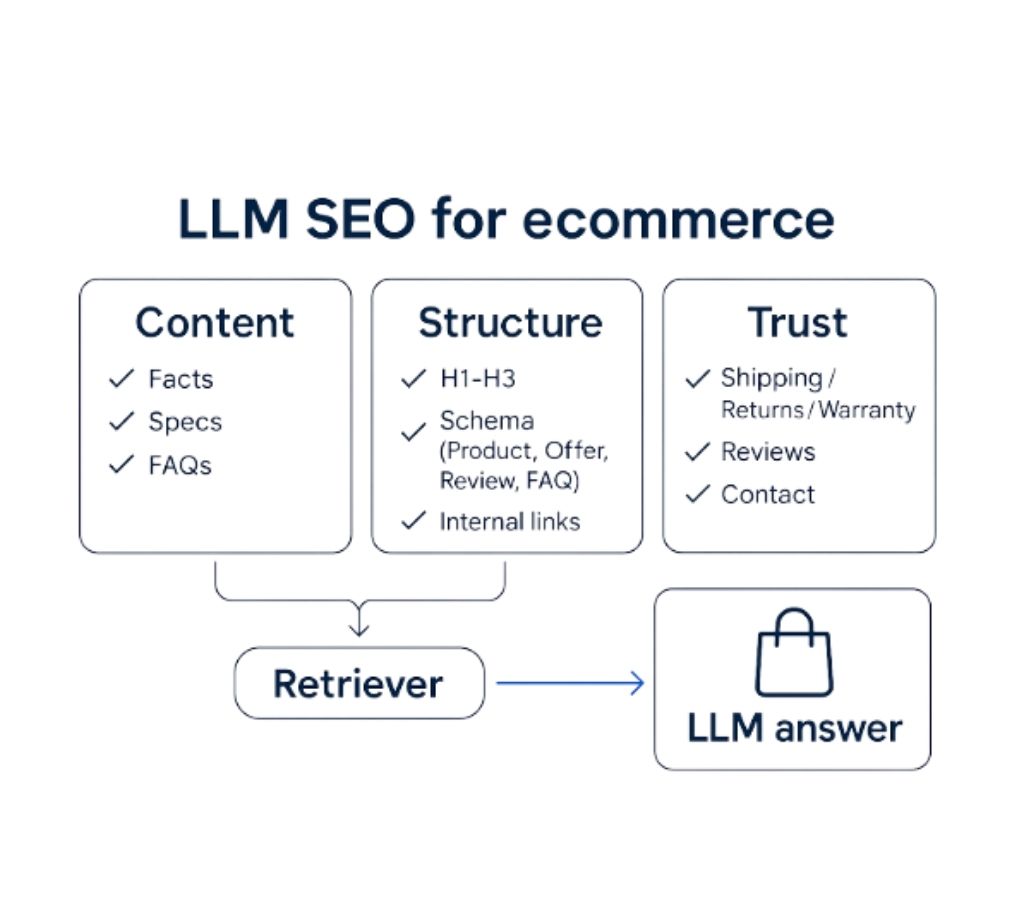
LLMs pick pages they can access and parse quickly. They are designed to extract facts and build responses rather than rank pages in the old way. Here is an overview of key elements and signals that AI tools look at when sourcing data for responses:
Accessibility and Format
For content to be easily consumed, LLMs favor pages that prioritize clarity and structure.
- Plain language that answers the question upfront;
- Clear headings and short paragraphs;
- Bullets and spec tables;
- Use the Product, Offer, Review, and FAQ schema to expose facts and link products, categories, and guides to show topical depth.
For content to be easily consumed, LLMs favor pages that prioritize clarity and structure.Key facts should be in HTML, not images or PDFs, so that they can be extracted. Fresh, consistent details help.
Credibility and Trust
Credibility matters immensely to an LLM, which seeks sources that are “safe to cite.” Signals of trust make a page more reliable:
- Visible shipping and returns policies;
- Clear contact info;
- Real, detailed product reviews;
- Identifiable authors or brand voices make a page safer to cite.
Uniqueness and Depth
Boilerplate manufacturer copy adds little, and uniqueness is the tie-breaker. Once a page is accessible and deemed credible, the originality of its content is key.
- Detailed specs;
- Honest comparisons;
- Clear buying criteria;
- Buying guides.
E-commerce Brands’ 5-Step Playbook for LLM Readiness
You do not need to rebuild your store. You need to make it easier for language models to understand, trust, and quote you. Use these five moves.
1) Make content AI-readable
LLMs pick up what is clear, specific, and close to the top of the page. Think helpful salesperson, not brochure copy.
Do this:
- Lead with what it is, who it is for, and why it helps.
- Turn specs into HTML bullets or a simple table with units.
- Replace vague claims with facts like materials, dimensions, certifications, compatibility, and warranty.
2) Cover conversational intents end-to-end
Shoppers ask questions in plain language. If your pages answer those questions directly, models can lift the lines they need.
Do this:
- Mine support tickets, live chat, on-site search, and reviews to list real questions.
- Add short FAQ blocks to product and category pages. Answer in the first sentence, then add one line of context.
- Link each answer to a more detailed guide or policy page when buyers need additional information.
3) Structure and markup so models can parse you
Good structure makes your content machine-friendly without hurting readability. Schema exposes the same facts in a format that models prefer.
Do this:
- Use a clean H1, H2, H3 hierarchy. Keep one idea per section.
- Standardize spec tables across products. Use the same field names everywhere.
- Add JSON-LD for Product, Offer, Review, AggregateRating, FAQPage, BreadcrumbList, and Organization. Keep schema values in sync with on-page text.
4) Enrich product and category pages for decisions
Most drop-offs happen when doubts go unanswered. Remove the doubt on the page.
Do this:
- Product pages: show full specs, what is in the box, setup, care, compatibility or sizing, shipping speeds, returns, warranty.
- Add buying criteria that help choose between models or versions.
- Category pages: explain who the range is for, how to choose, and how filters map to real needs. Link to comparisons and top guides. Avoid manufacturer boilerplate.
5) Build authority and trust, then shore up the basics
LLMs prefer sources that look safe to cite. Trust signals and technical hygiene raise your odds.
Do this:
- Publish visible policies and real contact details. Keep business info consistent across profiles and mark them up with the Organization schema.
- Encourage detailed reviews and on-page Q&A. Moderate for quality.
- Create topic clusters that interlink categories, products, and educational pages to show depth.
- Improve performance basics: fast pages, strong Core Web Vitals, clean URLs, correct canonicals on variants, controlled indexation for faceted pages, and accurate hreflang where relevant.
Close the LLM Visibility Gaps
You cannot improve what you do not measure. LLMs do not share rankings, so use signals you control.

Google Search Console
In Search Console’s performance report, look for long-tail question-style queries, brand and conversational terms, and impressions for product FAQs.
Monitor the indexing report to make sure your content is accessible to crawlers. Check the experience report to spot performance issues.

Google Analytics
In Google Analytics, set up tracking of on-site search and collect the exact phrases customers use. Check which pages in the Support section are visited the most.

Prompt Checks
Run spot checks on assistants. Ask the queries you want to win. You can do this either manually or with the help of an AI visibility checker. Note if your brand is cited, which pages are used, and what facts the answer leans on. Capture misses such as thin category intros, missing specs, or unclear policies.
Do this:
- Add or tighten a five-question FAQ on pages that earn question impressions.
- Fill spec tables with units and compatibility fields that the answers rely on.
- Validate and expand Product, Offer, Review, and FAQ schema.
- Add internal links from category guides to key products and comparisons.
- Refresh prices, availability, shipping, and returns so details match schema.
Repeat monthly. Small, high-signal edits compound into more citations.
Avoid the Parse Pitfalls: 10 Common Technical Gaps That Block AI Visibility
Most missed citations result from simple issues that make your pages hard to parse or trust. Avoiding these will raise your chances quickly.
Manufacturer info copy-pasted
Result: your page looks like everyone else.
Fix: add unique buying criteria, testing notes, and use cases.
Specs hidden in images, PDFs, or scripts
Result: models cannot extract them.
Fix: put specs in HTML tables and text.
Thin category pages
Result: product grids with no guidance.
Fix: add a short intro, selection criteria, and links to top guides.
Over-generated AI copy with no expertise
Result: low trust.
Fix: show brand or author expertise and keep claims verifiable.
Price or availability is out of sync with the schema
Result: lack of clarity and confidence.
Fix: sync the schema with on-page data and product feeds.
Duplicate variants without canonicals
Result: signal dilution.
Fix: set a primary URL and handle alternates correctly.
Faceted navigation is fully indexable
Result: crawl waste.
Fix: block unhelpful filter combinations, allow only useful ones.
Weak internal links
Result: orphaned guides and comparisons.
Fix: link categories to products and to educational content.
Policies buried or missing:
Result: risky to cite.
Fix: surface shipping, returns, and warranty near the buy area.
Overly strict robots rules
Result: important assets blocked.
Fix: allow key crawlers you are comfortable with and keep content accessible.
Your LLM Readiness Summary
AI search is rising. It may not be your biggest traffic source today, but it is growing fast, so preparing now protects future visibility. The good news: you do not need a new strategy. Good SEO is still good AI SEO. A few focused adjustments will help you win in classic results and LLM answers.
- Lead with extractable facts: what it is, who it is for, why it helps. Put specs and policies in clean HTML.
- Answer real questions on the page: short FAQs in natural language, clear buying criteria, simple comparisons.
- Add structure and schema: tidy H1 to H3 hierarchy, spec tables, Product and Offer schema, Review and FAQ schema, Breadcrumb and Organization.
- Show trust early: visible shipping, returns, warranty, real contact details, genuine reviews kept up to date.
- Keep improving monthly: refresh prices and availability, validate schema, strengthen internal links, and maintain fast, stable pages.
Closing thoughts
AI search is on the rise. It might not be your biggest traffic source today, but it is growing fast, and you will feel it sooner than you think. The good news is you do not need a new playbook. The same basics that help you rank in classic search also help language models understand and cite your pages.