
SEO Expert Gosia Ziółko-Urban spells out how to easily optimise existing content with AI Search visibility in mind.
In the world of SEO, nothing stays the same. AI-powered search has changed the game, but ChatGPT, Perplexity, Google SGE, and voice assistants are just the beginning. Today, AI not only helps users find answers. It creates them.
This means traditional approaches to content creation need a complete rethink.
Today, we’ll explore how the way we search for information is changing, and what that means for us, content creators, and SEO specialists. It’s a practical guide you can use to implement new strategies, and also a knowledge base you can share with clients.
What Is AI Search?
AI Search isn’t just another algorithm update. It’s a change in how users interact with search engines. Instead of typing short keywords, people are increasingly asking full questions, engaging in conversations, or even just speaking to their phones.
Users are no longer typing in robotic phrases like “best hiking boots 2025.” Instead, they’re asking questions like:
- “What are the most comfortable hiking boots for long treks?”
- “Which boots hold up in snow and mud?”
- “Can you recommend boots for wide feet?”
AI doesn’t just “read” the query. It understands it in context, analyses intent, and personalises the response. What’s more, it processes not only text but also images, sound, and data, combining them into a coherent answer.
The result? Responses are shorter, more precise, and less likely to require a click.
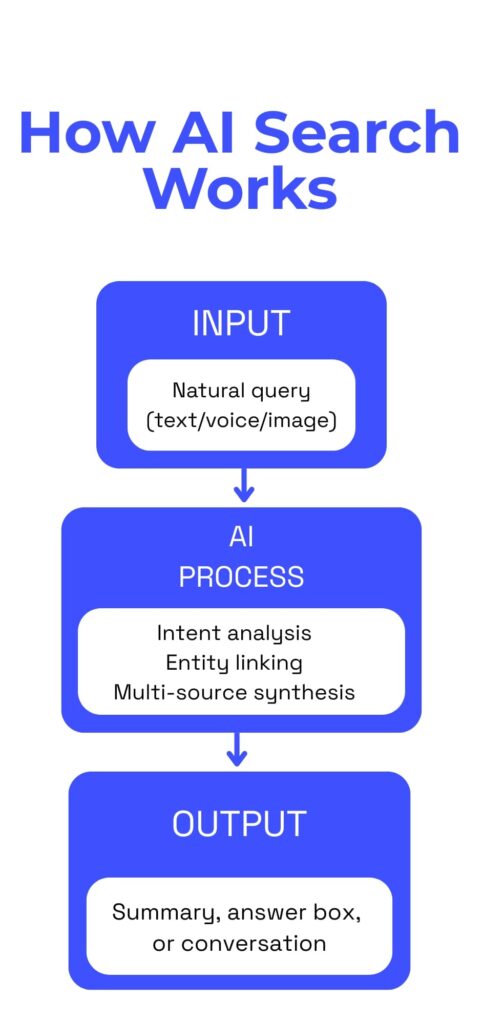
AI Search vs. Traditional SEO
In classic SEO, matching a keyword to content was key. With AI search, context and semantic relationships are more important. AI can merge various sources and generate a coherent answer without showing the full list of results.
Let’s break down how the landscape has shifted.
| Traditional SEO | AI-Powered Search |
| Keyword-matching | Intent and semantic understanding |
| SERP rankings determine visibility | Response quality and context relevance matter most |
| Featured snippets and blue links | Summaries, citations, and conversational answers |
AI evaluates relationships between entities, topical authority, and content depth. This requires a new approach:
- Answer questions holistically, not just once per keyword.
- Cover topics comprehensively, not just superficially.
Write for people, but with machine understanding in mind.
Impact on Traditional SERP Elements
Not only are users asking different types of questions, but they’re also receiving answers in new ways. Increasingly, AI determines which content snippets appear, and these often aren’t classic featured snippets.
Instead, we see summaries, contextual quotes, or real-time generated responses. This may lead to a decline in organic click-through rates, especially when users get satisfying answers directly in the search interface.
Knowledge panels might be replaced by dynamic AI-generated responses, and the SERP landscape will become more interactive and less predictable. For content creators, this means one thing: write not only to inform, but also to inspire clicks.
Make your content so valuable, interesting, and usable that even when summarised, users want to “learn more” and visit your page.
How to Create AI-Friendly Content?
Okay, so how do you actually optimise your content for AI search? There are several good practices to follow here:
Cover Topics More Comprehensively
Think holistically. Not just about a single keyword, but the entire topic. Build content around the subject, answer frequently asked questions, and expand on related themes. The more comprehensive and logically structured your content, the more likely AI will consider it a valuable source.
- Don’t focus on a single keyword. Choose a topic and explore it fully.
- Anticipate various user questions and answer them in your content.
- Use semantic SEO: focus on meaning, not just words. Use synonyms, related terms, and contextual phrasing.
Example:
Instead of: best trail running shoes
Try: What makes a trail running shoe great for rocky terrain?
Build Trust and Authority (E-E-A-T)
Finally, trust matters. AI evaluates it. That’s why E-E-A-T is becoming more important. It’s crucial who the author is, what experience they have, where else they appear, whether they link to credible sources, and whether they’re cited themselves.
All this builds a reputation not only with people but with algorithms.
- E-E-A-T: Search engines assess content based on Experience, Expertise, Authoritativeness, and Trust. Show that you’re a subject-matter expert.
- Brand building: Ensure consistent communication, content quality, and positive reviews.
- Links and citations: Mentions and backlinks from other sites signal to AI that you’re a reliable source.
Wrapping Up: Think Like AI, Write Like a Human
AI search isn’t a passing trend. It’s the future direction of the entire industry. Instead of traditional SEO focused on keywords and rankings, we’re entering an era of optimisation based on intent, context, and information relationships.
Content must be better written, more coherent, and focused on helping, not just users, but also the AI that “reads” and evaluates what we publish.
For SEO specialists and content creators, this is a challenge, but also a massive opportunity. If you can understand how AI thinks, you’re already one step ahead of the competition. And if you’d like help adjusting your strategy to meet new standards, we’re here for that.
Ready to future-proof your content? If you’d like help crafting AI-optimised content strategies that drive visibility, trust, and engagement, get in touch. We specialise in adapting SEO for the next generation of search.