Is AI impacting your client’s organic reach? This guide reveals how the Semantic Web and semantic SEO can help agencies regain control and visibility.
Let’s get one thing straight — if you’re still banking on exact-match keywords and hoping for the best, you’re not just playing catch-up.
You’re handing your traffic over to AI.
We’re entering a new era where search engines do more than just scan text. They interpret meaning. Understand relationships. Answer complex questions — sometimes without sending users to your site.
So here’s the million-visit question:
Will AI deliver your content to users or skip over you entirely?
This guide is your blueprint for regaining control by understanding the Semantic Web and using it to stay visible, relevant, and competitive.
Why Keyword-First SEO Is a Dead End
Once upon a time, SEO success was simply about identifying the “right” keyword, stuffing it a few dozen times into your H1, meta description and body copy, and then waiting for Google to reward your efforts.
But Google (along with users) has grown far more sophisticated. Today, the good old keyword-focused approach is not only outdated — it’s dangerous.
It misses the point of modern search altogether: understanding.
Google’s goal now isn’t just to find content that contains the search terms. It’s to deliver the most accurate and contextually relevant answer.
That means:
- Recognising synonyms and related terms;
- Understanding who or what the content is about (entities);
- Knowing how those entities relate to each other;
- Interpreting user intent behind the search.
Modern SEO is no longer about keyword tricks. It’s about building meaning, clarifying context, and connecting ideas so that Google knows exactly what your content offers — and who it’s for. Enter the Semantic Web…
Understanding the Semantic Web: What It Is and Why It Matters
The Semantic Web is not a new app or algorithm.
It’s actually a concept that originates from the World Wide Web founder, Tim Berners-Lee (basically the modern internet’s dad). He envisioned a system where machines could process and understand the data on the web.
At its core, the Semantic Web focuses on structuring data, meaning, and relationships in a machine-interpretable format.
It’s how search engines like Google and AI-powered tools like ChatGPT Search are now interpreting not just what users are typing but what they’re actually asking for.
That’s a long way from the early days of SEO when using keywords repeatedly throughout the page guaranteed success. Back then, Google didn’t focus on the meaning behind search queries. As long as the page matched the words in the search query, you could easily fight for the top spot in SERPs.
Everything changed in 2013 when Google introduced its Hummingbird Algorithm — its first step into the semantic approach to interpreting search queries.
Think of it like this:
- Old Web (pre-Hummingbird): A user searches “Apple,” and the search engine has to guess — do they mean the fruit or the company?
- Semantic Web (post-Hummingbird): The engine understands from the context that “Apple” appears next to “iPhone” or “MacBook” and confidently returns results about the tech company.
In plain English? It’s how Google knows your blog post isn’t just talking about “bats” — it’s about the cricket equipment, not the animal.
Basically, if you’re producing content today, you’re writing for two audiences: people and machines. And if machines don’t understand it, they won’t show it to people.
How It Works
The Semantic Web isn’t powered by guesswork — it’s built on structured frameworks that make meaning machine-readable. Think of it as the scaffolding behind every intelligent search result.
Three essential components make this possible:
1. Entities — Unique concepts like “London,” “Nike,” or “carbon footprint.” Search engines treat them as distinct identifiers, not just words.
2. Relationships — How those entities connect. For example:
- Nike produces running shoes;
- Running shoes help with foot support;
- Flat feet need specific features.
3. Structured Data — Markup like Schema.org tells search engines what each piece of your content means. It adds a layer of context machines can process instantly.
This way, when someone searches for “best running shoes for flat feet in 2025,” search engines take the intent behind the query and match it with the most relevant pages using that framework.
Based on it, it returns current, relevant, structured content — not just a page that happened to mention those words (for example a Nike store product page).
Knowledge Graphs and Semantic Search
One of the most prominent examples of how the semantic search works is knowledge graphs. These are databases that store and connect information about entities and their relationships.
When you search for something like “Mozart,” Google doesn’t just give you a list of links — it shows his birthdate, notable works, family members, and historical significance. That summary comes from a knowledge graph, not a traditional search index.
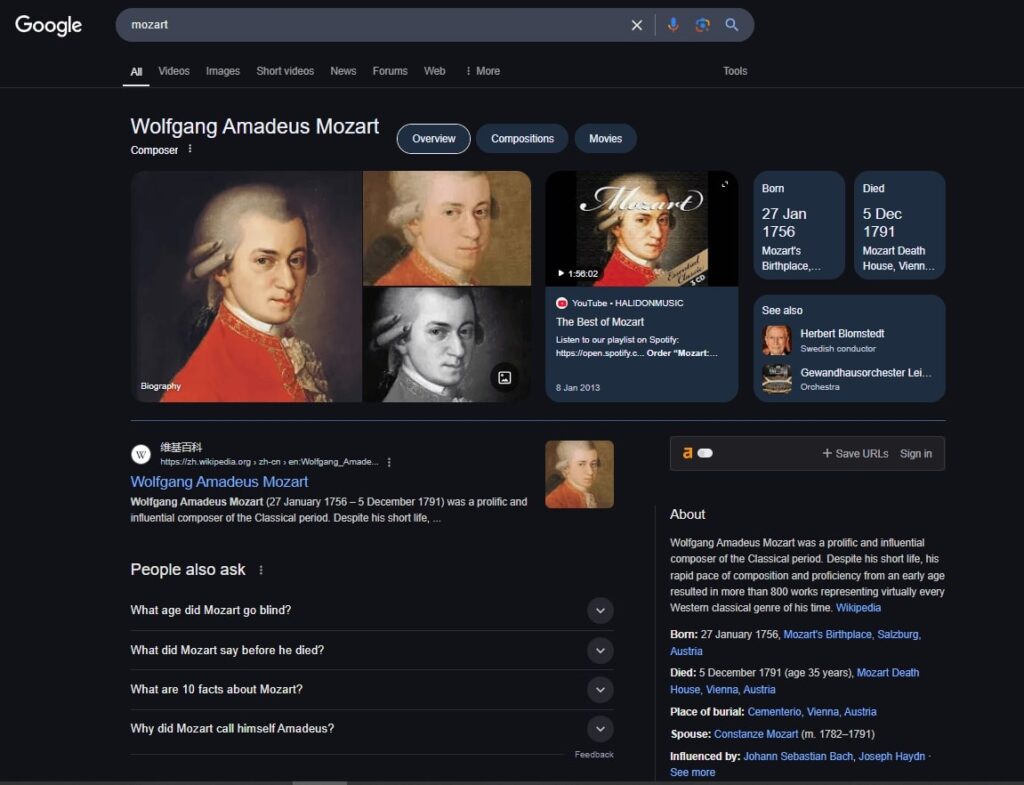
Example of a knowledge chart for Mozart
Here’s how it fits together:
- Entities like “Mozart” or “SEO” are recognised as nodes.
- Relationships (e.g., “composed by,” “founded,” “headquartered in”) link these entities together.
- Semantic analysis ensures that the search engine understands not only the terms in a query but also the context surrounding them.
When you optimise your content around clearly defined entities and contextual relevance, you help search engines map your site into their knowledge graph. This increases visibility, trust, and the likelihood of Google featuring your content in enhanced features like rich snippets or knowledge panels.
It’s All About Search Intent
At the heart of the Semantic Web concept lies search intent — the purpose and goal of the user’s search.
Intent is what separates a page that gets clicked — and one that getsignored.
If your page format, content structure, or CTA doesn’t align with what the searcher wants to achieve, even ranking well won’t help you convert.
In general, in SEO, we distinguish between four core types of search intent: informational, navigational, transactional, and commercial.
Let’s take a closer look at them:
| Intent | What the User Wants | Examples | Best Page Types |
| Informational | To learn or understand something | “What is white label SEO?” | Blog posts, guides, explainer videos |
| Navigational | To go to a specific brand or website | “Ahrefs login” | Homepage, login pages, branded content |
| Commercial | To compare, research, or evaluate options | “iPhone 16 vs Google Pixel 9” | Product pages, checkout flows |
| Transactional | To complete a specific action (buy, subscribe) | “Buy Spotify Premium” | Comparison articles, reviews, listicles |
Modern search engines are remarkably good at guessing the “why” — even if the user never says it. That’s thanks to years of data, AI models, and natural language processing.
For marketers and SEOs, that means writing for intent is non-negotiable. Your content needs to:
- Match the user’s stage in the journey;
- Provide real answers, not vague fluff;
- Use the right format (list, guide, comparison, review).
If someone’s comparing tools, give them a side-by-side breakdown. If they’re ready to buy, give them product specs and CTAs.
Intent tells you what kind of content to create, how deep to go, and what language to use. Get it wrong, and your bounce rate will tell the story.
Writing with Search Intent with Mind
Let’s say someone searches for:
“Best CRM software for small business”
A decade ago, the SEO playbook was simple:
- Identify the exact-match keyword;
- Use it in the H1, meta description, first paragraph, image alt text;
- Add a bunch of brand names to hit volume;
- Rank and hope for clicks.
This approach still exists in many corners of the internet — but it’s not enough anymore. Google doesn’t just want to know what your content says. It wants to know whether you actually understand what the user wants.
Approaching the same query with a semantic mindset means not just focusing on targeting words but thinking about the person behind it.
Here’s what this searcher is likely signalling:
- They’re a small business owner or decision-maker;
- They’re looking to compare available CRM tools;
- They care about features, pricing, ease of use, scalability, and support;
- They probably don’t want enterprise-level solutions with steep learning curves.
So your content needs to do more than list HubSpot, Zoho, and Salesforce with boilerplate descriptions.
Instead, you create a solution-focused experience that:
✅ Compares CRMs by business size and use case;
✅ Offers pricing tiers (freemium, small team, growing business);
✅ Highlights integrations with common tools (e.g. Gmail, Slack, Shopify);
✅ Shows screenshots and workflow examples;
✅ Answers key objections like “Can I switch from Excel easily?” or “Will my team need training?”
That’s how you win with modern SEO. You don’t write to match the keyword — you write to satisfy the searcher’s job to be done.
Intent in Google vs AI Searches
When talking about search intent, we need to look at it from the AI point of view, too.
As AI-powered tools become more important in how users search and consume information, understanding how they interpret intent compared to search engines like Google is vital.
Google’s algorithm is engineered to send users to the most relevant content. It’s built on decades of link-based authority signals, search history, and ranking systems designed to reward the best web content.
AI tools like ChatGPT or Gemini work differently. Their goal is to deliver answers, not drive traffic. These tools parse your content, extract meaning, and summarise it — often in real time — without necessarily sending users to your website.
| AI | |
| Google aims to drive traffic by listing links. | AI tools try to resolve the query on the spot. |
| Google ranks based on page-level factors and topical authority. | AI uses semantic cues and context to extract direct answers. |
| On Google, search intent often results in a site visit. | In AI-driven tools, the user may never leave the AI interface. |
This shift means your content must do more than be discoverable — it must be answer-worthy. If your copy isn’t clear, contextual, and structured for semantic digestion, AI tools may extract and paraphrase it — without attribution — and, to put it simply, steal your traffic.
How to Write for AI Queries?
To stay competitive:
➔ Write in a way that makes it easy for AI to cite you.
➔ Use schema, clarity, and structured answers.
➔ Make your pages the best possible version of the answer users (and AI) are looking for.
Semantic SEO is now your insurance policy against disappearing from the results entirely — whether that’s Google’s first page or an AI-generated response.
Entity Relationships: Your SEO Power Grid
By now, you’ve seen how entities, structured data, and search intent all contribute to how search engines understand content. But the real magic — and ranking power — comes from how those entities relate to one another.
This is where the Semantic Web goes from being descriptive to decisive. Relationships are the glue that holds meaning together — they allow search engines to move from recognising individual concepts to building full, contextual understanding.
That’s what search engines use to build their knowledge graphs, and it’s what helps them decide if your site is credible.
So, how do you build and leverage these relationships?
- Be consistent with how you reference entities across your site;
- Internally link related content to strengthen topical relationships;
- Use structured data to define the connections between entities explicitly;
- Create content clusters that revolve around a main topic and its related subtopics.
Say you’re targeting the term “local SEO.” Supporting content might include:
- What local SEO is;
- How Google Business Profile fits in;
- How reviews impact local visibility;
- Best tools for local rank tracking.
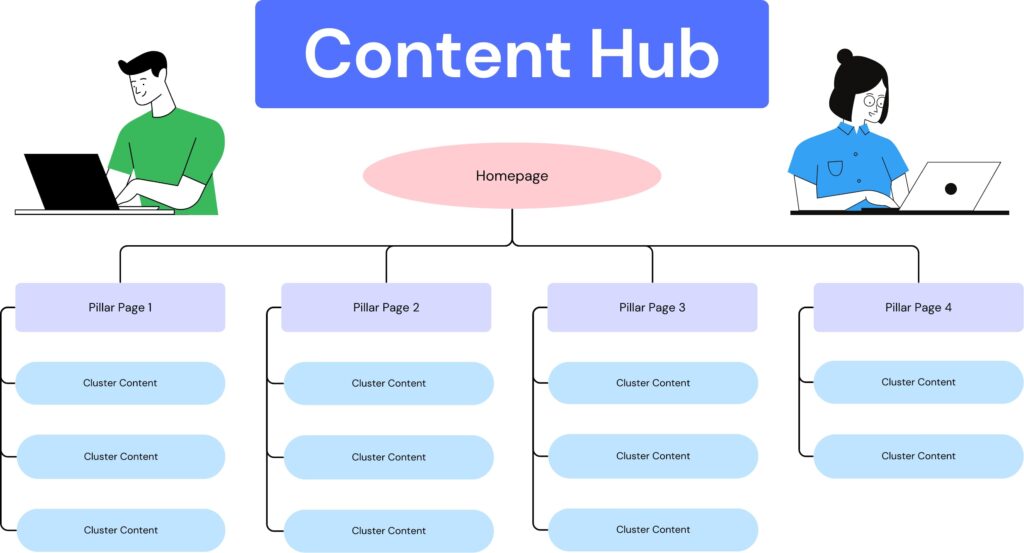
Example of a content hub/cluster flowchart
When linked strategically, this content ecosystem helps search engines understand that your site is an authoritative resource on the topic — not just a random blog post with keywords.
The more accurately you map relationships between your entities, the stronger your semantic footprint becomes.
How to Future-Proof Your SEO
So far, we’ve covered the what and the why of the Semantic Web — how search engines are evolving, how AI is reshaping visibility, and how entity relationships drive context and credibility.
Now it’s time for the how.
Below are six tactics that translate everything we’ve explored into clear, actionable steps. Whether you’re an SEO manager, content strategist, or digital marketer, these are the building blocks you need to stay competitive in an AI-first search environment.
1. Build Topic Clusters (Not Isolated Blog Posts)
Old SEO treated every blog post as an island. Semantic SEO builds topic ecosystems.
This is where topic clusters come in. They help you leverage entity relationships to create content that resonates with your audience, ensuring search engines and AI tools view you as an authority within your niche.
How to do it:
✔️ Choose a core topic (e.g. “technical SEO”).
✔️ Create pillar content that broadly covers the topic.
✔️ Surround it with in-depth posts on subtopics (e.g. “canonical tags,” “crawl budget,” “indexing issues”).
✔️ Link all posts back to the pillar page and to each other.
Pro tip: Use tools like Ahrefs or SEMrush to find related subtopics your audience is already searching for.
2. Focus on Entities, Not Just Keywords
Search engines don’t rank vague phrases — they rank defined ideas.
Think beyond keywords and zero in on the people, organisations, products, and locations your content revolves around.
How to do it:
✔️ Identify core entities in your niche using tools like Google’s Knowledge Panel, Kalicube, or LinkedIn.
✔️ Use those entities consistently across titles, URLs, alt text, and content.
✔️ Avoid keyword ambiguity. Don’t say “Apple” — say “Apple Inc.” or “Apple the tech company.”
Pro tip: Be specific. Don’t say “Apple” when you mean “Apple Inc.” This prevents ambiguity — especially for AI.
3. Use Schema Markup to Structure Meaning
Structured data is how you make your content machine-readable. It’s also how you qualify for rich results. The best way to approach this is to use schema markup.
How to do it:
✔️ Use Schema.org to add structured data for articles, FAQs, products, reviews, and events.
✔️ Validate your markup with Google’s Rich Results Test.
✔️ Include fields like author, organisation, date, and key topic entities.
Pro tip: Use FAQ schema to increase the real estate your result takes up in SERPs.
4. Map Content to Search Intent
Although they may search for similar queries with identical keywords, not all visitors are looking for the same thing. Your content should reflect whether someone is researching, comparing, or ready to buy — in short, the intent behind the search.
How to do it:
✔️ Align each page with one of the four core intent types: informational, navigational, transactional, or commercial investigation.
✔️ Format accordingly: long-form guides for informational, comparison tables for commercial, clear CTAs for transactional.
✔️ Use headers that match the intent (e.g. “How to…” for educational content).
Remember: Intent is the bridge between relevance and results.
5. Analyse Google’s Knowledge Graph in Your Niche
Understanding how your brand and competitors appear in the knowledge graph gives you visibility into how Google structures meaning around your space.
How to do it:
✔️ Google your brand, competitors, and top keywords — check for knowledge panels.
✔️ Use Kalicube Pro or InLinks to map how your brand connects to known entities.
✔️ Identify what’s missing: are your authors listed? Is your business location correct? Are reviews and profiles connected?
Quick win: Add organisation and person schema for authors and company bios to boost visibility.
6. Strengthen Internal Linking with Entity Relationships
Don’t underestimate internal links. They do more than just guide users through your site. They show search engines how topics are related. Think of them as semantic bridges between your ideas.
How to do it:
✔️ Audit your internal linking structure: does each post connect to a relevant cluster or pillar?
✔️ Use descriptive anchor text like “canonical tags in SEO” instead of “read more.”
✔️ Prioritise linking content that shares entities or semantic relevance.
Pro tip: Use topic mapping tools like Thruuu or Oncrawl to identify weak points in your linking strategy.
Final Thoughts: Don’t Let AI Own Your Audience
You’ve got two choices:
Let AI rewrite your traffic flow by prioritising content that plays the semantic game better.
Or take the reins by understanding how modern search really works — and building a site that speaks the same language.
AI-powered search is increasingly focused on relevance, structure, and clarity. It rewards the content that answers queries with depth and precision — not the page that repeated a keyword the most. If your site doesn’t reflect clear meaning, defined relationships, and semantic cues, it’s likely to be passed over by both Google and AI.
But here’s the upside: if you do understand how the Semantic Web works, you’re ahead of the curve. Way ahead.

By structuring your content around entities, mapping relationships, and aligning with search intent, you’re not just playing the game — you’re winning it. The competition is still catching up, and many still haven’t made this shift.
This is your edge.
Semantic SEO is how you:
- Future-proof your rankings;
- Build authority in your niche;
- Dominate both search results and AI-generated answers.
So don’t wait to be replaced. This is your opportunity to get in front and stay there.
And if you want help turning those principles into results?
SUSO Digital’s AI SEO services are built for exactly this challenge.
Get in touch. The smarter web is already here.