The way the world discovers brands has fundamentally changed. The era of the “ten blue links” is over; in its place is AI Search, where users receive direct, synthesized answers from Large Language Models (LLMs) like ChatGPT, Google’s AI Overviews, Gemini, and Perplexity.
This transition is accelerating globally, with AI adoption soaring. This guide presents the strategic blueprint for PR agencies to move from being an adjacent function to the indispensable leader of brand visibility in this new ecosystem.
Key Takeaways
The Paradigm Shift: From Clicks to Citations
AI Search provides synthesized answers directly, creating a “zero-click” reality that makes traditional SEO rankings less relevant.
Visibility now depends on being cited and mentioned as the definitive, authoritative source in an AI-generated answer.
PR is the Strategic Imperative
AI models prioritize authority and consensus across the web, which are the core outcomes of successful PR and earned media.
PR campaigns now convert a client’s brand equity (trust, reputation) directly into search equity (AI citations and visibility).
This shift positions PR agencies to win new business, deliver more measurable outcomes, and offer superior reputation management by proactively engineering the brand’s narrative for AI.
The Capability Gap and the Solution
The challenge for PR agencies is bridging the gap between their expertise in off-page trust signals (narrative, media mentions) and the technical demands of Generative Engine Optimization (GEO) (schema markup, content restructuring, robots.txt, metadata and <h> tags optimization, etc).
To claim this space and avoid missing the SEO opportunity a second time, agencies must think structurally, not just editorially.
To immediately close this gap, agencies have three strategic options: Build (an in-house team), Buy (a specialist SEO firm), or Partner (with a specialist firm like SUSO for instant, low-risk expertise).
What Is AI Search?
AI Search refers to search experiences powered by large language models (LLMs), such as ChatGPT, Perplexity, Google’s AI Overviews, and Gemini.
These experiences provide direct answers, often with cited sources, eliminating the need for a user to click through to a website. This new form of search is driven by three core technologies:
- natural language understanding
- semantic search
- generative summarization
Why Does AI Search Matter?
The rapid adoption of AI-powered platforms demonstrates that this shift is not a distant future, but a present reality:
- The number of ChatGPT weekly active users grew from 400 million to 800 million between February and October of 2025 alone.
- ChatGPT achieved 365 billion annual searches back in 2024, which is a 5.5x faster adoption rate compared to Google’s initial growth.
This explosive growth signals an urgent need for brands to adapt their strategies, and they come to PR agencies for guidance. Agencies that don’t have answers at the ready risk losing relevance and missing out on high-impact visibility for their clients.
At the same time, using the traditional SEO toolkit seems to be insufficient to gain visibility in generative search. According to research by BrightEdge published in September 2025, web pages cited in Google’s AI Overviews are not ranking in traditional results 45.5% of the time.
- 28% of ChatGPT’s most-cited pages have zero organic visibility
Ahrefs data from October 2025 says that 28% of ChatGPT’s most-cited pages have zero organic visibility. This poses both an opportunity and a challenge even for SEO-savvy PR professionals – the rules of the game have once again changed.
How AI Search Differs from Traditional Organic Results
AI search is fundamentally different from traditional organic search results, and understanding this distinction is key to a successful strategy.
From Links to Answers
Traditional search engine results pages (SERPs) served as a directory, not a destination. When a user entered a query, the search engine responded with a list of links. Each link included a title and a short description, or a snippet, designed to help the user choose the most relevant page.
The user would then click on a link, or several, to find the specific information they were looking for. The journey was one of discovery and navigation, with the user acting as the final curator of the answer.
“Search used to reward the brands that earned the most clicks; AI rewards the brands trusted to provide the answer. Visibility is no longer about sitting at the top of a list of links. Instead, it’s about being credible enough to be cited as the expert voice”
Cara Corbett, SUSO Digital
This model began to change with the introduction of SERP features like Featured Snippets and People Also Ask boxes. These features started to provide short answers, or previews to answers, to user queries right on the search results page.
This helped the user better understand whether clicking on a certain page would satisfy their query, or sometimes even provided them with a satisfying answer right there, in a snippet.
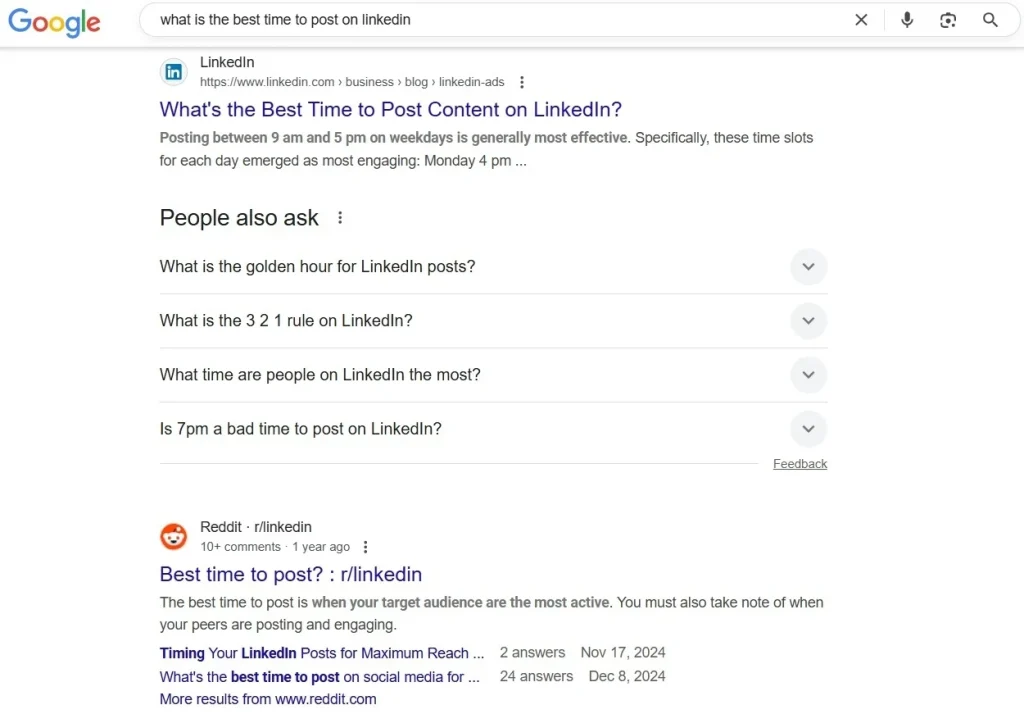
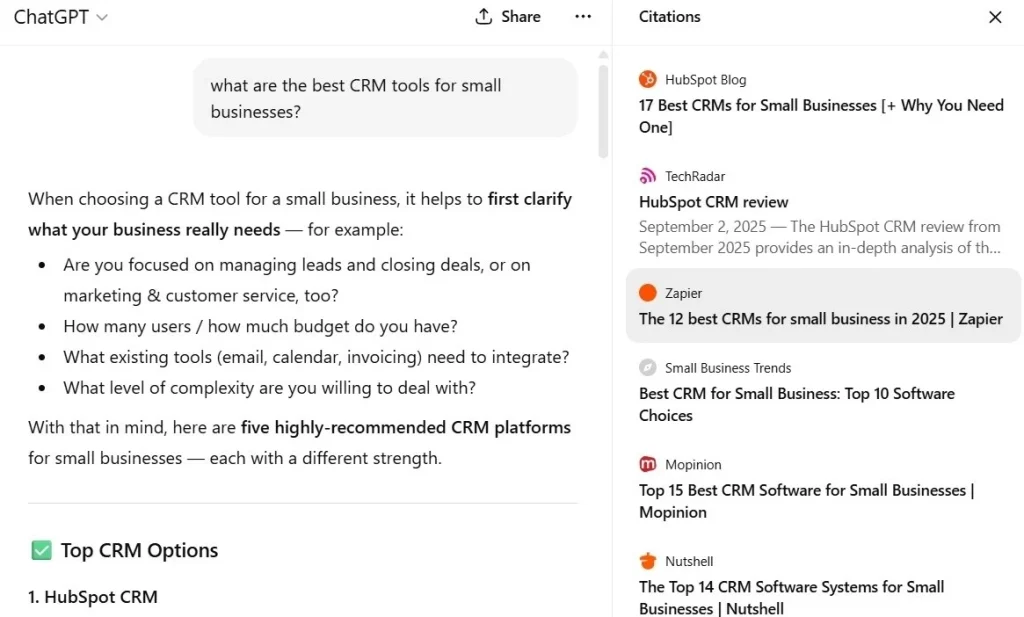
AI search further changes this process. Instead of providing a list of blue links or the best response available from a single web page, it synthesizes a single, coherent answer to the user’s query from multiple sources.
This zero-click experience satisfies the user’s intent immediately, making the brand or source cited in the AI response the primary point of authority and visibility. The focus shifts from getting users to click a link to getting the client’s brand mentioned as the source of a trusted answer.
Zero-Click, Zero Room for Error
In traditional SEO, a win was a click. A technically healthy website with keyword-optimized copy and backlinks meant traffic to the client’s site. AI search, however, introduces a new dynamic. By providing a direct, synthesized answer, AI models can satisfy a user’s intent without a single click to a website.
Key Stats
A study by Pew Research shows that:
- Users are half as likely to click on a traditional search result when the search results page contains an AI summary.
- There is only 1% chance of a click on a link in the summary itself.
- Users are 60% more likely to end their session right after visiting a search results page with an AI summary.
This means the strategic focus is no longer just about generating organic traffic, but about positioning your client’s content as a source so trusted and clear that an AI will cite it directly, making the brand a definitive authority in the digital conversation.
Why AI Search Is a PR Opportunity
The shift toward AI-driven search has not slowed down but rather accelerated. After the introduction of AI Mode in the US within Search Labs in March 2025, Google began rolling out these generative AI capabilities with unprecedented speed:
March 2025: AI Mode experimentally introduced in the US, within Search Labs.
June 24, 2025: AI Mode launched in India.
June 28, 2025: AI Mode launched in the UK.
August 21, 2025: expansion to over 180 countries and territories.
September 8, 2025: 5 new languages added
September 23, 2025: AI Mode available in Spanish
October 7, 2025: 35+ new languages added, with AI mode expanding to over 40 new countries and territories, totaling over 200 countries and territories, including many across Europe.
November 13, 2025: Google started rolling out agentic checkout features to AI Mode.
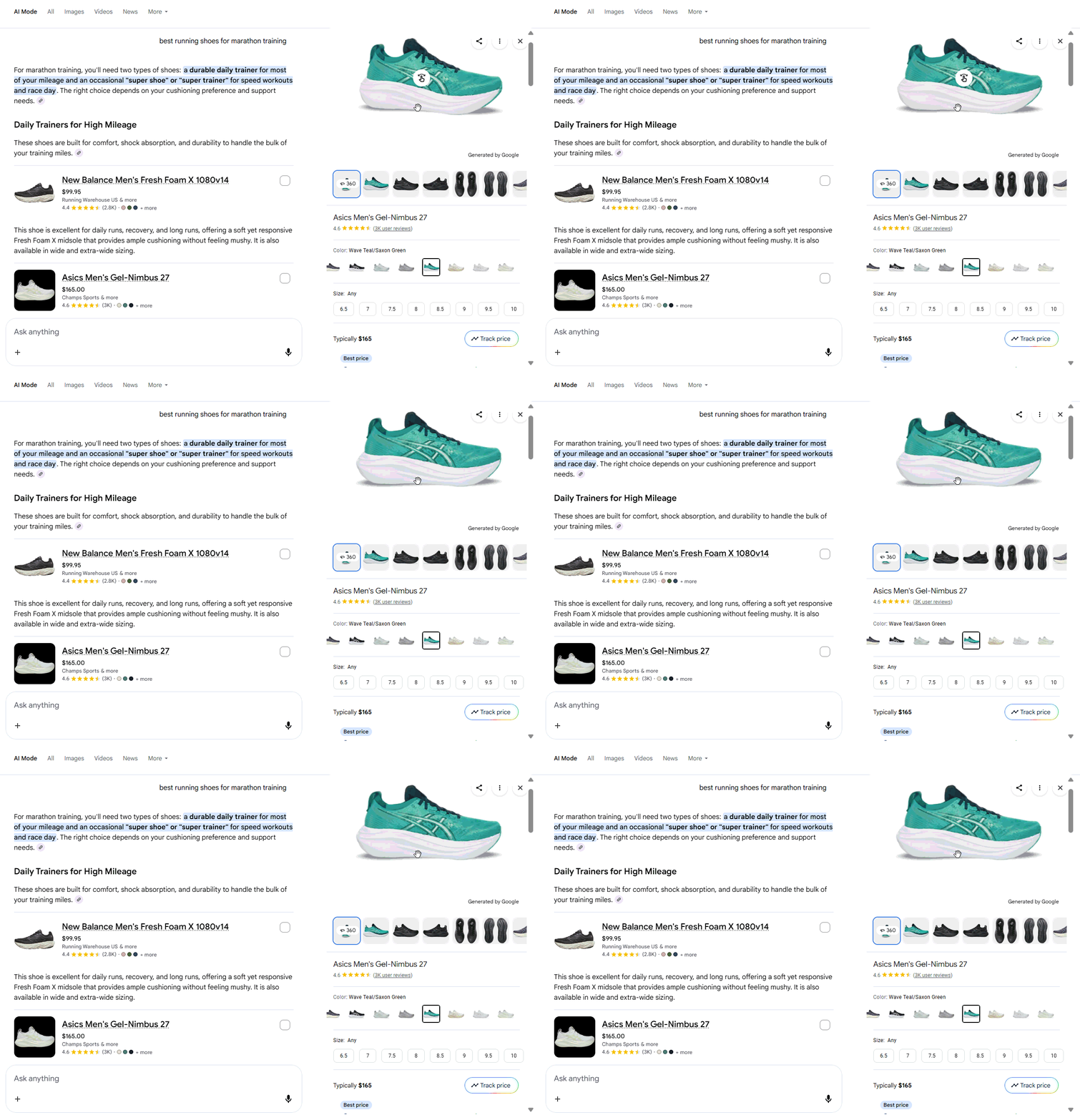
This rapid expansion, coupled with the explosive growth of platforms like ChatGPT, confirms that chat-based search is becoming normal behavior. In its 2025 State of Consumer AI report, Menlo Ventures estimates that approximately 500-600 million people globally rely on AI daily.
At the same time, it became evident that being “searchable” no longer guarantees visibility.
Key Stats
According to a study by SEMrush, over 50% of sources linked in Google’s AI overviews did not overlap with top organic search results.
Research into Google’s AI mode yielded similar findings: URLs coming up in AI Mode and in Google’s traditional search results overlap 32% of the time, domains – 51%.
A study by SE Ranking shows that 7.6% of search queries exhibit no shared domains in AI Mode versus organic top results.
This is both bad news and good news. The bad news is that the standard SEO promotion toolkit is no longer enough to help clients stay top of mind. The good news is, this presents an excellent opportunity for PR agencies to step up and lead the way for their clients in the age of AI Search.
The Role of PR in AI Discovery
Traditional search engine bots, like Googlebot, function as web crawlers that follow links and read code to index a website, categorize and rank pages for specific queries.
LLMs also have crawlers, but they are used to provide training and grounding data, which LLMs use to synthesize information from and form a coherent response to user queries.
According to a study by SEMrush, Google’s AI overviews are most often triggered by “how” and “what” questions.
The goal is clear: to facilitate users’ search for information, rather than just providing them with a ranked list of blue links to click through.
Therefore, it is natural that one of the elements LLMs consider when generating responses to user queries is the presence of clear, well-structured explanations that align with how people ask questions.
Furthermore, to provide users with the best responses possible, LLMs are less concerned with a page’s rank and more interested in what the page says, who said it, and how credible that information is across the web, thus prioritizing authority and consensus.
AI models are more likely to cite:
- Brands that are consistently mentioned in reputable sources
- Experts quoted in articles from trusted publishers
This is where PR teams have a natural advantage – they are building a reputation that AI models learn from and trust. PR directly influences how a brand appears in AI results by shaping the narrative and earning coverage by reputable publishers, which makes PR teams already half-equipped to win at AI search.
Most Cited Sources by LLMs
According to SE Ranking’s study on Google’s AI Mode based on 10,000 keywords from US locations, several sources stand out as the most cited across all datasets:
- Google’s own services, primarily Google Maps business profiles
- indeed.com
- Wikipedia
In addition to being a primary source for Google’s AI mode, Wikipedia is also the most cited ChatGPT source, according to Profound, with Reddit being the second most cited source.
- 7.8% Wikipedia’s percentage of total citations in ChatGPT
Semrush study from November 2025 adds social media to this list. LinkedIn appears to have reached 15% of AI Mode citations and exceeded 5% in ChatGPT. Facebook reached 4.36% of AI Mode citations.
PR Newswire reached 4.72% of citations in ChatGPT, and Forbes holds 6.93%.
Other publishers with known partnership deals with AI platforms include The Wall Street Journal, NY Post, The Washington Post, Financial Times, CNN, Associated Press, Fortune, LA Times, Hearst, The New Yorker, Wired, and others.
These are the sources that LLMs consistently recognize as authoritative, which signals the importance of earning coverage on these platforms.
How PR Directly Influences AI Search Visibility
The most powerful implication of the AI search shift for PR agencies is the ability to tie their work directly to tangible, measurable search visibility. Historically, PR efforts were difficult to quantify in terms of direct search impact. A media placement was a boost to reputation and awareness, but its contribution to Google rankings was often indirect. Now, the dynamic has fundamentally changed.
“PR agencies have always built trust; now that trust shapes discovery. The coverage you earn and the narratives you craft are becoming the sources AI points to first, turning reputation into measurable search presence that influences real decisions.”
Cara Corbett, SUSO Digital
When a brand is included and cited in an AI-generated answer, it gains instant trust and shapes public perception before a user even navigates to a website. This is the new premium visibility. Brand mentions, earned media, and thought leadership pieces are now direct inputs that influence which sources AI engines choose to cite.
This shift allows PR agencies to deliver three critical new outcomes for their clients:
Convert Brand Equity to Search Equity
PR campaigns no longer just earn headlines; they earn AI trust, a critical factor in the generative engine optimization (GEO) landscape. By building reputation, agencies are converting their clients’ existing brand equity (trust, reputation, authority) into measurable search equity (direct citation and visibility in AI search results).
Own Digital Discovery
PR professionals can now move beyond traditional awareness metrics and take ownership of a critical layer of digital discovery, impacting awareness, credibility, and even customer acquisition at scale.
Guarantee Authority
The new goal is to ensure clients are positioned as the definitive authoritative sources the AI recommends and cites for any relevant query, securing their place as the “trusted voice” in the digital conversation.
The new goal for PR agencies is to ensure their clients are the brands that AI recommends and cites.
Other Factors Affecting AI Search Visibility
While earned media is critical, AI search results also depend on factors that PR teams can influence but often overlook. Some agencies may assume that getting their clients featured in top-tier publications is enough to drive generative search visibility. However, a broader set of factors is at play.
Factor 1: Technical Hygiene
LLMs.txt has become a buzzword in the SEO world in 2025 – a lot of marketers swore by this file and made it a part of their LLM optimization offers, and consequently, many website owners rushed to add it to their websites.
But according to SE Ranking research from November 2025, adding this file to a website doesn’t impact its AI discoverability. There are, however, some other hard blocks for LLMs:
- PDF content: AI systems still have difficulty understanding this type of content.
- JavaScript-rendered content: in this case, the answer engine sees a blank white page. The same goes for JavaScript-only navigation – it prevents crawlers from finding and following internal links, which results in pages hidden behind the JS wall not getting indexed.
- Hard paywalls will also prevent content from getting picked up by AI systems.
At the same time, other technical factors impact the likelihood of getting cited by AI:
- Crawlability: robots.txt shouldn’t block AI crawlers. Cloudflare blocks bots by default, so if your client’s website uses this CDN (Content Delivery Network), it’s important to check the website’s settings and adjust as needed.
- Structured data: marking content up with different types of Schema, such as Organization, NewsArticle, Person, FAQ, etc., using HTML <h> tags and metadata helps make the content more easily digestible by AI systems like ChatGPT or Perplexity.
- User experience: a bad UX is not a hard block, but it definitely impacts LLM visibility: slower pages are 3 times less likely to be cited by ChatGPT. It is important to ensure good Core Web Vitals scores, with particular emphasis on the speed index.
Factor 2: Content Credibility
Google’s E-E-A-T framework (Experience, Expertise, Authoritativeness, and Trustworthiness) isn’t only important for SEO, but it is also applicable to generative search optimization.
These E-E-A-T signals have proven efficiency for enhancing visibility in LLMs:
Source Citations
According to Princeton University Generative AI researchers, backing up claims with references to sources and adding relevant quotations and statistics are powerful methods of boosting AI visibility, increasing the chances of getting cited by 40%.
The likely reason for it is that LLMs look for consensus to provide users with factual data, and by citing a recognized authority, publishers can strengthen their own arguments and thus “borrow” some of the source’s trustworthiness. Reputable sources to cite may include:
- Research papers and studies;
- Government websites;
- Industry reports;
- Recognized industry experts.
Social Proof
Social proof is an important part of building credibility online. A November 2025 study by SE Ranking suggests that claiming and managing profiles on review platforms, such as Trustpilot, Capterra, G2, and others, helps increase the chances of getting cited threefold.
Other ways of building social proof include establishing presence on Q&A platforms like Reddit and Quora, and publishing case studies.
Demonstrating authority and building trust by showcasing awards and certifications, and expert bios can also help boost AI citations.
Factor 3: Content Structure
Microsoft set a clear standard for how content should be structured to improve AI discoverability:
- The URL, title, meta description and H1 tag for a single page should be consistently aligned. Titles and H1s should provide a clear summary of the page’s content, phrased in a way that addresses the user’s search intent. Meta descriptions expand on it by explaining the value of the page.
- URLs with 17-40 character slugs seem to earn better AI visibility. According to Profound, natural language URLs drive 11.4% more citations.
- To improve readability, content should be broken down into distinct sections, with headings and subheadings marked up with H2 and H3 tags. Long walls of text should be avoided, but it is not recommended to make the structure too granular: content with 120-180 words’ sections between headings is 70% more likely to be cited by ChatGPT than pages with sections under 50 words.
- To address how-to queries and feature comparisons, it’s recommended to use bulleted and numbered lists and comparison tables.
- Question-style queries are better answered directly, using a Q&A format. LLMs favor concise, direct responses and often pull direct quotes from these answers. It may also be a good idea to phrase titles, H1s and H2-H3s as questions.
Factor 4: Content Freshness
Fresh content is valued by both traditional search engines and AI systems. According to SE Ranking research on ChatGPT citations from November 2025, content updated 3 months ago at the latest is almost twice more likely to get cited.
It is also recommended ensuring that Sitemap.XML is properly set up and regularly updated – its lastmod attribute informs crawlers when a page was last updated.
Factor 5: Content Depth
LLMs value sources that cover the topic in depth. SE Ranking research suggests that longer content (over 2.9K words) is 59% more likely to be cited by ChatGPT than content below 800 words, and this impact is especially visible for smaller domains. However, we don’t suggest writing longer texts just for the sake of it – the quality and value of content shouldn’t be watered down.
Key Stats
Content longer than 2900 words is 59% more likely to be cited by ChatGPT than content below 800 words.
One of the ways to enhance the coverage of a topic is to use query fan-out. It is a reasoning mechanism used by LLMs that content teams can also leverage.
Whenever a user types a query, the LLM then breaks that query down into multiple related sub-queries, which allows AI answer engines to understand the user’s search intent better and come up with a more comprehensive answer.
Using query fan-out when writing content can help enhance its value for readers and thus increase the likelihood of it getting cited by AI.
By expanding their toolkit beyond media coverage alone and integrating these technical and content foundations, PR agencies can lead the way in AI visibility for their clients.
How PR Agencies Can Make GEO a Competitive Differentiator
The shift to AI search fundamentally redefines the relationship between brand equity and discoverability. PR agencies are now positioned to be the strategic leaders that not only manage a client’s narrative but also engineer its visibility in this new ecosystem.
Why Should Your Clients Care?
Generative search optimization offers five critical benefits that move clients beyond the limits of traditional search and awareness metrics:
Stronger Visibility in Next-Generation Search
Instead of fighting for position on page one, brands can leap directly into the answer box. With AI overviews and AI-generated answers stealing your client’s clicks and traffic, getting them cited and mentioned in AI summaries brings your clients straight to where their audience is looking, which might be their only chance to get noticed.
Trusted Positioning in Authoritative Summaries
AI-generated responses carry a sense of neutrality and credibility. If a brand appears as a cited source, it inherits that trust. It’s third-party validation, baked into the search result. This might be a factor contributing to a higher conversion rate of AI referral traffic.
Key Stats
A study by SuperPrompt analyzing 12 million website visits across over 350 businesses, found that traffic generated by AI tools like ChatGPT, Claude, and Perplexity, has a 5.1 times higher conversion rate compared to Google’s organic traffic.
Compounding Impact
AI platforms don’t just cite once. Once your brand is learned and understood as a credible source, that mention can ripple across thousands of queries, articles, summaries, and results.
SE Ranking’s studies on AI Mode show that authoritative domains are frequently cited, creating a phenomenon of domain duplication where a brand’s website is repeatedly leveraged across multiple AI answers for different queries, with ChatGPT citing duplicate domains at the highest rate.
Long-Tail Discovery
AI search excels at surfacing niche, long-tail topics. Clients with deep expertise or complex offers benefit disproportionately when AI understands and references them as the go-to authority.
This focus on specificity is supported by Semrush research, which found that a large majority of AI Overviews (82% on desktop, 76% on mobile) occurred for keywords with less than 1,000 monthly searches, proving that AI search prioritizes low-volume, specific niche keywords.
Reduced Dependency on Ads
As click-based search declines, AI visibility becomes a sustainable alternative to performance marketing that builds equity, not just traffic. Around 5% of SERPs with AI overviews had ads, according to Semrush, and in those instances, URLs rarely overlapped.
Why Should You Care?
For PR agencies, understanding AI search is the foundation for a new, profitable service line, and the key to retaining existing clients. Agencies that seize this moment gain a significant competitive edge.
PR agencies that understand AI search:
Offer Strategic, Measurable Outcomes
By tracking AI mentions, citations, AI referral traffic and conversions, analyzing brand sentiment and benchmarking competitors’ visibility, agencies can offer more robust ROI assessments.
AI visibility provides a direct line between PR efforts and brand discoverability, allowing reporting on outputs like “cited in Google’s AI Overviews” or “referenced by major AI-driven platforms like Perplexity”.
Win Work from AI-Curious Clients
Clients are highly aware of AI’s future role. With 61% of American adults having used AI in the past 6 months (Menlo Ventures), and 78% of organizations reportedly using AI (Stanford’s 2025 Index Report), agencies that demonstrate AI expertise are well-positioned to attract forward-thinking clients.
Offering GEO services positions an agency as innovative and strategic.
Position Yourself as a Forward-Thinking Communications Partner
By understanding and embracing AI search, PR agencies can evolve into comprehensive communications partners, enhancing client relationships and strengthening their reputation as industry leaders.
This forward-thinking approach boosts their competitive edge and fosters greater trust.
New AI Search Readiness Service Offering
This is a critical, low-barrier entry point for PR agencies. They can offer high-value services, such as AI visibility audits, content GEO support, and tailored earned media strategies. This allows the agency to tap into the demand for AI search expertise and generate new revenue without needing to build an entire technical SEO team in-house.
First-Mover Advantage
The AI search landscape is still new, giving agencies a rare window to become early market leaders. Agencies that move quickly can secure early client wins, establish themselves as thought leaders by educating the market, and build a portfolio of AI-visible clients before their competitors can respond. Being proactive here becomes a powerful pitch differentiator that wins new business.
Improved Integration with SEO, Content & Digital
By bridging the gap between narrative (PR) and technical structure (GEO), agencies position themselves as the essential strategic connector between different marketing departments.
This moves the PR function from a siloed communications role to a cross-functional strategic partner essential for optimizing brand performance across all digital channels.
AI Search and Reputation Management
Reputation management is a core aspect of PR, and the rise of AI search has brought it directly into the search experience. AI models can either amplify or diminish public perception depending on what content they reference. By proactively optimizing AI visibility, PR agencies can help clients control their narrative more effectively.
Proactive Narrative Control
The key to AI-era reputation management is to establish a strong, positive, and authoritative foundation. Since AI-generated summaries and answers prioritize authoritative sources, PR teams can strategically influence what information AI platforms are likely to reference.
This is achieved by focusing on two main principles:
- Controlling source volume and quality: AI models establish authority by finding consensus across high-quality, trusted domains. PR agencies can flood the AI ecosystem with positive, credible content by securing frequent mentions and quotes in top-tier publications.
- Reinforcing positive perception: by ensuring a brand is frequently cited as an authority, agencies can proactively build a narrative that is overwhelmingly positive. This foundational authority helps to dilute the prominence of any future negative mention in the synthesized AI answer.
Managing Risk in the Generative Era
In the traditional search model, reputation management involved pushing negative links down the SERP. With AI search, the risk is different: an AI model can synthesize an entire negative narrative and present it as fact in a single answer box.
The value of PR in this context is in the following:
- Pre-empting negative synthesis. By consistently optimizing and structuring positive content (owned and earned), PR ensures the AI’s training data is overwhelmingly weighted toward the desired, accurate narrative. This minimizes the risk of the AI generating an unwanted or inaccurate summary.
- Highlighting credible, fact-checked sources through earned media positions the client as a source of truth, making it less likely the AI will trust unsubstantiated claims from less credible corners of the web.
By taking ownership of AI visibility, PR agencies transition from shaping a narrative for human perception alone to proactively engineering a digital narrative that is both search-proof and AI-trusted.
GEO as Part of a Broader Multichannel PR Strategy
Generative search optimization should not be viewed as a standalone service but as a powerful, integrated component that enhances the effectiveness of a client’s broader multichannel PR strategy.
PR is fundamentally about cross-channel integration and maintaining a consistent, authoritative voice across all platforms. GEO serves to reinforce this consistency by leveraging the success of other channels and amplifying the brand’s core message.
Integrating AI search optimization successfully into a client’s plan is built on three pillars of cross-channel synergy:
Consistent Brand Grounding
The most effective AI search strategy is one that ensures the brand’s core messaging is unified across all its digital properties. An AI model learns a brand’s identity by cross-referencing information from multiple sources.
- Ensure that the language, mission, and key product descriptions used in earned media placements are mirrored on the client’s owned assets (website, FAQ pages, press releases).
- When an expert is quoted in the media, their bio and credentials should be clearly structured on the company website, validating their expertise for the AI model.
Amplifying Earned Media Value
GEO offers a new, quantitative layer of value to traditional media relations.
- A successful media placement in a high-authority publication not only reaches that publication’s readership but simultaneously becomes a trusted source for generative AI models, effectively giving the placement a double-lift in visibility and trust.
- PR agencies can guide clients to quickly restructure earned media content into AI-friendly formats (e.g., adding FAQs and concise summaries) to maximize the chances of direct citation.
Strengthening Digital Performance
By connecting PR and generative search optimization, agencies position themselves as strategic partners who improve overall digital discoverability. GEO acts as the connecting tissue that ties public relations, SEO, and content marketing together. A strong PR strategy influences AI citations, which validates the content, which in turn improves the site’s overall search performance.
This holistic approach helps agencies view GEO as a sustainable way to increase brand visibility that works alongside all digital and traditional PR efforts, reinforcing the agency’s role as a complete communications partner.
Conclusion: PR’s Opportunity to Lead the Future of Search
The shift to AI search is not merely an industry trend – it is a fundamental restructuring of how brands are discovered and trusted.
As established throughout this guide, the core of this transformation is authority: AI models prioritize credible, high-quality sources, placing the work of PR agencies at the epicenter of Generative Engine Optimization. PR is no longer a peripheral function in search; it is the strategic imperative that determines a brand’s visibility.
The primary challenge now is the capability gap – the missing technical skills required to fully capitalize on this opportunity. For too long, PR focused primarily on off-page trust signals (compelling narratives, brand mentions, backlinks), while neglecting the technical optimization (schema markup, content restructuring, crawlability) that the AI models need to process that information.
Don’t Miss the SEO Train (Again)
This is a moment of critical reckoning for the industry. Back in 2012, when Google rolled out its Penguin update and thus created the need for higher-quality backlinks to get to the top of search results, many PR agencies missed an initial opportunity to own the SEO space, ceding control over search visibility to technical marketing teams.
Now the AI Search Era offers a clean slate, a major do-over, with PR being better positioned than ever before. PR professionals already shape narratives and build reputation.
The task now is to ensure the content they create and the platforms they guide their clients to build are engineered for the AI environment. To claim this new space, PR must go beyond the headline by:
- Thinking structurally, not just editorially.
- Taking ownership of the full brand footprint across earned, owned, and technical channels.
The Path Forward: Build, Buy, or Partner
To immediately bridge the capability gap and offer clients measurable AI search readiness, agencies face a clear strategic choice:
- Build: Acquire or train a specialist in-house team. This offers control but is costly and slow.
- Buy: Acquire a specialist SEO firm. This is expensive and involves significant integration challenges.
- Partner: Collaborate with a specialist GEO and SEO partner. This provides an immediate, low-risk solution to offer a full AI search service, allowing PR agencies to lead the strategy while relying on technical expertise for execution.
This is PR’s moment to shape the future of search. By choosing to partner, your agency can gain instant expertise, deliver robust, measurable outcomes, and position your firm as the indispensable, forward-thinking partner your clients need to dominate the AI search landscape.
FREE SUSO Partner Club
SUSO Partner Club is a free resource designed to help PR agencies achieve AI Search readiness without having to build or buy an entire SEO agency.
Join to gain FREE access to:
- Private Workshops: SUSO offers tactical training on AI search optimization.
- Analysis & Reports: we generate AI visibility audits and reports for your clients.
- Helpdesk Support: get direct access to technical experts to execute the necessary content restructuring and technical optimization.
Join the SUSO Partner Club
Start leading the conversation on AI search today.