
Key Takeaways:
The AI shopping shift is no longer a future concern. Adobe reported 693% year-on-year growth in retail traffic referred from generative AI platforms during the 2025 holiday season, alongside a 254% increase in revenue per visit from AI-referred traffic. Shopify’s data shows AI-referred shoppers converting at around 50% higher rates than organic search visitors on product pages.
AI visibility for eCommerce turns on three things: whether AI crawlers can reach your store, whether your structured data gives AI the signals it needs, and whether your product feed is accurate and machine-readable. Optimising the page itself is necessary but not sufficient.
Schema does not directly drive AI citations. Google’s AI Optimisation Guide and independent Ahrefs research both confirm this. For eCommerce, the value of Product schema is in powering the shopping surfaces that feed into AI discovery, not in generating citations.
Google Merchant Center is now an AI data layer. AI systems now verify stock, pricing, and shipping speed directly from product feeds, without a user visit to the site. Feed accuracy is no longer just a shopping ads concern.
On Shopify, being in the catalogue is not the same as performing well in it. The Agentic sales channel is live by default on all eligible Shopify stores.
The window to get ahead is right now. AI-referred retail traffic is already growing at triple-digit rates. The brands pulling ahead are the ones with clean, structured product data already in place
Product discovery has moved. AI search for eCommerce is now a significant and fast-growing traffic source, and that traffic converts at a materially higher rate than organic search. Generative engine optimisation (GEO) for online stores is no longer optional: it is the discipline that determines whether products show up where buyers are looking.
- +693% YoY growth in retail traffic from generative AI platforms. Source: Digital Commerce 360 / Adobe, Jan 2026
- +254% YoY increase in revenue per visit from AI-referred traffic. Source: Digital Commerce 360 / Adobe, Jan 2026
- 50% Higher conversion from AI-referred shoppers vs organic search (product pages). Source: Shopify AI Search Insights, Q1 2026
These numbers reflect the 2025/2026 holiday season, but the trend is structural. On Google’s AI Mode, product searches now return AI-generated summaries with embedded comparisons and ranked lists; and in regular search on Google, organic blue links are pushed well down the page, below AI Overviews.
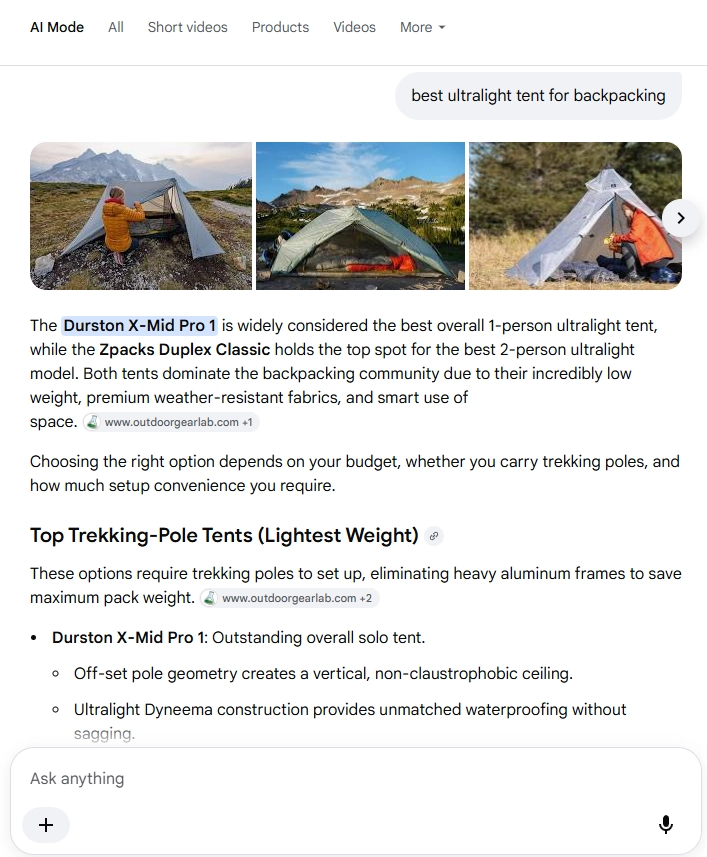
On ChatGPT’s Shopping Assistant, users run full conversational research sessions without leaving the chat.
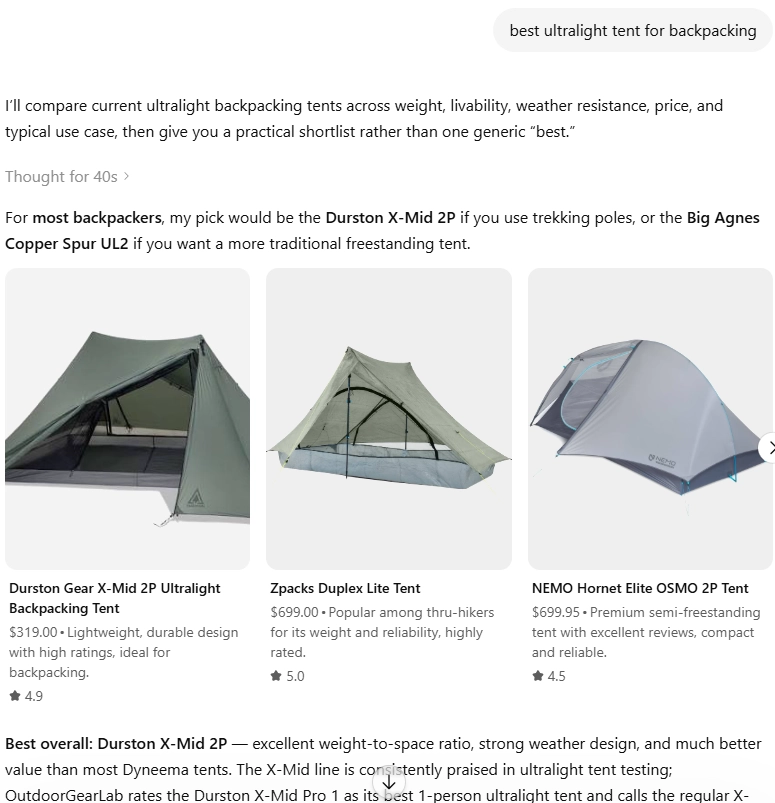
On Perplexity Shopping, product carousels come with clearly sourced results.
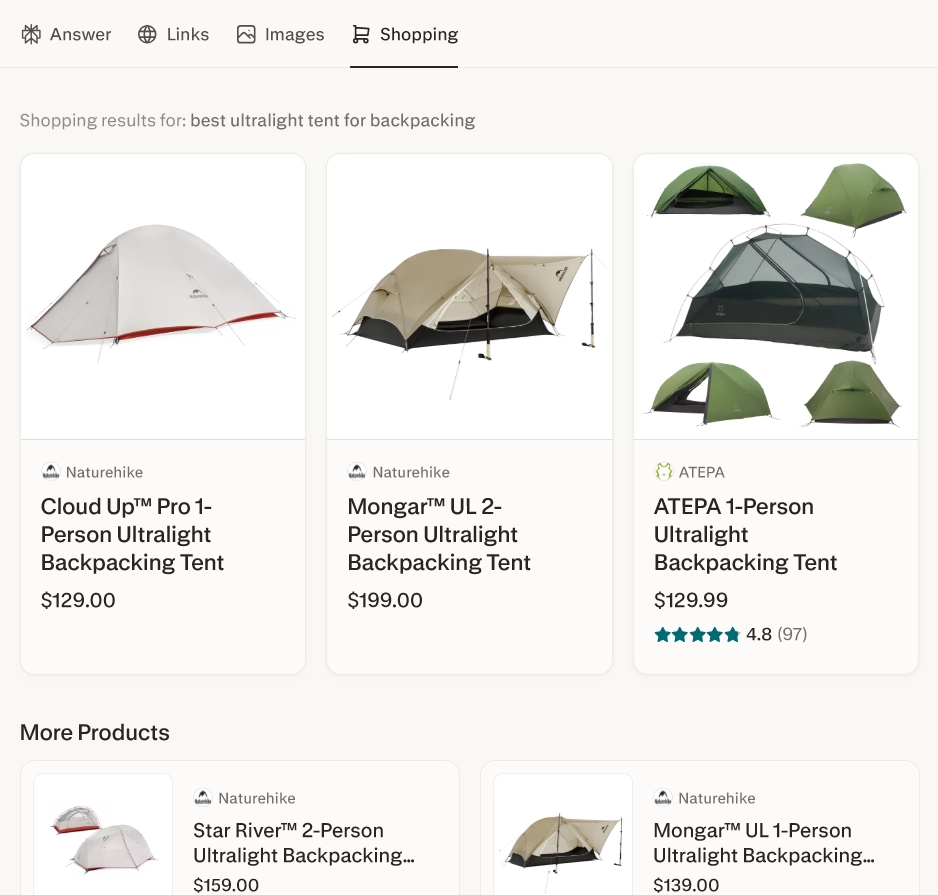
This is the new shelf. Products that do not appear here when buyers are researching are simply absent from the consideration set.
eCommerce Product Pages and Commercial Intent
That same shift plays out differently lower in the funnel, where buyers already know roughly what they want to buy. When a user types a high-intent query into Google (for example, one containing buy), what they see is product grids with advanced filtering, not organic links, and often not AI Overviews either. The Google Shopping layer dominates the commercial SERP.
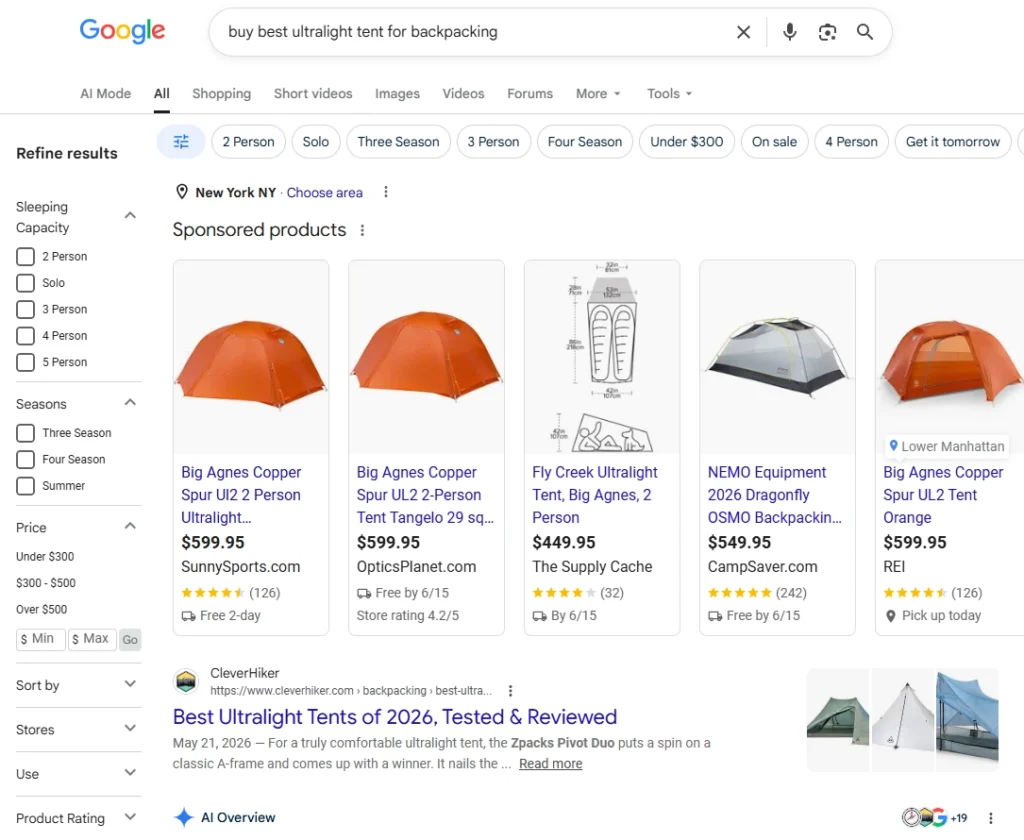
What this means is that a perfectly optimised product page can still lose out if the structured product data feeding into Google Shopping surfaces is incomplete. Page optimisation and data optimisation are separate problems, and both need attention.
eCommerce GEO: The Technical Blueprint
Closing that data gap starts with three technical fundamentals. Everything else in eCommerce GEO builds on these:
- AI bot access: can AI crawlers actually reach the store?
- Structured data: is the product data giving AI the signals it needs?
- Product feed optimisation: is the product data accurate, complete, and machine-readable?
Pillar 1: AI Crawlability and Technical eCommerce SEO
Crawlability is the foundation. If AI bots cannot reach a product page, they cannot index, understand, or surface it. That sounds straightforward (and it is), but the most common crawl blockers are not where people expect to find them.
robots.txt is the right starting point but it is not the full picture. Blocks regularly appear at deeper layers of the crawl stack, and several of them are silent: the bot appears to be allowed in robots.txt but the request never reaches the page.
So for an eCommerce website that strives to appear in AI results, the technical SEO audit needs to cover the full infrastructure, not just the surface layer.
| Layer | Common Issue |
|---|---|
| Hosting provider | Infrastructure-level restrictions that bypass robots.txt entirely |
| CDN / Cloudflare WAF | AI bots silently blocked despite being allowed in robots.txt |
| robots.txt | Key bots blocked, or allowances missing |
| Product page | Staging environment access rules carried into production |
Try SUSO’s AI Search Visibility Checker
💡 SUSO’s free tool provides an initial read on AI visibility and surfaces accessibility blockers before a full technical audit.
Pillar 2: Structured Data for eCommerce Product Pages
Once a store is reachable, the next question is what AI finds when it lands there: structured data. The relationship between schema markup and AI visibility in eCommerce needs careful framing. Two pieces of current evidence:
- Google’s AI Optimisation Guide (May 2026) states that schema is not required to appear in AI results. AI can extract from well-structured content without it.
- Ahrefs research found no significant correlation between schema markup and increased AI citations.
So the case for product schema in eCommerce is not about citations. For SEO on eCommerce product pages, the goal is product visibility in Shopping surfaces. Product schema powers Rich Results and unlocks full-featured merchant listings. Those surfaces are increasingly connected to AI-powered discovery, particularly in Google’s AI Mode. That is the chain that matters.
Don’t implement product schema expecting more AI citations. Implement it because AI shopping experiences rely on those product signals.
Filip Ruprich, Chief Performance Officer, SUSO
Product schema properties for eCommerce SEO
In practice, that means prioritising a handful of properties over a blanket implementation:
| Property | Why It Matters | Example |
|---|---|---|
| name, image, sku | Core identification | “Nike Air Zoom Pegasus 41” |
| offers | Pricing and availability | £129, In Stock, 2-day delivery |
| aggregateRating, review | Trust and CTR signals | 4.8/5 from 1,200 reviews |
| hasVariant, ProductGroup | Consolidates product variants | Same t-shirt in S/M/L, 6 colours |
| isSimilarTo | Surfaces alternatives in AI results | Stanley Quencher ↔ Yeti Rambler |
| isAccessoryOrSparePartFor | Product relationships | Laptop charger → MacBook Pro |
| additionalProperty | Decision-making attributes | Waterproof, BPA-free, Material: Steel |
| FAQ / inline Q&A | Conversational search queries | “Will this fit a 15-inch laptop?” |
The most commonly overlooked properties are isSimilarTo, hasVariant, and isAccessoryOrSparePartFor. These help AI understand what is related, what works together, and what serves as an alternative: context that is increasingly valuable in conversational shopping scenarios.
Product image optimisation for AI search
Schema covers structured product data. The other half of that picture is visual, and it matters just as much for discoverability as for conversion. A generic stock photo with a machine-generated filename and no alt text is basically invisible to visual search. A well-optimised product image should have:
- A descriptive filename (not IMG_4832.jpg)
- Meaningful alt text
- High resolution with multiple angles where relevant
- The image property linked in Product schema
Pillar 3: Google Merchant Center and Product Feed Optimisation
Schema and imagery shape what AI understands on the page itself. The data feeding shopping surfaces sits one layer further back. Google Merchant Center (GMC) is no longer just the infrastructure behind shopping ads. AI systems now verify stock levels, pricing, and shipping speed directly from product feeds, without the user visiting the store. A product with stale pricing, inaccurate inventory, or incomplete attributes may be deprioritised or dropped from AI-generated results entirely.
GMC optimisation checklist:
- Real-time stock accuracy (AI deprioritises out-of-stock products)
- Competitive pricing (AI compares across merchants)
- Shipping speed (faster fulfilment may rank more prominently)
- Accurate product attributes: title, GTIN, category
New: Google Merchant Center conversational feed attributes
In May 2026, Google introduced a set of supplemental feed attributes that most stores have not yet implemented. These sit on top of a standard Merchant Center feed and give AI systems richer product context. They can be submitted via a supplemental feed (TSV/XML/Sheet) or the Merchant API.
| Attribute | What It Captures | Example |
|---|---|---|
| question_and_answer | Q&A pairs for long-form queries (highest leverage) | “Is it dishwasher safe?” → “Yes, top rack only.” |
| document_link | Links to supporting documentation | Size guide, care instructions, spec sheet |
| related_product | Complementary items | Coffee machine → matching descaler |
| item_group_title | Human-readable variant group name | “Organic Cotton Men’s T-Shirt” |
| variant_option | How a variant differs | Colour: Forest Green · Size: M |
| popularity_rank | Relative bestseller signal | 95.5 (top seller) vs 34.1 |
The question_and_answer attribute is the highest-leverage entry point. It lets you pre-feed AI the exact questions shoppers ask and the answers you want it to provide (“Is this waterproof?” or “How long does the battery last?”), rather than leaving that to inference. Most stores have not implemented these yet, making it a clear early-mover opportunity.
You’re effectively feeding AI the exact questions your customers may ask and the answers you want it to give. That’s incredibly useful for conversational shopping.
Filip Ruprich, Chief Performance Officer, SUSO
Agentic Commerce and the Universal Commerce Protocol
Bot access, schema, and a clean feed are the groundwork. What they increasingly feed into is full transactional AI, known as agentic commerce. The Universal Commerce Protocol (UCP) is Google’s open eCommerce standard that enables AI agents to find products, apply discounts, and complete purchases, moving beyond reading product data into actively supporting transactions.
What AI agents can do inside UCP today:
- Purchase directly inside Google AI Mode and Gemini (no click to your site required)
- Pay via tokenised checkout through your existing payment stack
- The merchant stays as the Merchant of Record, retaining the customer relationship and data
On the roadmap:
- Build and edit multi-item carts in conversation
- Link loyalty and account programmes
- Handle post-purchase flows: tracking and returns
How to get started with UCP and agentic commerce
Google provides documentation for how to implement the Universal Commerce Protocol. Here are the essential steps to get started:
| Step | Action |
|---|---|
| 1 | Prepare Merchant Center: feed, shipping, and returns in good standing |
| 2 | Join the UCP waitlist and await Google approval |
| 3 | Set up Google Pay for checkout via Google Wallet |
| 4 | Publish your UCP profile so Google can locate your endpoints |
| 5 | Build native checkout: create, update, and complete sessions |
| 6 | Choose identity method: guest checkout or account-linked sign-in |
| 7 | Sync orders: push status updates back to Google |
UCP access is not automatic. It requires waitlist approval, and a self-serve integration tab in Merchant Center is currently US-only in a limited pilot. If this is on the roadmap, the time to apply is now.
What Merchant Center needs for UCP
Step one above, preparing Merchant Center, breaks down into five concrete requirements:
| Requirement | Detail |
|---|---|
| Baseline | Account in good standing; products approved for free listings |
| Return policy and support info | Required at account level |
| native_commerce attribute | Opts each product into agentic checkout. Missing or false = excluded. |
| consumer_notice | Required for products with regulatory warnings |
| merchant_item_id | Maps feed ID to Checkout API ID where they differ |
Product types not eligible for UCP checkout
Not every product can use this flow yet. The following categories are excluded for now:
- Subscriptions and instalment plans
- Personalised or made-to-order goods
- Used, refurbished, and no-return items
- Pre-orders and bundled services
- Age-restricted and prohibited categories
- Services, rentals, digital goods, and virtual goods
The practical takeaway on UCP: focus on strong data foundations now. Merchant Center in good standing and a clean product feed are both the UCP baseline and the precondition for strong AI performance more broadly. Full UCP implementation can follow as consumer adoption matures. Even ChatGPT pulled back its in-chat purchasing feature after limited uptake.
Shopify & AI Search: The Agentic Sales Channel
Everything in the blueprint above applies across platforms. Shopify gets its own chapter because it has built agentic discovery directly into the platform, with its own catalogue, dashboard, and diagnostic tools. This chapter covers how those Shopify-specific tools work, with input from Mack Johnson, Director of Commerce at eHouse Studio, a Shopify Platinum Partner.
How Shopify’s agentic commerce channel works
As of 1 May 2026, Shopify’s agentic sales channel is automatically enabled on all eligible live stores. No setup required. Shopify treats this as a core channel alongside the traditional online store, POS, and B2B, connecting products to AI-powered shopping surfaces such as ChatGPT, Microsoft Copilot, Google’s AI Mode and Gemini.
To access it, go to Settings → Sales Channels → Agentic, or append /mappings/shopify-catalog-mapping to the admin URL.
The agentic dashboard shows:
- Sessions and revenue attributed to AI channels
- Test query results: how products actually appear in AI chat search
- Completeness scores with deficiencies flagged against Shopify’s global catalogue top ten
Shopify also offers an Agentic plan for brands not running a full Shopify storefront. As long as products are in the catalogue and meet eligibility requirements, brands can participate in AI-driven product discovery without a full platform migration.
The Shopify catalog and AI search optimisation
That agentic dashboard runs on a single underlying system, so it is worth understanding what is actually in it. The Shopify catalog is a standardised, machine-readable index of every eligible product across Shopify’s merchant base. When AI surfaces product recommendations, it queries this catalog in real time: pricing, availability, variants, product relationships. If the data is accurate and complete, AI platforms can find and recommend the product. If it is messy, incomplete, or absent, the product is either invisible or misrepresented.
Every Shopify store is automatically included. Whether what is in there actually performs well is a separate question entirely.
The gap between ‘yeah, we’ve got product data’ and ‘our product data is actually working for us in AI, and we know it is’ is where most brands are sitting right now, and they don’t know it.
Mack Johnson, Director of Commerce, eHouse Studio
By default, Shopify maps product title, description, and category into the catalogue representation. That is fine as a baseline. The problem is that most product descriptions were written for a human browsing a traditional product page, not for the conversational queries AI is now fielding. Queries like “blue jeans under £80 with free shipping arriving in two days” or “a cosmetic bag as a gift for a work colleague” were never the target when that copy was written. If those intent signals are absent from the data, the product will not show up for those queries.
When data is incomplete, Shopify attempts to fill gaps using AI inference. If the underlying inputs are vague or off-purpose, the inference will be equally vague, and the brand loses control of how its products are represented.
Thoughtfully mapped data puts you in control, rather than leaving it to chance.
Mack Johnson, Director of Commerce, eHouse Studio
AI store optimisation: Shopify completeness checks
Shopify scores all of this automatically. The agentic dashboard runs completeness checks against four baseline factors, and flags exactly where a store falls short:
| Factor | What Shopify Checks |
|---|---|
| Description length | Sufficient detail to match conversational queries |
| Image count | Multiple images covering angles and variants |
| Review volume | Quantity of customer reviews |
| Average rating | Aggregate trust signal |
Store policies (returns, shipping) are also checked.
In practice, most stores pass on descriptions and policies. Images and reviews are where the gaps consistently appear. A single product image and a handful of reviews (or none) will knock products out of the global top ten results, even when everything else is solid. Both are fixable, and the dashboard surfaces exactly which products need attention.
Using the Shopify catalog query tool
For a more hands-on view of the same gap, Shopify also provides a catalog query developer tool. It lets you run real queries against the full Shopify catalogue and see the exact output an AI agent would receive. Type in a shopper’s query, and Shopify returns a JSON output showing whether the store’s products rank in the global top ten, why or why not, and what the competing products that do appear look like.
This is the most direct diagnostic available. It shows the gap between what a merchant believes their catalog says and what an AI agent actually sees, including which fields Shopify is inferring rather than reading from structured data.
Example: an apparel brand queries “five-panel hats under $25” and sees their products’ position, the specific data gaps affecting their ranking, and the competing listings that outrank them.
Common eCommerce GEO pitfalls on Shopify
Run that query tool against enough stores and the same five issues turn up again and again.
1. Empty category metafields
When a product is assigned to a category taxonomy, Shopify automatically generates suggested metafield values: colour, materials, style, and other product-specific attributes. Those suggestions sit unactioned until someone accepts them. The taxonomy gets assigned; the metafields stay empty. These fields are exactly what help AI understand the specific context of a product, not just its name.
2. Weak or mismapped product descriptions
Descriptions written for traditional product pages tend to lead with specifications (“100% cotton, machine washable”). AI search queries are intent-driven and occasion-based (“perfect for gifting”, “suitable for sensitive skin”). If that language is absent from the product data, the product is invisible to those queries.
3. Non-standard product titles
Titles that work well in brand-led editorial (creative, evocative, non-taxonomic) can undermine AI’s ability to categorise and match products to structured queries. Titles need to follow a predictable format aligned to how shoppers search.
4. Fragmented variants
Variants set up as separate products rather than grouped correctly make it harder for AI to understand the full product offering and present it accurately. A shopper asking for “the grey version” of a product should not be sent to an unrelated listing.
5. Missing intent keywords
Product data needs to contain the language of intent, not just specification. If the data does not include signals like “gift”, “travel-size”, “quick-dry”, or “eco-friendly”, those queries will not return the product, even if it is objectively a good match.
Measuring eCommerce AI Search Performance
Fixing the pitfalls above is half the job. The other half is knowing whether the fixes are actually working, which comes down to three places to check.
Step 1: Technical eCommerce SEO audit for AI bot access
Auditing a store’s AI search optimisation starts with the full crawl stack. Confirm access for:
- GPTBot
- GPT-User
- OAI-SearchBot
- Googlebot
- Gemini-Deep-Research
- PerplexityBot
- Perplexity-User
- ClaudeBot
- Claude-User
- Claude-SearchBot
Then check for silent blocks in CDN/WAF rules (Cloudflare in particular), confirm hosting provider defaults are not restricting AI crawlers, make sure that robots.txt allows AI bots, and verify that staging access rules have not carried over to production.
💡 SUSO’s free AI Search Visibility Checker provides an immediate read on a brand’s AI visibility and surfaces potential technical blockers before a full audit.
Step 2: Search Console reports for eCommerce product pages
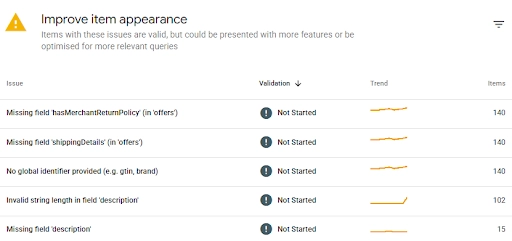
With bot access confirmed, the next check is whether the structured data behind those pages is actually valid. Search Console offers the most direct health check for structured product data, even though it is not built for AI-specific reporting. Three reports are relevant:
| Report | What It Shows |
|---|---|
| Product Snippets | Confirms Product structured data is valid |
| Merchant Listings | Confirms full-featured merchant listing data is valid |
| Merchant Opportunities | Flags missing merchant data (delivery policy, returns, payment methods) |
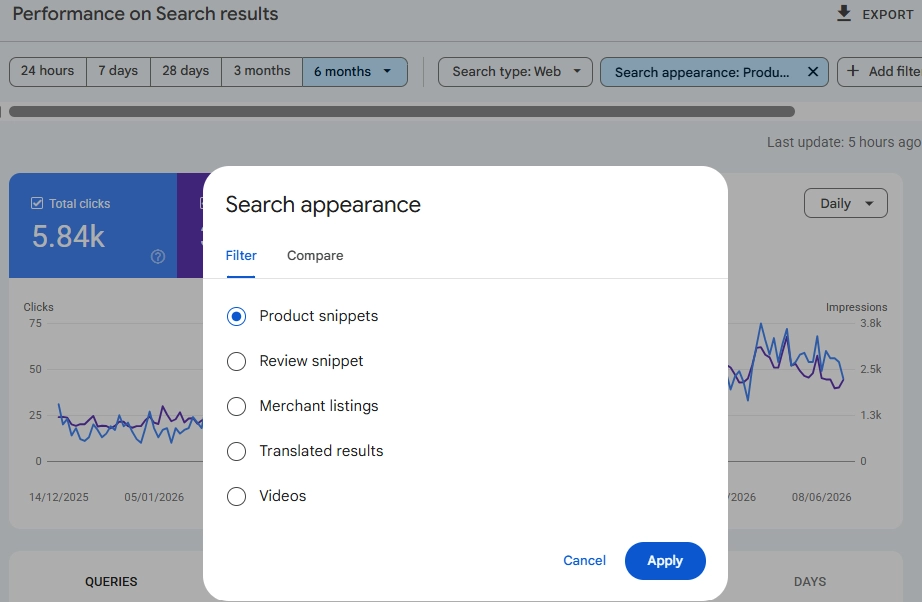
Filtering the Performance report by Search Appearance gives click and impression data broken down by rich result type. Use this to track whether structured data improvements are moving CTR, and to identify which pages and queries are generating rich results.
Step 3: Product analytics in Merchant Center
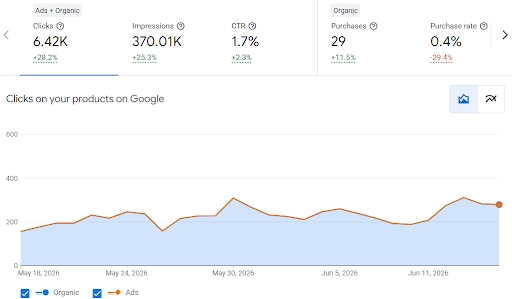
Search Console confirms the data is structured correctly. Merchant Center goes a step further and shows whether it is actually performing. The product analytics report surfaces signals that directly inform both data quality and wider catalogue strategy.
| Signal | Action |
|---|---|
| Popular now and trending up | Keep in stock. Fix any “needs attention” flags immediately. |
| Trending down | Investigate early before the drop compounds. |
| High impressions, low CTR | Review the image, title, and price against competing listings. |
| Organic vs ads, online vs local | Segment to isolate what is actually driving demand. |
Upcoming AI search measurement tools for eCommerce
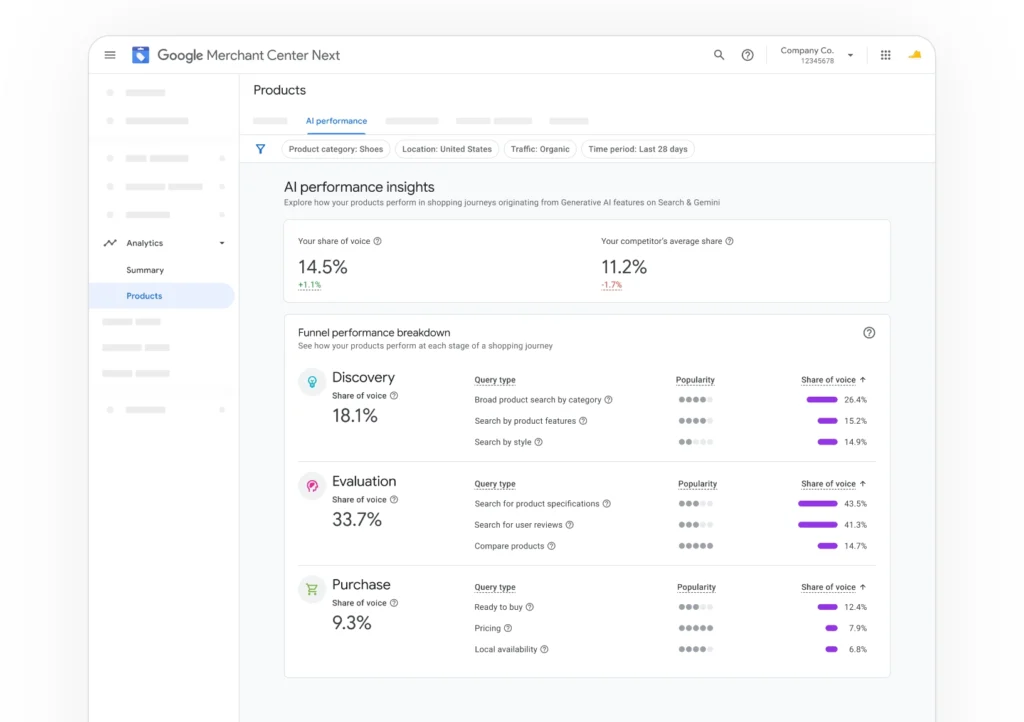
Everything above is built for shopping ads and structured data rather than AI specifically, which makes it necessarily indirect. That is starting to change. Two measurement tools currently in rollout will make AI-specific performance data more visible:
- Google AI Performance Insights (Merchant Center): direct visibility into product performance across AI-generated results.
- Shopify Agentic Readiness: Shopify’s own assessment of how prepared a store is for agentic commerce. Available at shopify.com/agentic-readiness.
Want more insights into GEO?
Join the SUSO Partner Club
It gives agencies access to free AI visibility audits, private workshops, and direct access to our SEO and GEO team.
FAQs
-
What is eCommerce GEO?
Ecommerce GEO (Generative Engine Optimisation) is the practice of making online stores and product data visible and understandable to AI-powered search platforms: Google’s AI Mode, Gemini, ChatGPT, and Perplexity, among others. Where traditional SEO is concerned with ranking in organic blue-link results, eCommerce GEO is about appearing in AI-generated product summaries, recommendations, and agentic shopping experiences.
-
How is eCommerce GEO different from traditional eCommerce SEO?
Traditional eCommerce SEO focuses on ranking for keywords in Google’s organic results. eCommerce GEO focuses on making product data accessible and understandable to AI systems that generate answers and recommendations directly. The biggest practical difference is that AI does not just crawl pages: it queries product feeds, reads structured data, and verifies information without the customer visiting the site at all. Page-level optimisation still matters, but it needs to be paired with clean product data and feed accuracy.
-
Does schema directly improve AI citations for eCommerce stores?
No. Google’s AI Optimisation Guide confirms that schema is not required to appear in AI results, and Ahrefs research found no significant correlation between schema and AI citation rates. For eCommerce, product schema matters because it powers Rich Results and Shopping surfaces that feed into AI discovery, not because it generates citations directly.
-
What is agentic commerce? Do I need to prepare my store for it now?
Agentic commerce refers to AI agents that can complete product purchases autonomously on a user’s behalf: finding products, comparing prices, and checking out without the user visiting a retailer’s site directly. Google’s Universal Commerce Protocol and Shopify’s agentic channel are the two primary live implementations. Consumer adoption is still early, but the data foundations required for agentic commerce (clean Merchant Center feeds, accurate product data) are also the foundations for strong AI search performance today. Preparing now serves both goals.
-
If a store is on Shopify, is it already set up for AI search?
Shopify stores are in the agentic catalog by default, which is a head start. Being in the catalog and performing well in it are different things. Most stores have incomplete category metafields, product descriptions that do not map to conversational queries, and limited image and review coverage. The agentic dashboard and catalog query tool show exactly where the gaps are.
-
Can brands be part of Shopify’s catalog without a full Shopify storefront?
Yes. Shopify’s agentic plan allows brands that do not run a full Shopify storefront to participate in AI-driven product discovery, provided products meet eligibility requirements. It is a lower-barrier entry point than full platform migration.
-
How do we check which AI bots can crawl a store?
Make sure that AI bots are allows in robots.txt, check WAF rules at the CDN level (Cloudflare is the most common source of silent blocks), and confirm hosting provider defaults. SUSO’s free AI Search Visibility Checker is a practical first step before running a full technical audit.
-
What are conversational feed attributes in Google Merchant Center?
They are a set of supplemental attributes submitted alongside a standard Merchant Center feed to give AI additional product context. The most valuable is question_and_answer, which lets merchants pre-answer the questions shoppers are likely to ask (“Is this dishwasher safe?”, “Does this come in wide fit?”), rather than leaving AI to infer. Other attributes cover related products, variant descriptions, documentation links, and popularity signals. Most stores have not implemented these yet.
-
How is eCommerce AI search performance measured right now?
Current tools: SUSO’s AI Search Visibility Checker for an initial visibility read, Search Console shopping reports for structured data health, and Merchant Center product analytics for feed performance and demand signals.
Google Analytics also shows traffic, revenue and conversions directly attributable to LLMs in the Traffic Acquisition report filtered down to the AI Assistant Channel. You can also use the Attribution Paths report to see if AI traffic participated in a conversion path when a conversion got attributed to another source. This is provided you have conversions tracking set up properly.
Google’s AI Performance Insights (rolling out in Merchant Center) will add more direct AI-specific measurement as they become widely available.
If your online store is a part of the Shopify catalog and , you should also be able to how many sessions and what revenue is attributed to AI channels. Additionally, Shopify offers a catalog query developer tool that allows testing whether your products appear for your target conversational queries when checked against the entire Shopify catalog. And finally, Shopify provides an Agentic Readiness assessment tool for testing individual product pages.
-
Should eCommerce stores invest in blog and editorial content for AI search?
Yes. Semantic and conversational search means product discovery is frequently also brand discovery. A shopper asking questions about products in your niche is often also a potential buyer, and the store with the most detailed, contextually rich answer to that question builds the trust signal AI needs to recommend it with confidence.
The highest-value content for eCommerce is experience-led: product comparisons, expert reviews, use cases, original research. The closer the content is tied to specific products and buying decisions, the more useful it is for AI referral. Basic informational topics are lower priority.
-
If a customer completes a purchase through AI Mode without visiting the site, what data does the merchant receive?
The order and shipping data needed to fulfil the purchase comes through. What is lost is the analytics layer: pixel data, session duration, source attribution, and the broader behavioural data typically captured through a site visit.