

Your target audience is asking AI platforms questions and acting on the answers they get. If your brand is not cited in ChatGPT, Gemini, Perplexity or Claude, it simply doesn’t register. The shift from traditional Google rankings to AI-generated answers has changed the rules of search visibility, and most brands haven’t caught up yet.
If you’ve been treating AI search as a passing trend, Google Search recent updates should be the signal that changes your mind. AI Overviews and AI Mode are no longer features sitting above the results; they are the results. Google’s biggest search overhaul in 25 years restructured the entire search engine results page around AI. If your brand isn’t part of the answer, you may not be visible at all.
That’s exactly why AI search visibility checkers exist. We tested 10 of the best tools available, ran them through a rigorous scoring framework across 9 weighted categories, and ranked them so you don’t have to guess which one is worth your time.
One thing we want to disclose upfront: the SUSO Digital AI Search Visibility Checker, one of the tools analyzed here, is our own product. We’re open about that in the SUSO section, where we walk through why we think the score holds up. Every tool here was assessed using the same methodology, the same test brand, and the same 9 weighted categories.
Quick Comparison: Top AI Search Visibility Checkers at a Glance
Ready to see how LLMs view your brand, if they mention it at all? Here’s a quick breakdown of the top 10 AI visibility checkers we reviewed:
| # | AI Visibility Checker | Score | Award | Free Access | Live Testing |
| 1 | SUSO Digital | 80 | Best overall AI search visibility checker | Email-gated | ✅ |
| 2 | Rankability | 71 | Best single-prompt AI search report | Email-gated | ✅ |
| 3 | Amplitude | 71 | Best large-sample prompt analysis | Limited free | ❌ |
| 4 | HubSpot | 67 | Best AEO / reputation snapshot | Email-gated | ❌ |
| 5 | Ahrefs | 62 | Best quick brand visibility check | Demo-gated | ❌ |
| 6 | Semrush | 60 | Best SEO-suite checker | Demo-gated | ❌ |
| 7 | Neil Patel | 57 | Best custom prompt/location checker | Credit-limited | ✅ |
| 8 | Mangools | 47 | Best multi-model snapshot | Demo-gated | ❌ |
| 9 | Am I Visible on AI | 44 | Best technical accessibility check | Fully free | ❌ |
| 10 | Featureon | 43 | Best live single-prompt checker | Demo-gated | ✅ |
What Does an AI Search Visibility Checker Actually Do?
When you type a query into Google, what you get is a list of ranked pages. Every click, position, and impression is also tracked in Search Console and conveniently available for marketers to analyse.
When someone asks ChatGPT or Gemini a question, the LLM synthesises an answer that is based on training data, real-time web searches, and source authority. Your brand either appears in that response, or it doesn’t.
What AI Visibility Tools Actually Measure
Ultimately, every AI visibility tool checks for one thing: whether your brand is mentioned by an AI platform. However, tools that we’ve reviewed go further and tell you:
- Which AI platforms mention your brand (ChatGPT, Gemini, Perplexity, Claude, Grok, and others)
- How often your brand appears across a sample of relevant prompts
- What AI says about you — whether it’s positive, neutral, or framing you in a way you wouldn’t choose yourself
- Who else is being mentioned alongside you — or instead of you
- Which sources AI is citing when it mentions your brand or your competitors
- Whether your website is technically accessible to AI crawlers at all
An Important Caveat: AI Visibility Results Are Inherently Variable
Before you invest time in any of these tools, there’s something worth understanding clearly: AI search results are not stable in the way Google rankings are.
Ask ChatGPT the same question 100 times, and you’ll get 100 different answers. The brands mentioned, the order they appear in, and even whether your brand is cited at all can change from one query to the next, even in the same location, at the same moment in time. This isn’t a flaw, it’s just a fundamental characteristic of how large language models generate responses.
Research published by SparkToro found that AI systems are highly inconsistent when recommending brands or products. Across nearly 3,000 runs of 12 different prompts through ChatGPT, Claude, and Google AI, SparkToro found that the number of unique brands recommended varied dramatically from run to run.
For some prompts, every response produced a different list. The same brand could appear in 80% of answers for one prompt and 12% of answers for a semantically similar one.
For a deeper look at what this variability means in practice and how earned media connects to AI visibility, watch this clip from one of our webinars:
How We Evaluated These Tools
We ran all 10 tools against the same brand (Nike) inputs and scored each one across 9 categories. Every score in this review is based on direct hands-on testing.
| Category | Weight | What it measures |
| Result Depth & Evidence | 20% | Granularity of results, citations shown, prompt-level detail, sentiment analysis |
| Access & Friction | 15% | Free access type, whether sign-up is required, setup speed |
| Data Infrastructure / Provider Trust | 15% | Platform maturity, methodology transparency, established data ecosystem |
| AI Platform Coverage | 10% | How many AI platforms are checked |
| Live Testing | 10% | Does the tool query AI systems in real time, or rely on estimates? |
| Competitive Insight | 10% | Quality and depth of competitor comparison |
| UX, Methodology & Reuse | 10% | Ease of use, methodology explanation, repeatability across brands |
| Actionability | 5% | Does the tool tell you what to improve, or just show the score? |
| Export & Shareability | 5% | PDF export, shareable URLs, social sharing options |
The 10 Best AI Search Visibility Checkers
1. SUSO Digital AI Search Visibility Checker — Score: 80/100
| Best for | Agencies and in-house teams that need the most complete free audit with live testing, sentiment, citations, competitor data, and a PDF report in one place. |
| Pricing | Free (email-gated). Paid SEO agency services available on request. |
We want to be upfront: this is our own tool. SUSO Digital built the AI search visibility checker you’re looking at, and yes, it came first.
The scoring framework was identical for every tool: 9 weighted categories, one consistent test brand (Nike), hands-on testing across all 10 checkers before any rankings were set. SUSO scored 80/100 because it delivered the most in Result Depth & Evidence, the highest-weighted category at 20%, producing live prompt-level breakdowns, sentiment analysis, citation tracking, and competitor comparison in a single free report. That combination wasn’t available in any other free tool we tested. It’s a measurable output: run the checker yourself and see what it produces.
The level of output available at no cost here would sit comfortably behind a paywall on most competitor platforms.
How it works
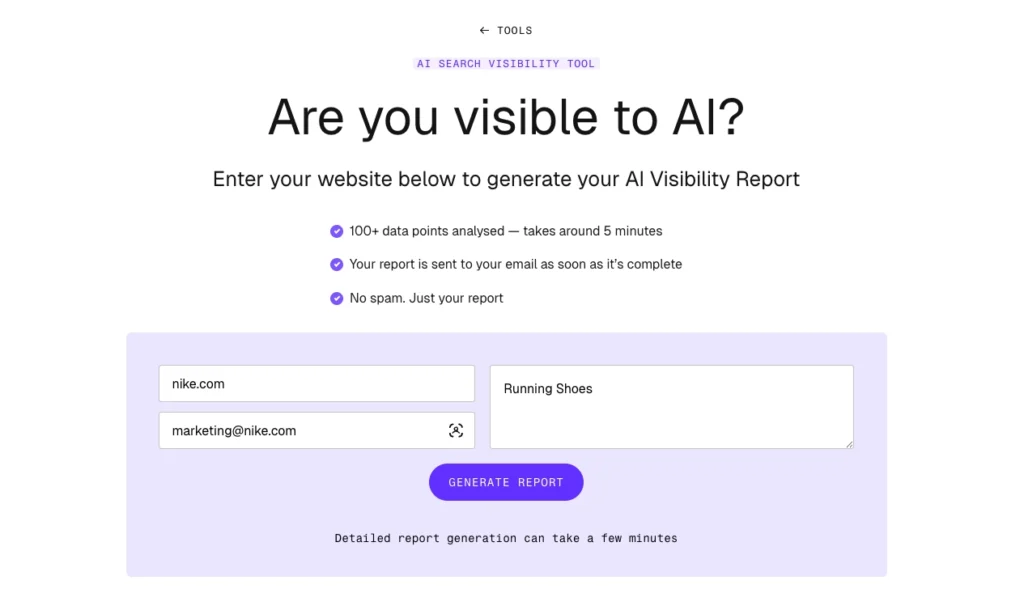
You enter your website URL, your company email, and optionally, the products or services you want AI to find you for. SUSO runs 20 live queries across ChatGPT, Perplexity, Gemini, and Claude, then delivers results both on-page and directly to your inbox as a PDF report.
What you get
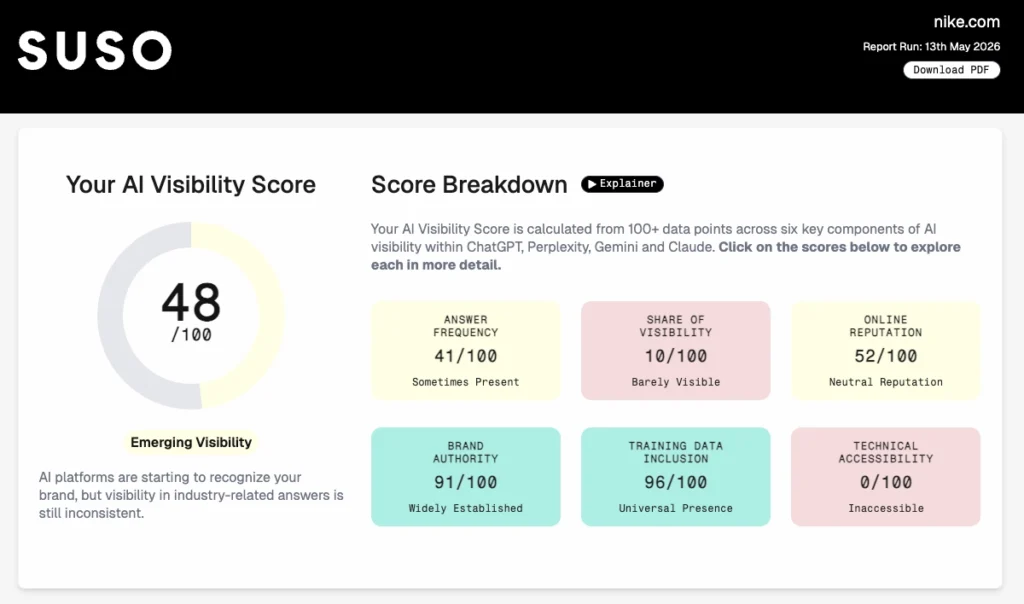
The output is most detailed of any tool we tested, providing:
- Visibility scoring with a detailed breakdown of your brand’s AI presence
- Prompt-level insights showing the exact questions used and how your brand appeared in each response
- Citation and source tracking revealing which URLs and sources AI platforms rely on to justify their answers
- Sentiment analysis assessing whether your brand is portrayed positively, negatively, or neutrally
- Competitor comparisons highlighting which brands appear alongside yours in AI-generated responses
- PDF export functionality for easy sharing with clients, stakeholders, or internal teams
This level of detail makes it easy to move beyond basic visibility tracking and understand why your brand is, or is not, showing up in AI search results.
What makes it stand out
SUSO Digital’s AI visibility checker is a free tool that performs live testing with sentiment analysis, citations, competitor comparison, and detailed prompt-level reporting in a single report. The fact that results are also emailed means you have a dated record of your AI visibility at the time of testing, which is useful for tracking change over time.
Limitations
In order to get results, you need to provide your company email address, and the checker doesn’t let you choose specific AI platforms to test or custom prompts.
2. Rankability Free AI Search Visibility Checker — Score: 71/100
| Best for | Teams that need a polished, instantly shareable AI visibility report for clients or stakeholders. |
| Pricing | Free checker (email-gated). |
Rankability is an SEO and content platform that offers a free AI Search Visibility Checker, delivering valuable insights with a single prompt.
How it works
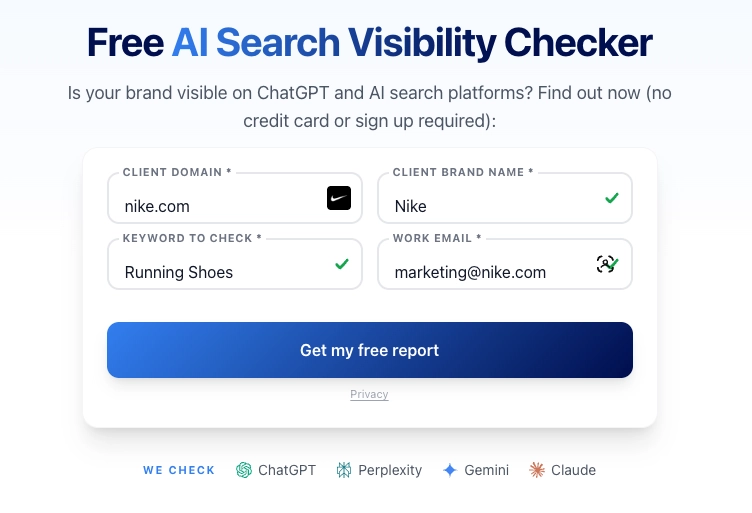
Enter your domain, brand name, keyword, and work email to initiate one live query across ChatGPT, Perplexity, Claude, Grok, Google AI Overviews, and Google AI Mode, and returns a detailed report. Results are delivered on-page and emailed.
What you get
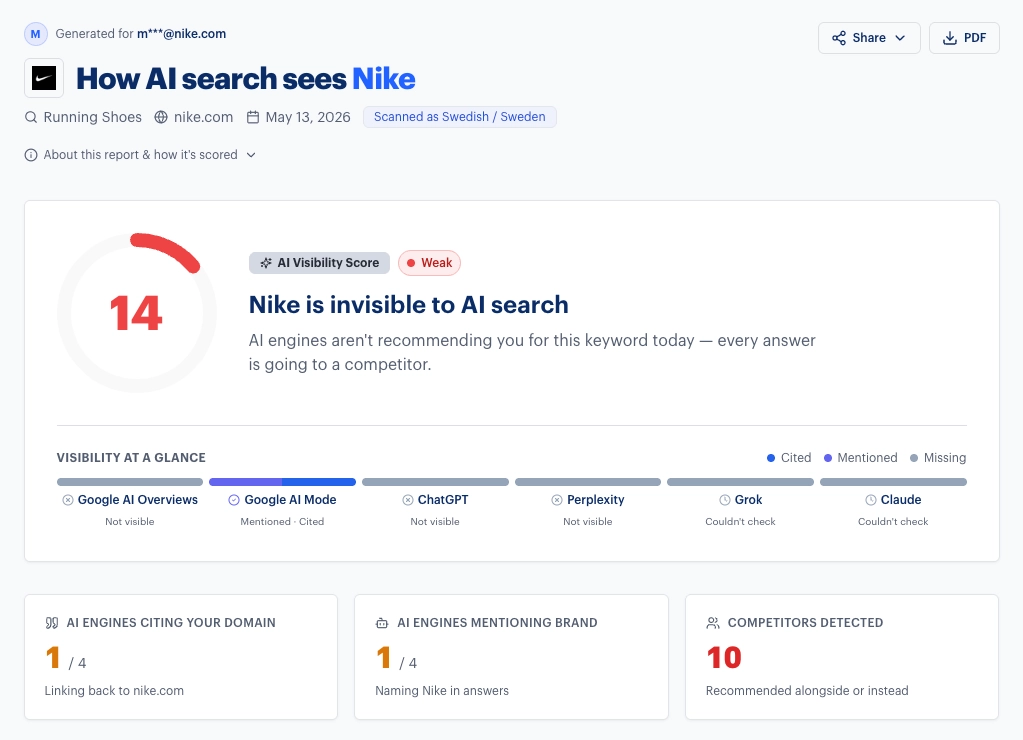
A visibility score, citation data showing which sources the AI platforms are pulling from, and a well-structured single-prompt report. Where Rankability is genuinely best-in-class is export: you can share results via a unique URL, download as PDF, email directly from the tool, or share to LinkedIn and X.
What makes it stand out
Rankability covers 6 AI platforms, including Google AI Overview and Google AI Mode, which provides broader coverage than almost any other free tool. The sharing options are also a standout feature if you need to present AI visibility findings to a client or stakeholder quickly.
Limitations
The core limitation is the single-prompt scope. Given the high variability of AI responses, a single prompt gives you one data point in a probabilistic system. For a quick shareable proof-of-concept, it’s excellent; for a meaningful audit, pair it with a tool that tests a larger prompt sample.
3. Amplitude AI Visibility Checker — Score: 71/100
| Best for | Enterprise SEO teams and anyone who needs the most statistically meaningful free prompt sample. |
| Pricing | Free (no sign-up required). |
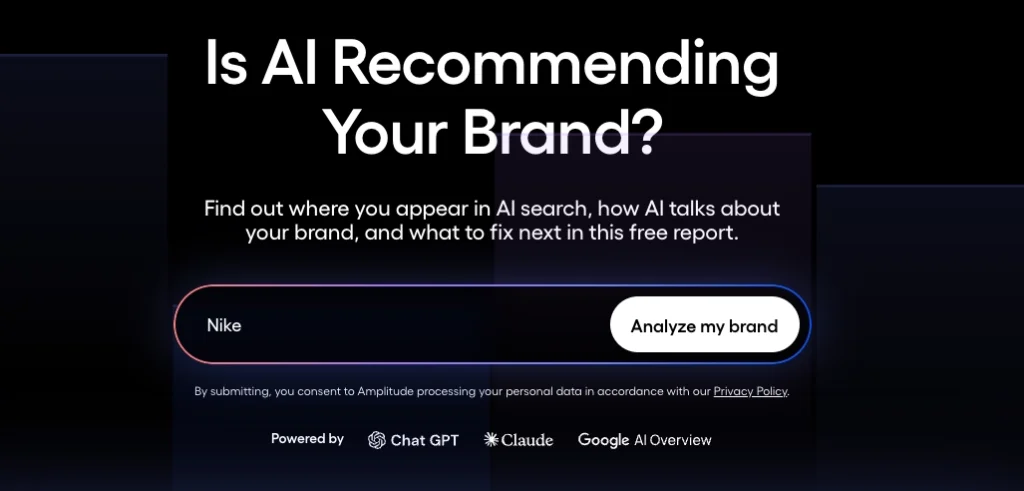
Amplitude is best known as a product analytics platform; hence, its AI visibility checker takes a different approach to the tools on our list. Instead of a quick snapshot, it runs your brand against 225 prompts, producing the most statistically robust free analysis available.
How it works
You only need to enter your company name, and Amplitude will run its analysis across ChatGPT, Claude, Gemini, and Google AI Overviews using 225 prompts and return results directly on the page with a shareable URL.
What you get
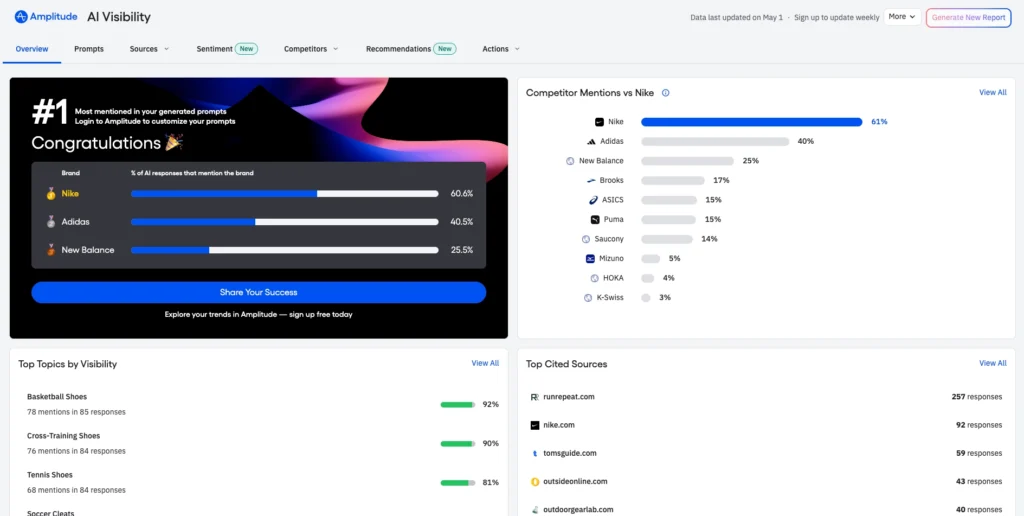
The report contains prompt-level detail across a massive sample, sentiment, competitor comparison, and citation tracking, showing which sources are being referenced.
What makes it stand out
Amplitude has the most prompts used in the checker, with Mangools next at 35. This matters because AI responses are variable, meaning the same question asked twice will have different answers, and a brand’s visibility score can look very different depending on which prompts you use.
Limitations
Amplitude doesn’t offer a visibility score, so the data you receive is up to your interpretation. There’s also no live testing, and the analysis is based on modelled estimates rather than real-time AI queries. No mobile support, and no explanation of the methodology. For a marketer who wants a number they can put in a slide deck, this requires more interpretation than most.
4. HubSpot AEO Grader — Score: 67/100
| Best for | PR and comms teams focused on brand reputation and sentiment rather than traditional SEO metrics. |
| Pricing | Free (email-gated, no credit card). The paid HubSpot AEO monitoring tool starts at $50/month standalone, or is included in Marketing Hub Pro and Enterprise plans. |
HubSpot built its AEO (Answer Engine Optimisation) Grader, which frames AI visibility explicitly through a reputation and brand positioning lens.
How it works
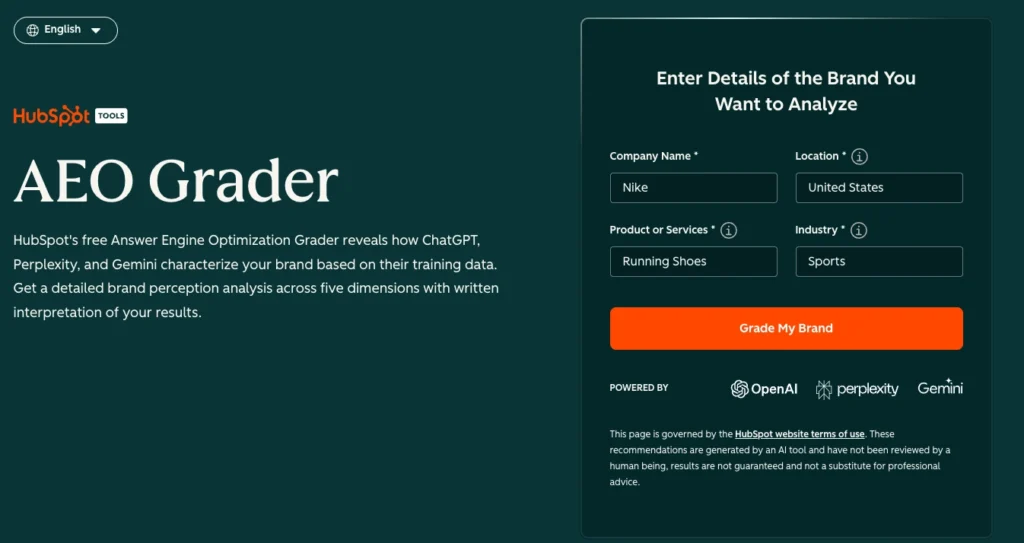
To get results, you need to provide your company name, location, product or services and industry. HubSpot runs its analysis across ChatGPT, Gemini, and Perplexity, and delivers an on-page report with a breakdown of how each LLM sees your brand.
What you get
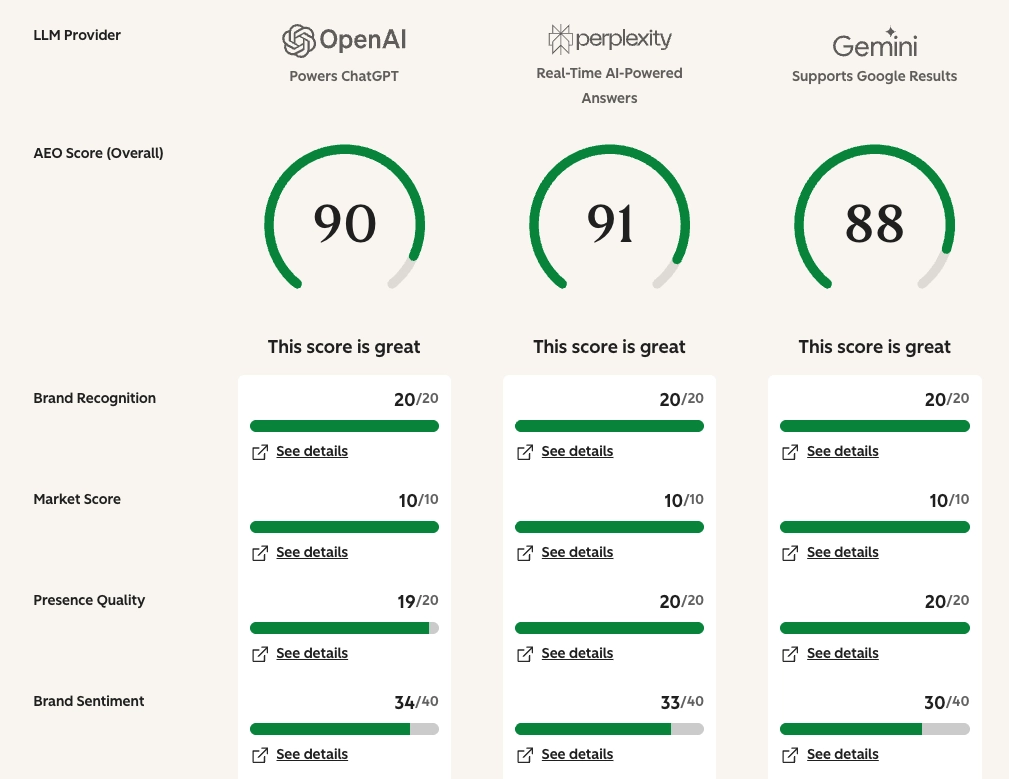
HubSpot’s AEO Grader provides a clear breakdown of a visibility score, sentiment and reputation analysis, and competitor comparison. The tool also offers export options, including both PDF and a shareable URL.
What makes it stand out
It’s one of only two tools (alongside SUSO Digital) that delivers both a score breakdown and sentiment analysis. These are the two things that matter most if you’re approaching AI visibility from a brand reputation angle rather than a pure SEO angle. The HubSpot platform trust also adds credibility to the output for clients and stakeholders who recognise the brand.
Limitations
The input is heavier than most tools, requiring the information about location, products, services and industry to run an analysis. This may add friction if you’re running multiple checks. Another disadvantage is that the analysis is not live, and the prompt count is not specified, making it harder to assess the audit’s accuracy.
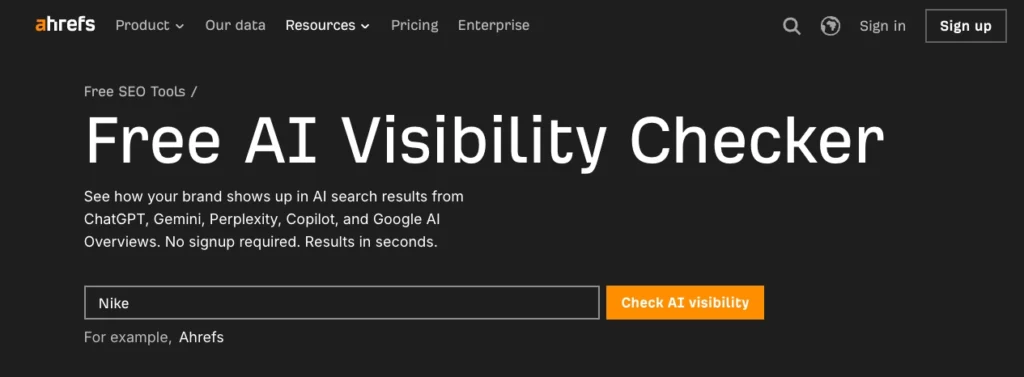
5. Ahrefs AI Visibility Checker — Score: 62/100
| Best for | Quick, zero-friction multi-brand checks requiring no account and no email. |
| Pricing | Free limited checker (no sign-up required). Ahrefs paid plans start at $50/month for a Basic package and go up to $700/month for full access to Brand Radar AI. |
Ahrefs is one of the most established and trusted names in SEO data. Its AI Visibility Checker is the leanest tool in this list that provides results in seconds and with no sign-up required. If you need a fast, credible answer and don’t have time to fill in a form, this is the tool to reach for.
How it works
Simply enter your brand name, and the tool will run its analysis across ChatGPT, Gemini, Perplexity, Copilot, Google AI Mode, and Google AI Overviews. The result is an almost-instant snapshot on the page, which you can share via a unique URL.
What you get
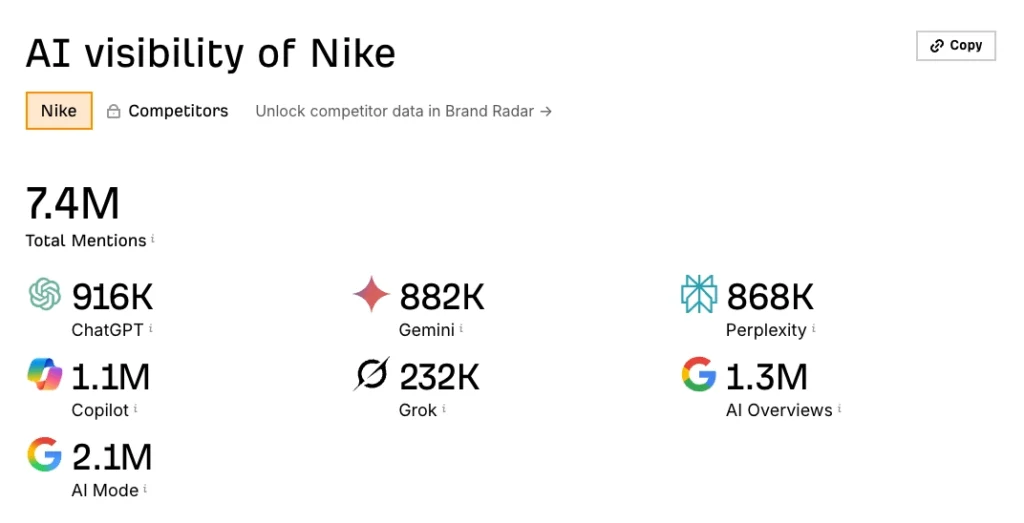
What you get is a brand visibility snapshot across six AI platforms, with citations and sources shown. The result comes back in a few seconds.
What makes it stand out
Ahrefs offers the broadest AI platform coverage of any tool tested across six platforms, including Microsoft Copilot, which almost no other free tool checks. Combined with zero friction (no email, no sign-up, no account), it’s the most repeatable tool for quick multi-brand checks.
Limitations
The output is intentionally limited to a broad overview rather than a detailed analysis. There’s no visibility score, competitor comparison, sentiment analysis, or prompt-level detail. This is more of a gut-check tool, not an audit tool. If you need to understand why your brand is or isn’t appearing, or what to do about it, you’ll need to combine this with a more detailed tool.
6. Semrush AI Search Visibility Checker — Score: 60/100
| Best for | SEO teams already in the Semrush ecosystem who want a fast score and competitor snapshot without leaving the platform. |
| Pricing | Free limited checker with a daily 3-check cap (no sign-up required). The main AI Visibility Toolkit costs $99/month. |
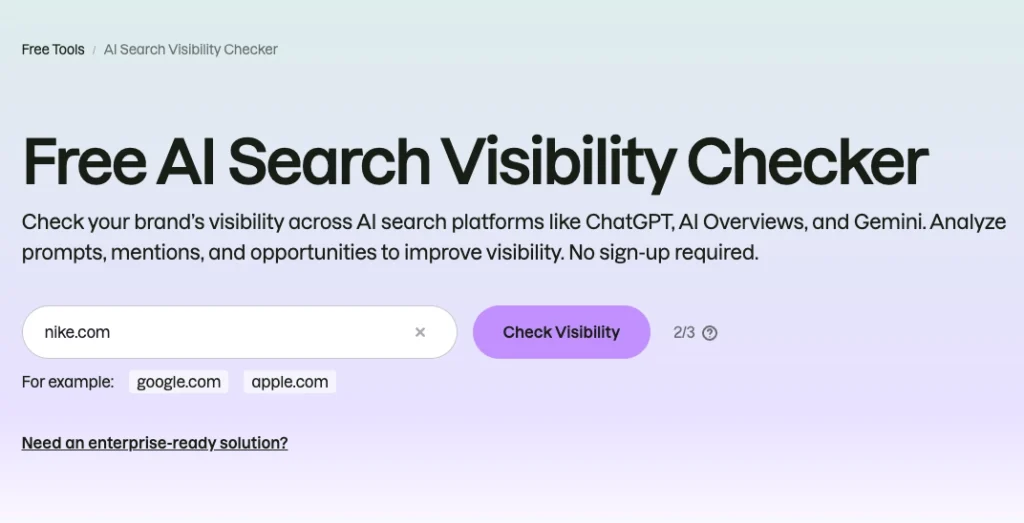
Semrush is the other major SEO platform in this list, and its AI Search Visibility Checker takes a similar quick-snapshot approach to Ahrefs, but adds a visibility score and competitor comparison that Ahrefs doesn’t provide. The trade-off is a daily check limit (3 times per day) and no citation detail.
How it works
Enter your website URL and hit “Check Visibility.” There is no sign-up required. Semrush will then check ChatGPT, Google AI Overviews, and Gemini, and will provide a score and a competitor comparison on-page instantly.
What you get
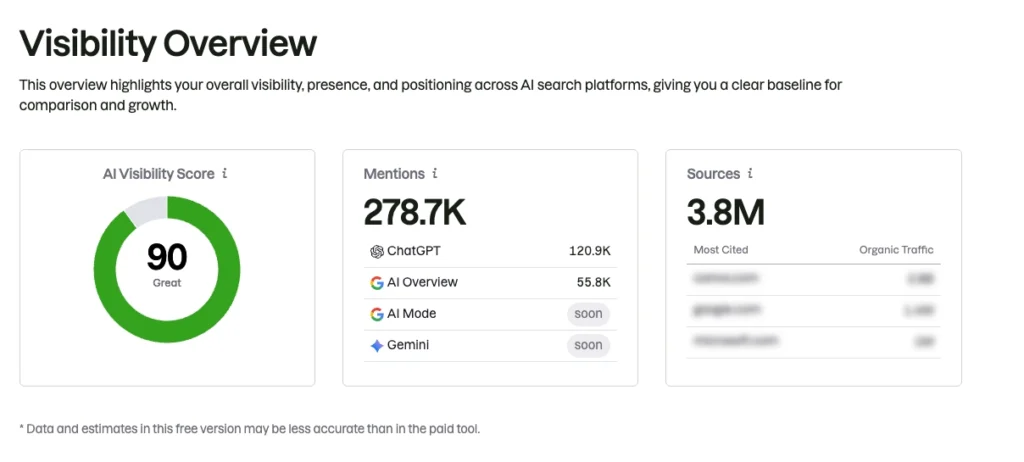
Your snapshot will contain a visibility score and a competitor comparison showing how your brand stacks up against similar companies in AI responses. Results are on-page with no export options.
What makes it stand out
It’s the lowest-friction tool that provides both a score and competitor comparison from a platform that SEO teams already trust.
Limitations
The three-check daily cap is the most significant practical constraint for agencies or teams checking multiple brands. Output is high-level only: no citations, no prompt detail, no sentiment, no export. And three platforms (ChatGPT, Google AI Overviews, Gemini) are a narrower view than most tools in this list.
7. Neil Patel AI Search Visibility — Score: 57/100
| Best for | Local, multilingual, or niche brands that need to test AI visibility in a specific location, language, or with custom prompts. |
| Pricing | Free tier with limited credits (account required). Paid plans starting at $12/month that include 10 prompts a month to $40/month with 20 prompts. |
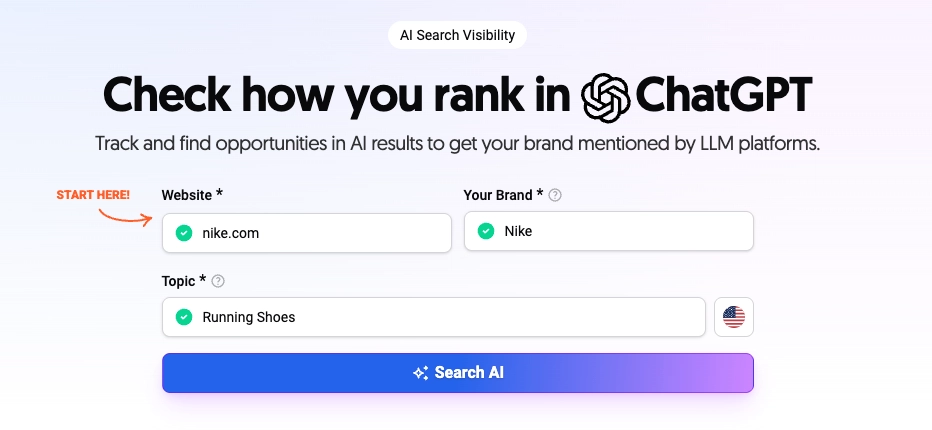
Neil Patel’s platform takes a different angle from every other tool in this list. Where others run a fixed set of AI platforms with auto-generated prompts, Neil Patel lets you specify your topic, location, and language. Additionally, the tool lets you input your own custom prompts. For brands with local or international audiences, this is the only free tool that genuinely addresses their needs.
How it works
To run an AI visibility check, you first need to create a free account with limited credits, and then enter your website, brand name, topic, location, and language. Neil Patel runs 10 live queries across ChatGPT and Gemini, and returns the results on-page.
What you get
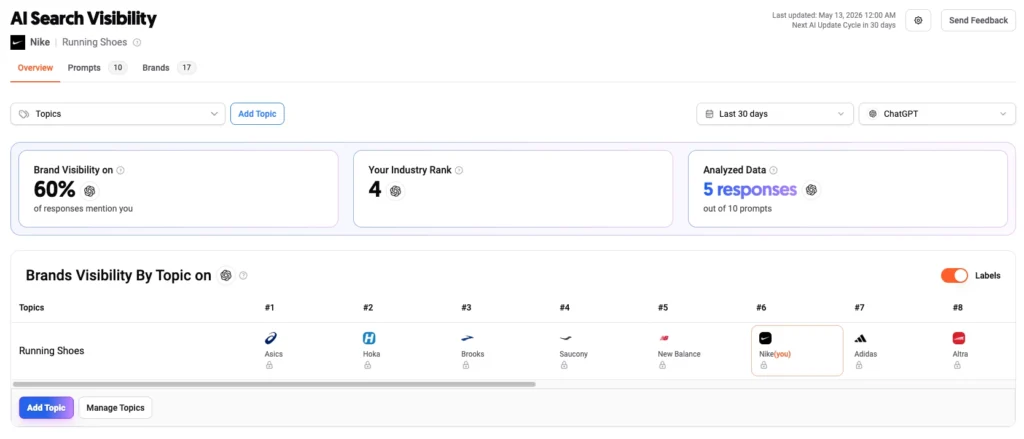
You get a prompt-level detail, competitor comparison, citations, and moderate result granularity. Worth noting that the custom prompt feature is unique, and no other tool in this list lets you test the exact questions your audience is actually asking.
What makes it stand out
Location and language targeting, combined with custom prompt input, make this the only tool suited to local SEO, multilingual brands, or any business where the AI search context is specific rather than generic. If you want to know whether you appear when someone in a specific city asks a specific question, this is the only free tool that can answer it.
Limitations
The fact that you need to create an account and operate on a credit system adds the most friction of any tool we tested. Platform coverage is limited to ChatGPT and Gemini, far narrower than most competitors’. The custom prompt advantage doesn’t compensate for missing major platforms like Perplexity or Claude.
8. Mangools AI Search Grader — Score: 47/100
| Best for | Technical and developer-adjacent brands that need to check visibility across non-mainstream AI models, including DeepSeek, Mistral, and Llama. |
| Pricing | Free checker (no sign-up required). Mangools paid plans start at $30.50/month or $18.85/month (annual) for the full SEO suite. |
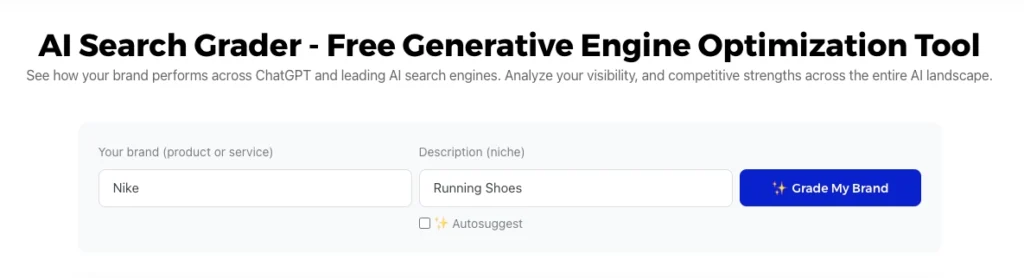
Mangools is another well-regarded SEO toolset, and its AI Search Grader takes a different approach by prioritising broad AI model coverage over deep analysis. It’s the only free tool we tested that checks 7 AI models in a single scan: ChatGPT, DeepSeek, Claude, Grok, Gemini, Mistral, and Llama.
How it works
Mangools doesn’t require a sign-up, but asks for your brand name and niche. Then, it runs 35 prompts across its AI models and returns a visibility score and prompt-level breakdown on the page in seconds.
What you get
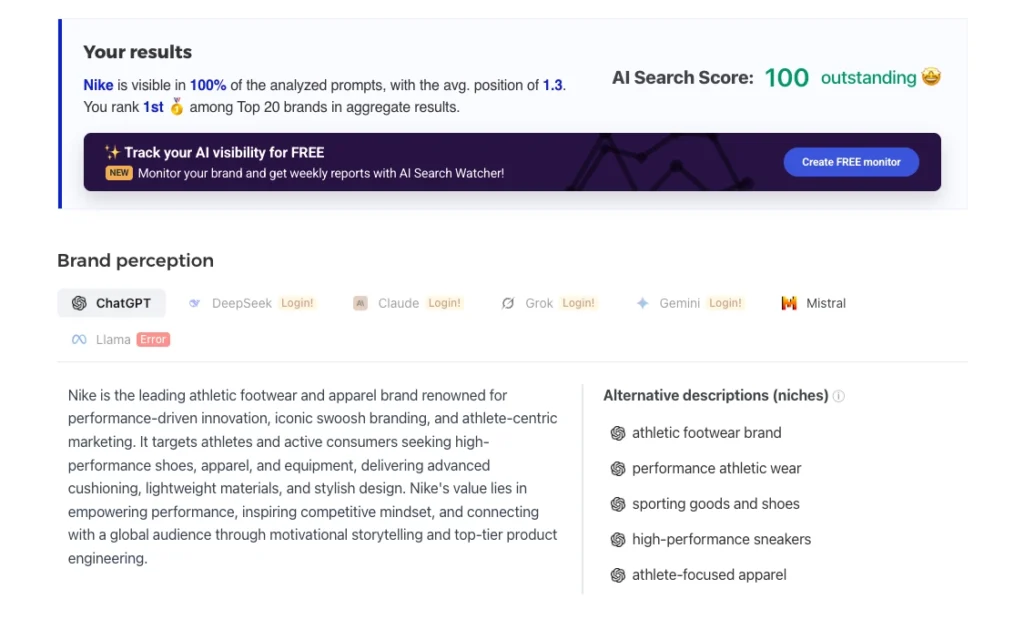
The report shows your brand’s visibility score, prompt-level detail across a broad range of AI model selection, and fast results with no friction. However, the results stay on the page, and they are not exportable.
What makes it stand out
No other free tool touches DeepSeek, Mistral, or Llama. For brands in technical or developer-adjacent markets, where these models have meaningful adoption, Mangools is the only way to check visibility without a paid subscription. For most mainstream brands, whether Llama or Mistral mentions them is a secondary concern; but for the right audience, this is uniquely useful.
Limitations
The audit doesn’t feature citations, competitor comparison, and cannot be exported. Despite the broad AI model coverage, the output is fairly surface-level. The 35-prompt sample is reasonable, but it’s modelled rather than live, so the results reflect an estimated visibility position rather than real-time AI responses.
9. Am I Visible on AI — Score: 44/100
| Best for | Checking AI crawler accessibility and technical visibility. |
| Pricing | Fully free. No paid plans; no sign-up, email, account, or usage limits required. |
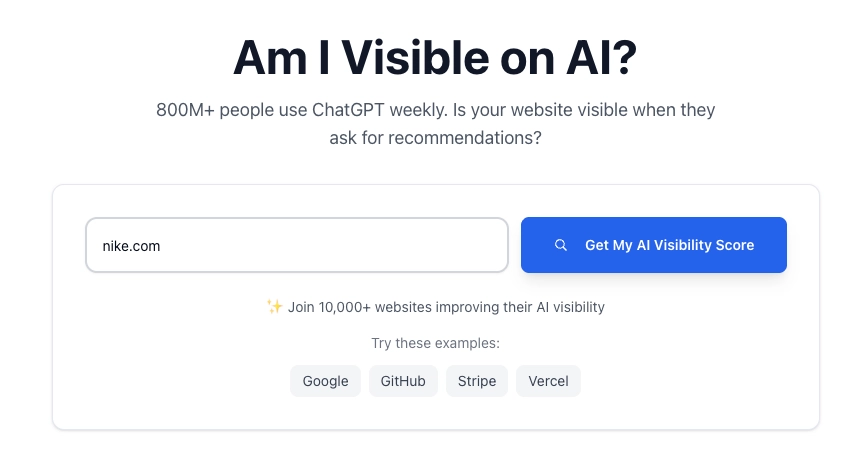
Am I Visible on AI is the only completely free tool on this list, with no email, sign-up, account, or usage limits required. Simply enter your website URL for an instant result. The trade-off is that it functions more as a technical accessibility audit than a true visibility checker, assessing whether your site is structured for AI platforms to crawl and index rather than whether it actually appears in AI-generated responses.
How it works
Enter a website URL, and wait for the tool to check ChatGPT, Claude, and Perplexity. Note that the tool doesn’t query AI models live, and it doesn’t run any prompts. Instead, Am I Visible on AI offers a technical audit rather than a response check.
What you get
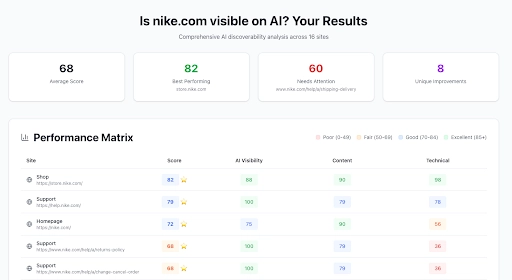
You will get a report available on the page almost immediately. It contains a simple visibility score, actionable recommendations, and an instant result without any obstacles.
What makes it stand out
Undoubtedly, the fact that you don’t need to share your work email, create an account, or be limited by credits is a big advantage. This tool is suitable for a quick first diagnostic before investing time in a more detailed checker. The actionable output is also a differentiator for a tool at this simplicity level.
Limitations
It’s important to understand what this tool is and isn’t. It doesn’t run prompts, it doesn’t check live AI responses, and it doesn’t tell you whether your brand is being mentioned in AI-generated answers. It’s a technical readiness check. If your score is low, it tells you your site has structural issues that could be limiting AI visibility, but a high score doesn’t mean you’re actually appearing in responses.
10. Featureon Free AI Visibility Checker — Score: 43/100
| Best for | Live, single-prompt AI visibility checks, especially useful for comparing real-time vs. cached results. |
| Pricing | Free tier with one check per 24 hours. |
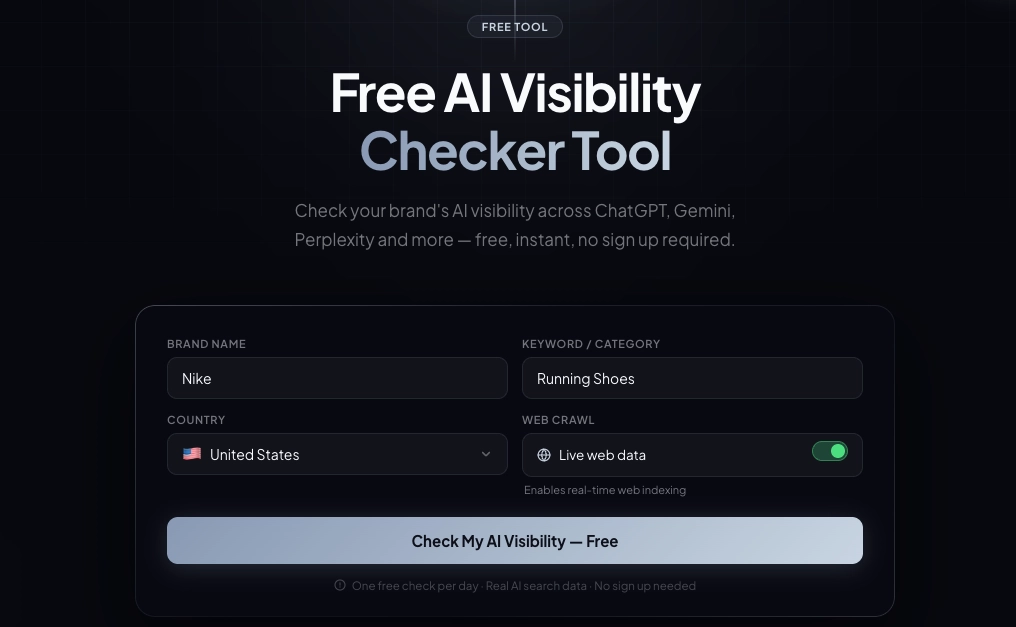
Featureon is the newest and least established platform in this list, but it offers something genuinely distinctive: the ability to toggle live data on or off, so you can see the difference between real-time AI responses and cached data for the same brand query.
How it works
Enter a brand name, category, country, and toggle live data on or off. Featureon runs one live prompt across ChatGPT, Perplexity, Gemini, and Claude, and returns results on-page. You will have one check available per 24 hours on the free tier.
What you get
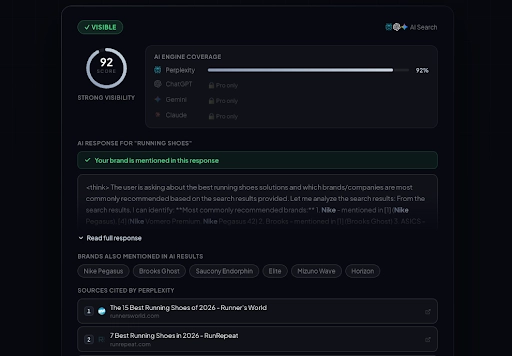
Your report will consist of a visibility score, prompt-level detail, and citation sources from a live AI query. The live/estimated toggle is a unique feature not available in any other tool.
What makes it stand out
The live/estimated toggle is genuinely useful for understanding the gap between what AI platforms say in real time versus what cached or modelled tools report. If you’ve seen a discrepancy between different tools’ results for the same brand, Featureon gives you a way to ground-truth it against a live response.
Limitations
The one-check-per-24-hours limit is the most restrictive cap in this list. No competitor data, no export, no methodology explanation, and limited platform infrastructure behind it.
Which AI Visibility Checker Should You Use?
No single tool does everything well, and each of them excels at something different. Here’s the fastest way to find your match:
- Need the most detailed free audit → SUSO Digital
- Want the fastest check with zero friction → Ahrefs
- Need to share results with a client or team → Rankability
- Care about sentiment and brand reputation → HubSpot
- Want the biggest prompt sample → Amplitude
- Testing a specific location or custom prompt → Neil Patel
- Want to cover the most AI models → Mangools
- Already using Semrush → Semrush
- Fully free, no strings attached → Am I Visible on AI
- Want to see live AI responses → Featureon
For agencies, the strongest combination is SUSO Digital for detailed audits and Rankability for client-ready shareable reports. For in-house SEO teams, SUSO Digital or Amplitude give the most data to work with. For PR and brand teams, HubSpot is the only tool that frames results in terms of reputation and sentiment as a primary output.
Why did Nike score 14 on one tool and 100 on another?
Because they’re not measuring the same thing, and that’s arguably the most important finding from our research.
When we ran Nike through all 10 tools, the scores ranged from 14/100 (Rankability) to 100/100 (Mangools). For context, Nike is one of the most recognisable brands on the planet. A perfect score and an “invisible” rating aren’t both right because they’re answering different questions.
Rankability tested Nike against a single live prompt: “Running Shoes.” On that specific keyword, AI engines weren’t recommending Nike, every response pointed to a competitor. So the score reflects Nike’s visibility for one transactional query, not its overall brand presence.
Mangools tested Nike across 35 prompts in the running shoes niche and found it present in 100% of them, ranked first with an average position of 1.3. Broader prompts, broader picture.
HubSpot, Semrush, and Featureon all scored Nike between 88 and 92, as you’d expect for a globally dominant brand. SUSO Digital returned 48/100, labelled “Emerging Visibility,” with a breakdown showing Brand Authority at 91/100 and Training Data Inclusion at 96/100, but Technical Accessibility at 0/100 and Share of Voice at just 10/100.
That last result is the most instructive. Nike scores near-perfect on brand recognition and training data, but poorly on whether it’s actually being cited in AI-generated answers to relevant queries. A tool that only measures brand awareness will score Nike 100. A tool measuring active citation share will tell a different story.
The takeaway isn’t that any tool is wrong, but before you interpret a score, you need to understand what that score is actually counting.
Conclusion
AI search visibility is no longer a speculative metric. It’s a real, measurable signal of how your brand is performing in the channel that’s increasingly shaping purchase decisions, brand perception, and organic reach.
Our testing made one thing clear: no single tool tells the full story. The good news is you can start measuring it immediately at no cost. SUSO Digital offers the most complete free overview, Ahrefs gives a quick, low-friction snapshot, and Amplitude provides the most statistically meaningful sample. Each tool on our list has a distinct strength depending on what you need to understand.
The brands that build a habit of measuring their AI visibility now will be the ones best positioned to act on it as the landscape matures.
FAQs
-
What is an AI search visibility checker?
An AI visibility checker is a tool that tests whether your brand appears across LLMs like ChatGPT, Gemini, or Perplexity. It shows you whether people ask AI platforms questions about your products or services. In contrast to traditional Google ranking, the AI visibility checker measures your presence in AI-generated responses.
-
Are AI visibility checkers actually free?
Not always. While some are fully free, some may require an email address or may be demo-gated. Others may operate on a credit system that limits how many checks you can run. None of the tools we tested requires a paid subscription to get an initial result, but tools like Ahrefs and Semrush are parts of paid SEO platforms; their AI visibility checkers are offered as free standalone tools, while full platform access is paid.
-
Do these tools test AI platforms in real time?
No, and this distinction matters more than most tool comparisons acknowledge. Only four tools in our test actually query AI systems live: SUSO Digital, Neil Patel, Featureon, and Rankability.
The other six use cached data, modelled estimates, or historical snapshots. A brand could appear “visible” in a live tool and “invisible” in an estimated tool for the same query, simply because of when the data was last refreshed.
-
How reliable are AI visibility scores?
This is the most important question to ask. AI systems are inherently variable, where the same prompt run multiple times will produce different brand recommendations each time. SparkToro’s research found significant inconsistency across nearly 3,000 AI responses, with some prompts producing a different brand list almost every time.
This means scores from any single test should be treated as directional indicators, not definitive rankings.
-
Which AI platforms do these checkers cover?
Coverage varies significantly, and no single tool covers every major AI platform. However, ChatGPT and Gemini are the most commonly covered across all tools.
Ahrefs has the broadest mainstream coverage, including Copilot and Google AI Mode alongside ChatGPT, Gemini, and Perplexity. Mangools is the only tool covering DeepSeek, Mistral, and Llama alongside the major platforms. Rankability is the only tool to include both Google AI Overviews and Google AI Mode.
-
Can I check a competitor’s AI visibility?
Partially. No tool currently supports running a fully independent audit on a competitor brand the way you would on your own.
Yet, several tools include automatic competitor comparison in their output. SUSO Digital, Semrush, HubSpot, Amplitude, Neil Patel, and Rankability all show competitor data alongside your own results. Only Amplitude lets you manually define which competitors to include.
-
How many prompts should a good AI visibility checker test?
The more prompts tested, the more representative and reliable the results. AI responses are variable, meaning the same question can produce different answers across different sessions.
Amplitude’s 225-prompt sample is the most statistically meaningful available for free. SUSO Digital’s 20 prompts and Mangools’ 35 are reasonable for a directional audit. Single-prompt tools like Featureon and Rankability give you one real-time data point.
-
What’s the difference between AI visibility and traditional SEO?
Traditional SEO focuses on ranking in Google’s top 10 results shown below any search. The metrics are position, impressions, and click-through rate, all trackable in Google Search Console.
AI visibility, on the other hand, is about whether AI systems cite, mention, or recommend your brand when generating responses to conversational queries.
-
Can a page rank well in Google but still be invisible in AI search?
Yes, high Google rankings don’t guarantee inclusion in AI-generated responses because AI systems use different ranking signals, including content quality, citations, E-E-A-T, and answer clarity.
-
How often should I check my AI search visibility?
AI models update frequently, cited sources rotate, and competitive positions shift. A monthly check is a reasonable baseline for most brands.
If you’re actively running an AEO (Answer Engine Optimisation) strategy, where you publish new content, build citation sources, and improve structured data, checking more every two weeks will help you see whether those efforts are moving the needle.
For brands with active PR programmes or that are in fast-moving competitive categories, weekly checks may be warranted.
-
What should I do if my brand isn’t visible in AI search?
The first step is diagnosing the cause, including whether your site is technically accessible to AI crawlers and whether competitors are being cited instead.
From there, the core levers include producing more authoritative, citation-worthy content that provides clear, direct information; building broader third-party mentions and references; improving your site’s structured data; and ensuring your brand is described consistently across the web.
-
Which AI visibility checker is best for agencies?
SUSO Digital is the strongest option for agency use. It combines detailed output, PDF export, and email delivery in a single report that’s client-ready without additional formatting.
Rankability is the best choice when you need to share results quickly and impressively, with PDF, shareable URL, email, LinkedIn, and X sharing all available from the tool itself.
Ahrefs is the most practical for high-volume multi-brand checks, given its zero-friction, no-sign-up flow. A combination of SUSO Digital for depth and Rankability for shareability covers most agency use cases.


