

Find out how to optimise your website content for Google’s new search feature: AI Overviews.
What Are AI Overviews?
Google’s AI Overviews are a new search feature that replaced the Search Labs experiment known as Search Generative Experience (SGE). The feature provides searchers with instant, AI-generated answers to certain queries, displayed at the top of other search results.
For example, if you search “best time to plant lavender” Google will display an AI-generated answer for you.
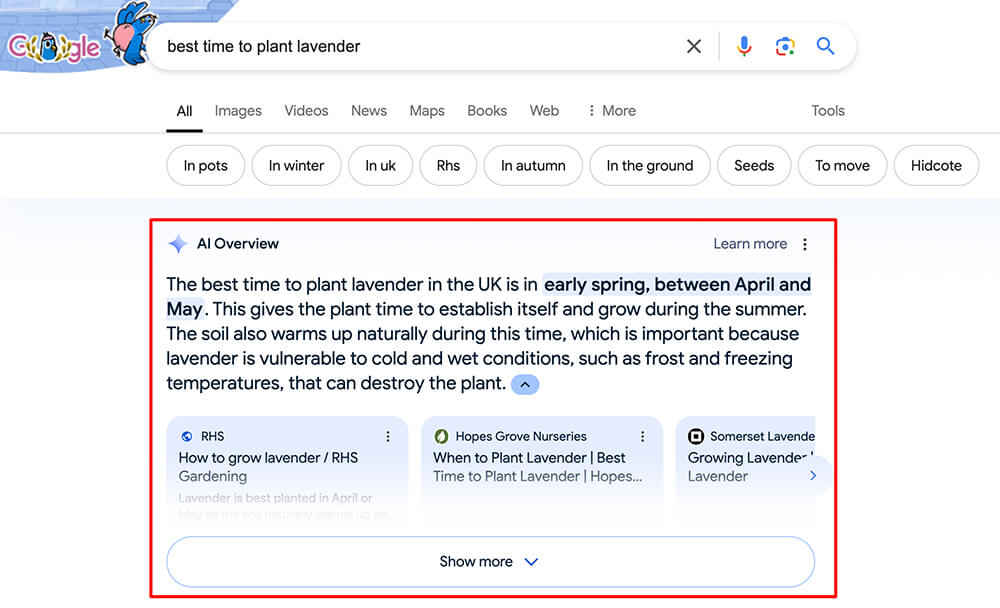
AI Overviews (AIO) essentially allows you to let Google do the Googling for you. It can take the user’s work out of searching by providing an AI-generated snapshot with key information and links to relevant sources for you to dig deeper.
The aim of AI Overviews (like it was with featured snippets and instant answers), is to provide users with quick answers to their questions so that they don’t have to browse through multiple websites.
How Does it Work?
The answers Google displays are created using advanced generative AI technology powered by Google’s Gemini language model.
Here’s a graphic which explains the process:
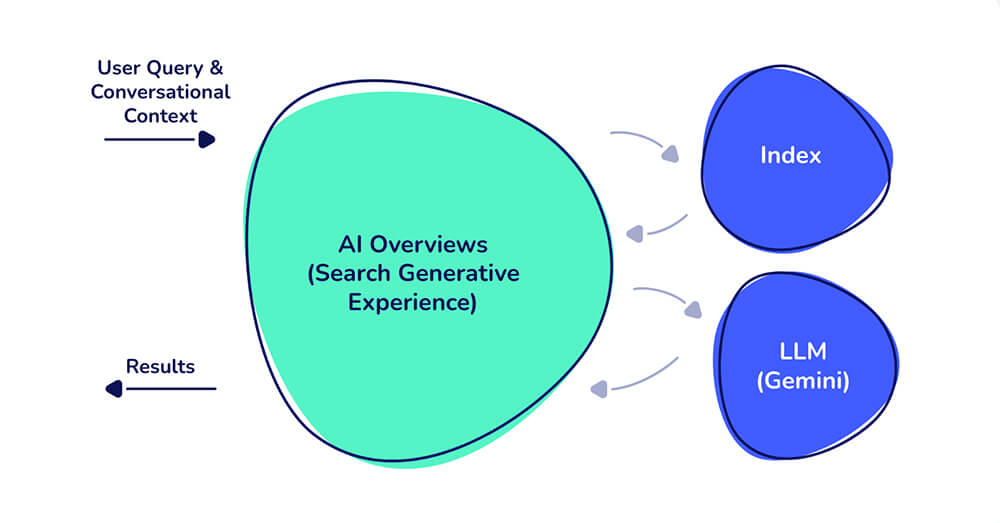
- Query Processing: When you type in a query, the AI processes your words and generates a text response, similar to how ChatGPT functions.
- Document Selection: Google’s algorithm then selects a small group of relevant web pages that contain information related to the generated response.
- Fact-Checking: These selected documents act as fact-checkers. If any information in these documents contradicts the AI-generated text, the AI adjusts its response accordingly. These are the “sources” you see in each response.
- Display Results: The results are shown to the user in the search results page.
The Three Components of AI Overviews
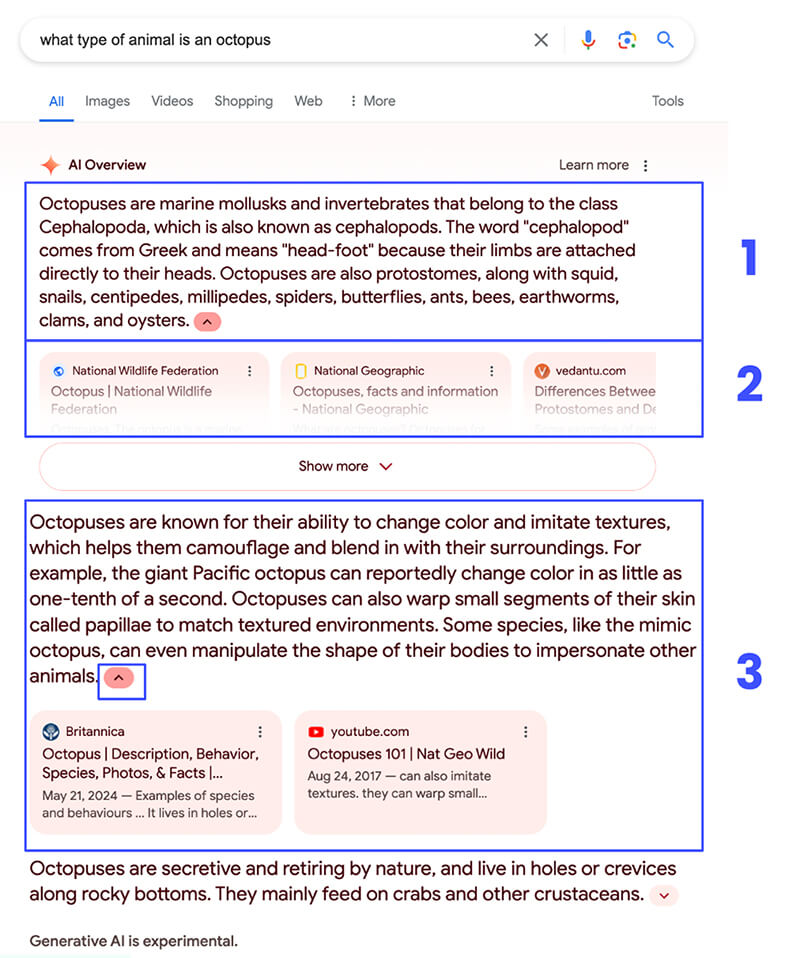
The AI-generated results comprise of three components:
- Answer – Provided by Generative AI (Gemini)
- Links – To some of the websites that show related information
- Drop Downs – Links to sites that corroborate the information from the AI-generated answer
Why Are Google’s AI-Powered Overviews Important?
Google’s AI-generated search results are important as they’re arguably the biggest transformation to the search results in over a decade.
The introduction of these new kinds of results will drastically impact how users search. For example, searchers will rely on AI Overviews to get answers for informational queries instead of clicking on the traditional organic search results.
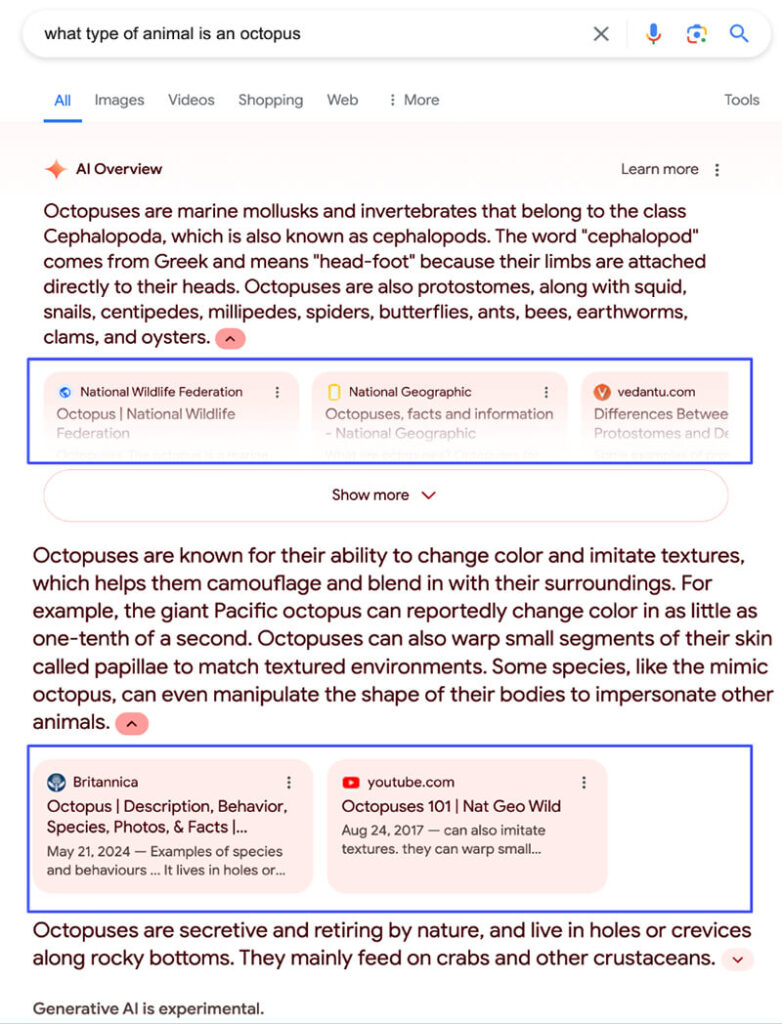
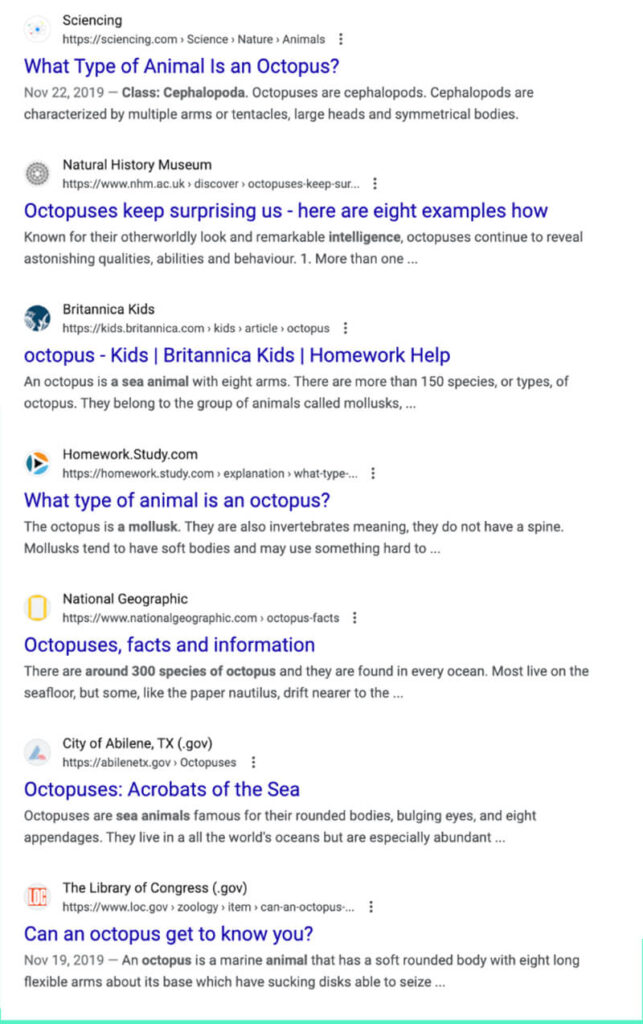
In addition, the links that appear in AI Overviews are more prominent and richer than typical search results. They include: site names, headings, snippets and potentially even images.
The number of links displayed also varies. AI Overviews shows between 2 to 5 clickable;e links within the carousels in comparison to the traditional 10 blue links users are used to seeing in the SERPs. Having fewer options to click from should increase the click-through rate of the links within AI Overviews.
AI Overview Links
Traditional Links
How to Optimise for AI Overviews
Google has confirmed that its systems automatically identify which links and sources to use for its answers so there’s no specific or official methodology for optimising for AI Overviews at the moment.
What this means is that there’s nothing “extra” that you need to be doing in order to be selected as a source for AIO. You should continue to follow the best practices for SEO in order to appear in the search results.
Below are some key techniques you should be using to increase your chances of appearing as a source for AIO.
Implement E-E-A-T Tactics
When generating AI answers, Google needs to be confident that the sources it uses for the information are credible. Demonstrating that your website as such is crucial in giving yourself the best chances of being featured in these search results.
There are several tactics that you can implement to show high levels of E-E-A-T (Experience-Expertise-Authority-Trust). These are characteristics that Google’s human quality raters specifically look out for when analysing content.
- Experience: A demonstration of your first-hand experience; offering a unique perspective.
- Expertise: Showing your depth of knowledge in a subject; an informed view.
- Authority: An acknowledged and respected source; a well-sought opinion.
- Trust: Providing an experience that users can trust; a consistently high standard.
Provide Helpful Content
Google has officially embedded its Helpful Content Update into its core ranking algorithm. This means that the algorithm is seeking to reward websites with content that provides value to the end user.
Ask yourself the following questions:
- Is your content helpful to the search audience for the target keyword?
- Are you adding original insights that can’t be found anywhere else?
- Are you writing content for humans as opposed to search engines?
Answering yes to all three of these questions is crucial in ensuring that your content aligns with what users are looking for.
Be Transparent
Be transparent about who wrote the content and demonstrate that they’re a credible source on the topic. This is especially important for websites operating within YMYL (Your Money Your Life) niches, where the information provided may impact a person’s financial, physical, or emotional well-being.
- The About Page is an opportunity for you to let Google and users know more about who you are and what you’re about.
- For eCommerce websites, you can show transparency by providing clear customer policies, shipping information, contact information.
Building Authority
Think about it this way. Just like students are asked to cite quotes or statistics from relevant, credible sources when writing an essay or dissertation, Google wants to use links from relevant, trustworthy sources for its AI Overviews answers
Backlinks help Google to determine the relevancy of pages and find new content.
Building authority with backlinks is another important tactic to help demonstrate your website’s E-E-A-T.
They should be:
- Relevant: Backlinks from domains that are relevant to your client’s niche.
- High Traffic: Backlinks from domains that already have high amounts of organic traffic
- Natural: Backlinks from domains that have a natural backlink profile of their own.
Brand Reputation
Creating a positive brand reputation demonstrates trust to both users and Google.
- Encourage your users or customers to leave reviews of your products, services or brand on your website.
- Ask them to also leave reviews on your Google Business Profile.
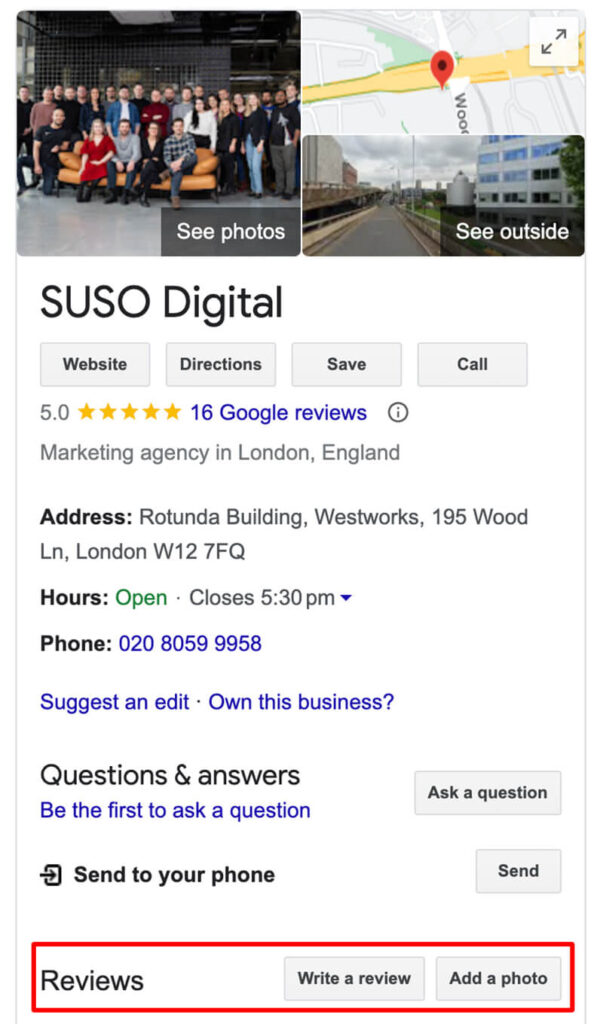
- External review websites like Tripadvisor and Trustpilot (or any other relevant sites related to your industry) in addition to positive brand mentions on the Web are also used by Google’s human raters to evaluate brand reputation.

Optimise Your Information Architecture
As is the case with optimising your content for featured snippets, you can follow some simple steps to increase your chances of Google using your site as a source for its AI-generated answer.
- Use short sentences and straightforward language
- Provide answers to the questions as quickly as possible
- Don’t overuse keyword manipulation
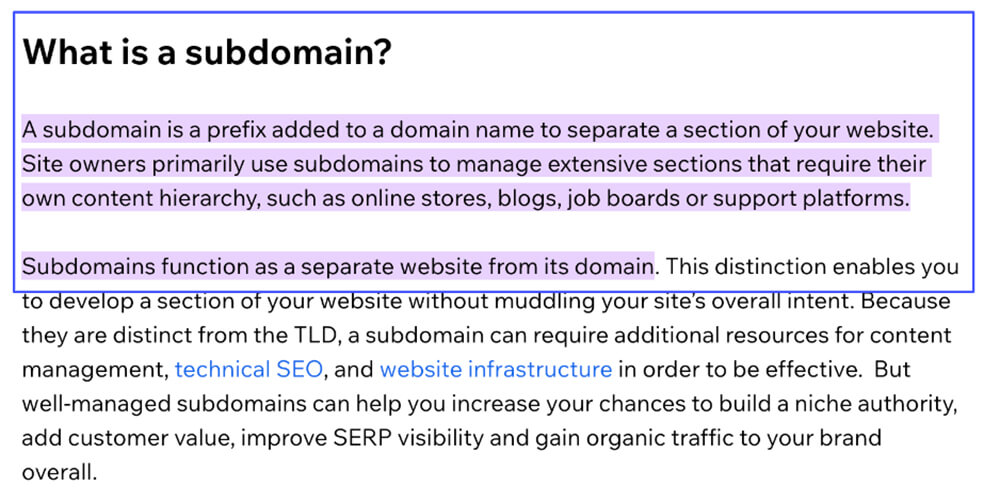
Here’s an example for the keyword “what is a subdomain”.
Website Copy
AI-Generated Answer
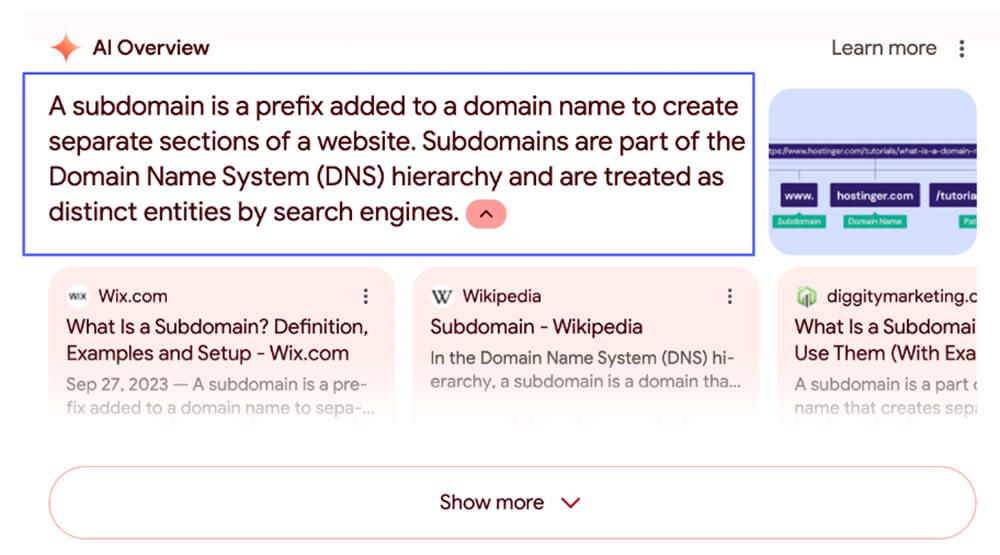
You can see that relevant well-crafted information at the top of the web page that clearly answers the question is used as the answer within Overviews.
Likewise, passages highlighted in the linked websites tend to be short. This is because, even in a longer AI Overviews answer, the linked website is used to support one particular point – as seen in the above example, where only the first sentence was used for the AI answer.
AI Overviews is designed to provide short, easy-to-read answers so it needs to reference short, easy-to-read sentences to decrease the chances of summarising inaccurately or taking the point out of context.
Target Long-Tail Keywords
With the introduction of AI Overviews, we’ll likely see a shift in how users search with people using longer sentences to ask questions to the AI, i.e., using full sentences when speaking. As a result, long-tail keywords will become more important.
To have a chance of winning, SEOs need to target longer, more specific keywords that have less competition. For example, instead of going after broad keywords like “software development,” target phrases like “custom mobile app development for startups”.
- Target long-tail keywords that address very specific pain points or questions from your target audience.
- The search volume (i.e., the average number of people searching for the keyword) might not be as high, but you have a better chance of ranking well because fewer websites will be targeting it.
- People who use these specific searches are more likely to take action on your website.
- Provide detailed answers to specific questions.
The Bottom Line
AI Overviews is currently only available in the United States and a few smaller territories across the world and users currently do not have the ability to opt out of it (or turn it off), but since its launch in May 2024, it’s clear that this new search feature is going to change the way Google Search is used.
Learn more about SEO and AI in this in-depth interview with Andrew Oleksik about ChatGPT Search.


