
While the industry debates the perfect term for optimizing for AI Search, the path to success is already being forged.
Digital PR has emerged as a powerful and indispensable means to achieve this crucial optimization, delivering tangible results where it matters most.
Traditionally, Digital PR in SEO has centered on attracting valuable links from top-tier publications.
For AI Search optimization, however, its mechanics differ significantly, placing a premium on deeper brand authority and discoverability.
Our Head of Off-Site, Estelle Slabbert, and Head of SEO, Filip Ruprich, will explain both the strategic PR and technical SEO required to master this new landscape, and why soft PR campaigns need technical SEO expertise in order to reach their full ranking potential in Chat GPT search, Perplexity or Google AI Overviews and AI Mode.
How Digital PR Improves AI Search Visibility on ChatGPT, Perplexity and Google AI Overviews
Estelle Slabbert, SUSO’s Head of Off-Site SEO, brings extensive experience in Digital Marketing, PR, and Global SEO campaigns. Her unique expertise lies in understanding precisely what kind of brand presence AI Search responds to, making her our go-to authority on building the brand authority AI truly learns from.
Below, Estelle explains the “how and why” behind the soft side of optimising for AI Search:
I’ve watched the landscape of SEO evolve at an incredible pace, particularly with the rapid ascent of AI Search. Just a couple of years ago, our focus was heavily on link metrics.
But today?
Our clients are asking to be cited in Forbes and mentioned in trending Reddit threads. Journalists, once happy with an infographic, now demand quotable data and expert opinions, often within 24 hours. So, what does this look like in reality for brand building?
Client Wins: Digital PR’s Direct Impact on AI Search Results
Consider a real estate SaaS client of ours who recently landed a quote in The Next Web.
That single mention, without a direct link, initiated a chain reaction: dozens of subsequent brand mentions, a noticeable spike in branded search, and eventually, their inclusion in an AI summary box for ‘top lead gen tools.’
Or think about pitching a digital security client for a Reddit AMA roundup—again, no link, just a brand mention—only to see them referenced in a Hacker News thread weeks later.
Google’s AI is sophisticated enough to pick up that sentiment and connection, directly impacting AI visibility and rankings. This is how non-link-based PR efforts deliver real results in the AI era.
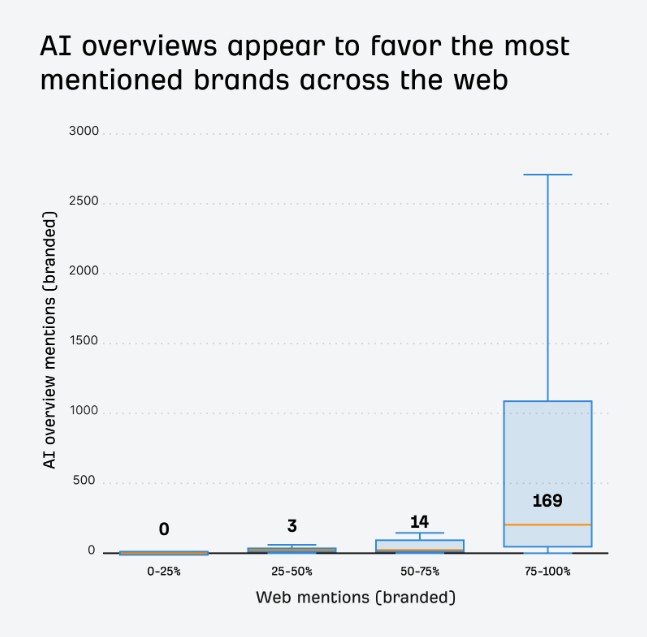
AI is becoming incredibly adept at parsing brand trust. Search is truly becoming more semantic.
AI Overviews don’t just show sites with links; they summarize authority based on consistent, cross-platform mentions.
In fact, Google is quietly merging its Knowledge Graph with sentiment and PR data to fuel AI-generated answers. What does this mean for us? Digital PR isn’t optional anymore—it’s foundational.
Our Approach to Digital PR in AI Search
It starts with Content Creation, ensuring PR is about expert-led, service-specific content that truly positions the brand as a source of truth.
Then, through Strategic Outreach, we build curated media lists and pitch with relevance, not templates. Crucially, Narrative Control is paramount: across every channel, consistency is the trust signal. If AI detects contradictory messaging, brand authority weakens.
Brands appear in AI Overviews and answer boxes not only because of keyword targeting but because of semantic authority and entity-level trust.
The strongest signals we can build today are not just links: they’re citations, sentiment, and relevance.
If you want to future-proof your SEO without spamming and strengthen your online footprint, don’t just chase links: Build presence. Build reputation. And above all, build trust everywhere your audience (and AI) are looking.
Why Technical SEO is Important for AI Search Visibility
Filip Ruprich, SUSO’s Head of SEO, has been instrumental in shaping our AI Search Service into a groundbreaking solution for PR agencies. While the allure of PR campaigns for AI visibility is clear, Filip steps in to articulate the “why and how” of this collaboration.
The Role of PR Materials as “Training Data” for AI
Structured Data & Knowledge Graphs
PR materials like press releases, expert commentary, or interviews often follow clear journalistic structures with named entities, dates, quotes, and verifiable facts. This structured, credible format makes it easier for AI systems to extract relationships and attributes, feeding them directly into knowledge graphs that power brand-related answers in AI search. Well-formatted data increases the odds of your brand being properly classified and retrieved.
Entity Recognition & Salience
AI language models continuously learn to connect entities – brands, people, products – with their context. Repeated, high-quality mentions of your brand across respected publications reinforce its significance. Expert attributions (e.g., “Jane Doe, CEO of Company X”) boost the salience of both the expert and the company, making it more likely AI will surface them in responses to future queries.
Topical Authority
A consistent PR campaign positions a brand as a trusted voice on specific subjects, providing a trail of reliable data points. This pattern helps AI models view your brand as an authoritative source for that topic cluster, increasing the probability your information will be prioritized and summarized in AI-driven results for relevant questions.
Semantic Understanding
Unlike keyword-driven SEO alone, PR storytelling helps AI models understand the full semantic picture of your brand– its mission, values, differentiators, and expertise. Quotes, case studies, and product explanations found in PR materials add depth to the AI’s knowledge of what you do and why it matters, beyond just “matching” keywords to pages.
Integrating PR With Strategic SEO
Strategic SEO teams should first analyze search demand, audience intent, and topic opportunities to identify what people truly want to learn or solve. These insights inform the PR team, helping them craft authoritative, compelling stories that answer real questions and address emerging trends.
Synchronising PR With Technical SEO
PR teams perform thorough research into search demand, audience intent, and industry conversations. Afterwards, the technical SEO team ensures it is fully discoverable by search engines and AI systems, implementing structured data, robust internal linking, and clean architecture.
Together, this approach guarantees that well-researched, genuinely interesting PR materials don’t just exist – they actually reach the audiences and AI platforms that matter.
How to Measure AI Visibility From PR & Technical SEO Campaigns
Key KPIs to track might include:
- Increase in the number of featured snippets owned
- Growth in brand mentions across authoritative domains
- Higher frequency of brand entity recognition in knowledge panels
- Uplift in non-branded organic impressions for informational queries
- Share of voice on AI-generated answers (e.g., AI Overviews, Gemini, ChatGPT)
What Are We Doing About It?
Yes, we are adapting our approach. While we still carry out targeted outreach to secure valuable backlinks, we are intentionally reducing its share in the overall strategy. Instead, we are allocating more budget and focus toward Digital PR (DPR) campaigns that deliver wider brand-building benefits.
This integrated approach strengthens knowledge graphs, improves entity recognition, and maximizes brand visibility in AI-powered results like featured snippets, direct answers, and knowledge panels.
The AI Search and PR Relationship Summed Up
AI search success hinges on a powerful, integrated strategy.
As both Estelle and Filip have shown, Digital PR lays the foundational groundwork, meticulously building the brand trust, authority, and pervasive mentions that AI systems now prioritize above all else.
However, without the precise, data-driven orchestration of Technical SEO, these invaluable PR efforts risk being overlooked.
Only by combining the “soft power” of compelling brand storytelling with the “hard science” of technical optimization can agencies truly unlock unparalleled AI visibility.