As ChatGPT and other AI writing tools allow us to create content more quickly and efficiently, it’s no wonder that more and more marketers and businesses are using them in their operations.
Exploding Topics reports that 78% of global companies claim to use AI, and 71% of them apply generative AI in at least one business function. It can be used for blog posts, email campaigns, and social media captions, you name it.
But there’s a catch.
AI content, while grammatically correct and keyword-rich, often falls flat. It lacks the soul—the human nuance, emotion, and relatability that connect with readers on a personal level.
Why does this matter? There are 3 main reasons:
- Audiences look for authenticity.
- Google rewards it.
- Robotic-sounding content typically doesn’t convert.
Let’s dive right into it!
What Is AI-Written Content?
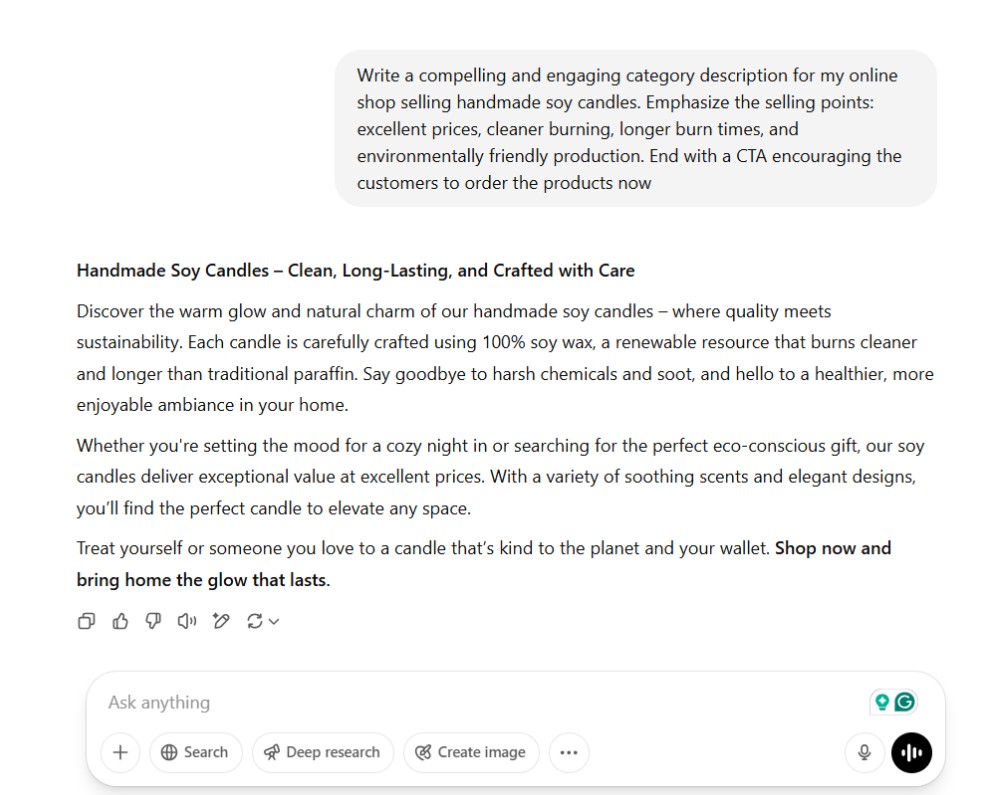
AI-written content refers to any text (such as blog posts, product descriptions, social media updates, or email copy) generated by artificial intelligence tools like ChatGPT, Jasper, or Copy.ai.
These tools use large language models (LLMs) trained on massive datasets to create human-like writing.
The process is simple: you provide a prompt, and the AI generates a coherent response.
The Benefits of AI-Written Content
✔️ Speed: AI can produce articles in seconds.
✔️ Scalability: Creates high volumes of content across topics.
✔️ Cost-effectiveness: Reduces time spent on first drafts.
The Limitations of AI-Written Content
❌ Lacks emotional depth
❌ Can be repetitive or vague
❌ Misses brand voice or unique perspective
Because of these limitations, professional content creation still requires significant human intervention. You need to refine and personalize the text using the right techniques to make it sound credible and engaging, not robotic.
Can Human Readers Detect AI Content?
Absolutely. Even if the readers are not familiar with AI tendencies, they can feel when the content is off. AI writing often sounds:
- Emotionless
- Repetitive
- Overly formal or oddly structured
- Vague or bloated
- Lacking in strong opinions or personal touches
When visitors encounter such content on a page, they are more likely to leave it immediately, which can harm your SEO campaign and negatively impact your brand relevance.
Does Google Penalize Sites With AI-Written Content?
As Google informs us on its blog, its algorithms don’t punish AI-generated content just because of the automation.
Their official stance is that it cares about the quality and usefulness of content, not who (or what) wrote it.
What matters is whether your content:
- Demonstrates E-E-A-T: Experience, Expertise, Authoritativeness, Trustworthiness
- Helps people, not just algorithms
- Avoids spammy, auto-generated patterns that add no value
In other words, AI content is fine, as long as it’s good.
When You Might Get Penalized for AI Content
While AI-generated content itself isn’t banned, here’s when you might run into trouble:
- Thin content with no unique insights or depth
- Keyword-stuffed text designed to manipulate rankings
- Unedited AI content that sounds robotic or inaccurate
- Duplicate content copied from other sources
Ranking Better in Google and AI Search
Google’s search algorithm has grown smarter and more human-focused, and it has long emphasized Expertise, Authoritativeness, and Trustworthiness.
In December 2022, a new E was added to the E-A-T abbreviation, standing for Experience and showing how Google appreciates genuine insights from real people.
It’s no longer enough to stuff your article with keywords and hope for the best. Instead, the algorithm rewards content that includes first-hand experience and offers new perspectives.
AI-generated text, when left unedited, often lacks such credibility. Humanizing it by injecting original thoughts, clear expertise, and a relatable voice helps satisfy Google’s algorithmic expectations. In this way, it contributes to building better visibility in search results.
Protecting Your Brand from AI Content
Take into account that if you leave AI-generated content unrefined, it will most likely sound impersonal and generic, not aligning with your brand voice.
By humanizing it, you can adjust it to your brand’s tone, character, and values.
If you want to make your brand trustworthy and reliable, you need to keep its voice consistent with its overall unique style. In this way, your business will be more distinguishable and harder to forget.
Maintaining Cultural Sensitivity in AI Content
What’s more, AI-written content may not suit cultural nuances and context, which may lead to misunderstandings or even offending certain communities. Taking a closer look at it and refining it allows you to make sure it respects the audience of various backgrounds and their traditions.
This way, your message can be well-received by diverse audiences, which will additionally improve your brand’s reputation and reach.
5 Ways to Spot AI Generated Content
There are a few signs that typically let you spot machine-made writing at a glance, such as:
1. Repetitive Phrasing
AI tools rely on patterns and probabilities, so they often reuse the same sentence structures, connectors, or phrases across a piece. For example, you might see “In conclusion,” “It is important to note,” or “In today’s digital world” used multiple times throughout a blog post.
Such repetition feels unnatural to human readers, who expect variety in tone and expression.
Robotic Example:
“It is important to note that content creation plays a vital role in marketing. It is also important to note that many companies use content strategies today.”
Humanised Version:
“Content creation is at the heart of modern marketing. And let’s face it—every brand is trying to own a piece of that spotlight.”
In the humanised version, varied sentence construction and conversational tone keep things engaging and fresh.
2. Overuse of Generic Transitions
AI loves structure, but it often leans too hard on generic or too formal transitions. Typically, words like “Moreover,” “In addition,” or “Furthermore” appear more frequently in AI writing than they do in natural human speech or casual blog posts.
While these words are grammatically correct, they can make your writing sound stiff and academic, which sounds awkward, especially in conversational formats like blog posts or newsletters.
A human voice might opt for “Also,” “On top of that,” or even a standalone sentence like, “Here’s the kicker.” These kinds of transitions keep the tone fluid and engaging, rather than mechanical and formal.
Robotic Example:
“Furthermore, social media is used by many brands to engage customers. Moreover, it provides an effective way to build brand awareness.”
Humanized Version:
“Social media? It’s where your brand meets your audience. It’s not just about likes—it’s about connection.”
Human transitions flow more like a conversation, while robotic ones stick out like formal punctuation in a casual email.
3. Lack of Storytelling or Emotion
AI is good at providing explanations, but it struggles with nuance, first-hand experience, emotion, and storytelling. Human writing often includes small personal touches, while robotic content tends to be dry, generic, and emotionally flat.
Robotic Example:
“Email marketing is an effective strategy to communicate with customers. It helps companies inform users about new products or services.”
Humanized Version:
“You know that feeling when the perfect email hits your inbox right when you need it? That’s email marketing done right—it’s timely, personal, and drives action.”
Adding storytelling or emotional resonance helps the reader feel the point, not just read it.
4. Over-Explaining the Obvious
AI often assumes the reader knows nothing, so it tends to over-explain basic concepts, even when the audience is familiar with them.
This results in producing unnecessarily long, redundant paragraphs that can frustrate or bore the reader.
Robotic Example:
“Websites are pages on the internet that people visit to find information, buy products, or learn about services.”
Humanized Version:
“Your website is your digital storefront. If it’s clunky or confusing, your audience won’t stick around.”
As most readers already know what a website is, a human-written article skips the generic explanation and proceeds to a meaningful insight.
5. Flat, Predictable Tone
AI usually plays it safe and uses a flat and overly polite tone, lacking variety and emotional depth. As a result, its content often feels too neutral and dry, in contrast to human writing, which often includes strong opinions, bold statements, or sarcasm, making the article more engaging.
Robotic Example:
“Using social media consistently may help improve engagement and visibility over time.”
Humanized Version:
“Show up consistently on social media or get lost in the scroll. That’s the game.”
The human version isn’t afraid to be bold, punchy, or even a bit dramatic—because that’s what grabs attention.
17 Ways to Humanize Your AI Writing
Humanizing AI content isn’t rocket science—it’s enough to follow a few simple strategies to make the robotic text sound more natural and engaging. Let’s take a look at some of the best ones:
1. Add Personal Anecdotes and Human Examples
Stories make content memorable. Humans connect through shared experiences, not bullet points.
Including a quick anecdote, even if small, instantly adds life to your writing. It gives your content emotional weight and makes it easier for the reader to relate.
For instance, if you’re writing about the benefits of a particular product or service, share a personal story about how it affected your or someone else’s life.
Such a human touch can boost your authority as a writer and make the brand sound more reliable.
✍️ Example:
“I used to spend hours drafting content calendars manually—then I started using [Tool Name]. Within a week, I cut my planning time in half. More importantly, my client noticed the improvement and said, ‘Your strategy feels way more focused now.’ That’s when I knew it wasn’t just saving time—it was delivering better results.”
2. Vary Sentence Structure and Rhythm
AI tends to follow predictable patterns in sentence length and structure, and it often produces paragraph after paragraph of mid-length sentences that read like a high school essay.
But humans don’t talk like that—we interrupt ourselves, we pause, we emphasize. We mix short, punchy lines with longer, more thoughtful reflections. This natural rhythm makes writing feel dynamic and alive.
✍️ Example:
“You need to get to the point. Fast. But sometimes, a story takes time to unfold—and that’s okay. The key is knowing when to speed things up and when to slow down.”
3. Use Rhetorical Questions and Informal Transitions
Rhetorical questions can sound intriguing and make readers feel curious and involved. Also, they signal a conversational tone, like the writer is talking with the audience, not at them.
Informal transitions like “So,” “Here’s the thing,” or “Let’s be honest” make content sound more friendly and accessible, and guide readers effortlessly through your points.
✍️ Example:
“Why should anyone care about your brand’s mission statement? Because if you don’t tell them why it matters, no one else will.”
4. Include Opinions and Bold Statements
AI is programmed to be neutral and inoffensive, which often results in bland, generic content. But readers crave perspective.
Sharing your opinions (especially if they’re bold or contrarian) helps establish authority and makes your content more memorable.
✍️ Example:
“Honestly, if you’re still ignoring your email list in 2025, you’re handing customers to your competitors. It’s the most underused asset in digital marketing.”
5. Break Grammar Rules (Strategically)
Perfect grammar can sound perfectly boring. Strategic rule-breaking may spice up your content and improve the flow of your writing.
Think sentence fragments. Starting with “And.” Dropping the subject. These techniques reflect how people actually speak, and they help your writing feel less like a textbook and more like a conversation, building a connection with the reader.
✍️ Example:
“You could spend another three hours editing. Or—you could publish it and move on.”
6. Use Contractions and Casual Language
Formal language sounds robotic, so it’s good to use contractions like “you’ll,” “they’re,” or “it’s” to sound natural, especially in blog posts and other types of less official content.
Similarly, casual phrases like “a bit,” “kind of,” or “no big deal” soften your tone and make content more accessible.
✍️ Example:
“If you’re not using a scheduling tool, you’re probably spending way too much time in spreadsheets. Trust me—it doesn’t have to be that way.”
7. Add Humor, Metaphors, and Emotions
AI struggles with creativity and cultural nuance, so injecting analogies, pop culture references, or emotional language makes your content stand out.
Even a simple comparison or funny comment can make a dull paragraph more fun to read and, therefore, more likely to catch the reader’s attention.
✍️ Example:
“Trying to build a brand without content is like opening a restaurant and forgetting to put up a sign. People might find you eventually—but don’t count on it.”
8. Adjust Content to Your Unique Style
Editing AI should be largely about shaping tone, style, and flow. Read your content out loud and ask yourself: “Would I say this to a friend? Does this sound like me?”.
If the answer is no, it’s time for further edits. Get rid of the robotic phrasing and replace it with something that reflects your voice, your values, and your vocabulary.
✍️ Example (comparison):
AI-generated: “This platform facilitates effective communication strategies.”
Humanized: “It helps your team talk to each other—and actually get stuff done.”
9. Refer to Current Events
AI is not always good at keeping up with current trends, news, or cultural shifts, which means it’s up to you to add that human awareness and make content set in a specific context.
By referring to recent events, viral moments, or brand examples you make the article more reliable. Why? Because it builds your authority as a writer who is up-to-date with what’s happening in their niche and beyond.
✍️ Example:
“Remember when Threads launched and half of Twitter migrated overnight? That’s how fast digital platforms can shift—and why agility in content marketing is non-negotiable.”
10. Treat AI as a Rough Draft
Think of AI as your brainstorming partner, not your ghostwriter who will do all the work for you. It’s great for overcoming writer’s block, building outlines, and generating ideas to help you get started and focus on refining your content instead of creating it from scratch.
However, the final product should always be passed on by humans. Your job is to refine, personalize, and elevate that content until it sounds like it was written with care, not code.
✍️ Example (comparison):
First Draft (AI): “Email marketing remains a viable communication channel.”
Final Version (You): “Email’s not dead—it just needs a better subject line.”
11. Provide Reliable Data
Another important way of humanizing AI content is to include reliable data, such as statistics, research data, or case studies, to confirm your claims.
When you cite specific sources (or better yet, results from your own campaigns), you not only sound more trustworthy but also more human. Readers trust content that feels grounded in reality, not just opinion.
✍️ Example:
“In fact, 70% of marketers say SEO delivers better ROI than pay-per-click, according to Databox. We’ve seen this firsthand—after optimizing just five blog posts, one client saw a 3x traffic boost in 60 days.”
12. Use Active Voice
Passive voice typically makes an article sound dull, indirect, and, yes, robotic. AI-generated text often uses it because it feels safe and formal.
On the other hand, an active voice brings clarity, energy, and ownership to your content. It’s more direct and engaging, which makes your writing feel alive and confident.
✍️ Example:
- Passive: “The product was launched to address user complaints.”
- Active: “We launched the product to fix what users were frustrated about.”
As you can see, active voice shows who’s doing what, which is an essential part of sounding human and in control.
13. Fact-check the Content
Unfortunately, AI still often fails at providing accurate facts, and fabricates information or misquotes sources. As the New York Times reports, tests have shown that even advanced models from companies such as OpenAI show an error rate as high as 79%.
For this reason, one of the most human things you can do when editing AI-generated content is to fact-check everything. Confirm names, dates, statistics, and historical references to make sure you don’t misinform your audience, lowering your authority.
If you’re quoting a study or citing a trend, be sure it’s real and current. This will not only improve your credibility but also show readers that you care about accuracy.
✍️ Example:
AI might generate this:
- “According to a 2020 Harvard study, 80% of blogs fail within the first six months.”
But after fact-checking, you might discover:
- No such Harvard study exists—and that stat likely originated from an unreliable blog.
14. Be Concise and Delete Fluff
AI-generated content often uses such filler phrases as “In today’s world,” “It is important to note,” or “This article aims to explore…” These add bulk but no real value, and most readers prefer articles that get straight to the point and provide answers to their questions quickly.
To make your content sound more human, cut the fluff and say what you mean clearly. Concise writing respects your reader’s time and keeps them engaged.
✍️ Example (comparison):
AI-generated (fluffy):
“In today’s fast-paced digital landscape, it is becoming increasingly important for businesses to consider using social media platforms as part of their marketing strategy.”
Humanized (concise):
“If your brand isn’t on social media, you’re invisible. It’s that simple.”
15. Use First-Person Pronouns
Using first-person pronouns like I, we, and our makes your writing sound more human and conversational.
AI typically sticks to third-person phrasing, which can make content feel impersonal. First-person language builds trust and creates a sense of connection, as it reminds the reader that there’s a real person behind the words.
✍️ Example (comparison):
AI-generated:
“Writers should always review content for clarity and tone before publishing.”
Humanized:
“Before I publish anything, I always read it out loud to catch awkward phrasing and fix the tone.”
16. Improve Your AI Prompts
Apart from editing the already generated text, you can improve the quality of your prompts to make the content less robotic from the start.
If you ask the AI to “write a blog post about SEO,” you’ll get something generic and robotic. But if you humanize the prompt by specifying tone, perspective, and audience, you’ll get output that’s more natural, relevant, and easier to humanize further in editing.
✍️ Example (comparison):
Generic Prompt:
“Write a product description for a standing desk.”
Humanized Prompt:
“Write a product description that speaks directly to busy professionals working from home. Use first-person phrases, highlight the comfort and health benefits, and include a line about your own back pain disappearing after switching.”
17. Check Your Text With AI Detectors
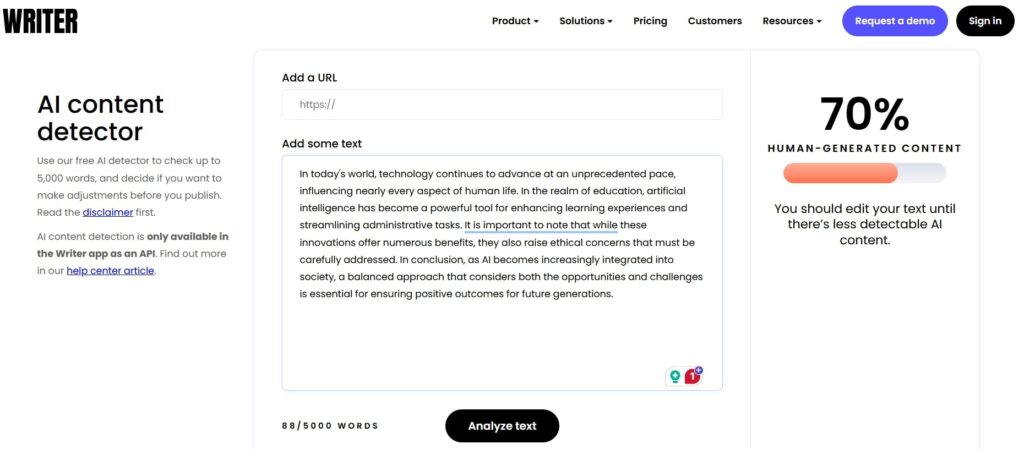
To identify robotic text more easily, you can use various online AI detection tools.
While not foolproof, they can help flag content that lacks variation, voice, or originality. Use them as a diagnostic (not a definitive judgement) to find areas that may need more human touch.
⚒️ Popular tools include:
So, Should I Use AI-Generated Content?
That’s up to you. But AI writing tools are here to stay, and they’re not the enemy.
They can be incredibly powerful allies in your content creation process. But if you want your texts to connect, convert, and stand out, you can’t skip the human touch.
The truth is, no matter how advanced AI gets, it still can’t replicate your lived experiences, opinions, or emotional intelligence. That’s why humanising AI content is not optional, but essential.