
Will Bagnall, SUSO’s founder and CEO, discusses the industry’s shift into AI-based search.
The rules of the SEO game are changing — and quickly.
For years, we’ve played by Google’s playbook: optimise for crawling, climb the rankings, capture traffic. But generative AI has kicked the door off its hinges. Platforms like ChatGPT, Gemini, Copilot, and Perplexity don’t crawl websites the way Google does.
They interpret. They synthesise. They recommend.
And they’re doing it in a way that’s quietly rewriting how people find, trust, and buy from brands online.
This isn’t some slow-moving trend. It’s happening as we speak. Two-thirds of Gen Z already use AI models to research purchases. Our clients, teams, and even our own buying habits reflect that change.
The question for brands and agencies isn’t “Will this affect us?”
It is:
“What is AI already saying about our brand?”
From Ranking to Relevance: The Real SEO Shift
SUSO has been in the industry long enough to have weathered more Google updates than I care to count — Panda, Penguin, Medic, BERT — and each time, we adjusted. Tweaked metadata, improved UX, doubled down on E-A-T. But this? This isn’t that.
This isn’t an update. It’s a reset.
The way most brands approach SEO in 2025 still feels like a relic from the 2010s. Pages optimised for keywords. Content clusters. Link building campaigns. All geared toward earning visibility in search results after someone types a query.
That model assumes one thing: the user finds your site, visits it, and makes a decision there.
But with generative AI — especially LLM-powered answer engines — the user often never leaves the interface. The decision is made before they even see your site. The summary is the product comparison. The model is the salesperson. And if you’re not in that answer? You’re not even in the running.
| Feature | Traditional SEO | AI SEO |
|---|---|---|
| Goal | Rank in SERPs | Be included in the answer |
| Optimises for | Search engine algorithms | LLMs and generative models |
| Key action | Attract clicks | Influence answers |
| Content focus | Keywords match, internal links | Structured data, semantic clarity |
| Winning metric | Organic rankings | Answer inclusion, citation rate, share of model |
| Traffic outcome | Site visits | Brand mentions, purchase influence, conversational presence |
Old SEO: Crawl, Index, Rank
Traditional SEO was built around the needs of bots. Help them crawl your site, index your pages, and rank your content based on signals like authority and relevance. You optimised for the algorithm.
AI SEO: Understand, Interpret, Recommend
AI SEO, on the other hand, is about how a model understands your content. It’s about influencing its response, not just getting seen, but getting included in the answer. Because these tools don’t work like search engines. They’re interpreters, not indexes.
That changes everything.
Now, the most important questions aren’t about position on the SERP. They’re about:
- Whether the model can read and summarise your content accurately.
- Whether it trusts the sources that mention you.
- Whether your product, brand, or answer is understandable and relevant in context.
And here’s the kicker: The places models learn from are not always your site. They’re forums, help docs, review articles, schema-rich product pages, news coverage, Reddit threads, even GitHub repos. That’s the training data. That’s the influence map.
So yes, ranking still matters — especially for Google. But it’s no longer the ceiling of visibility. It’s the floor.
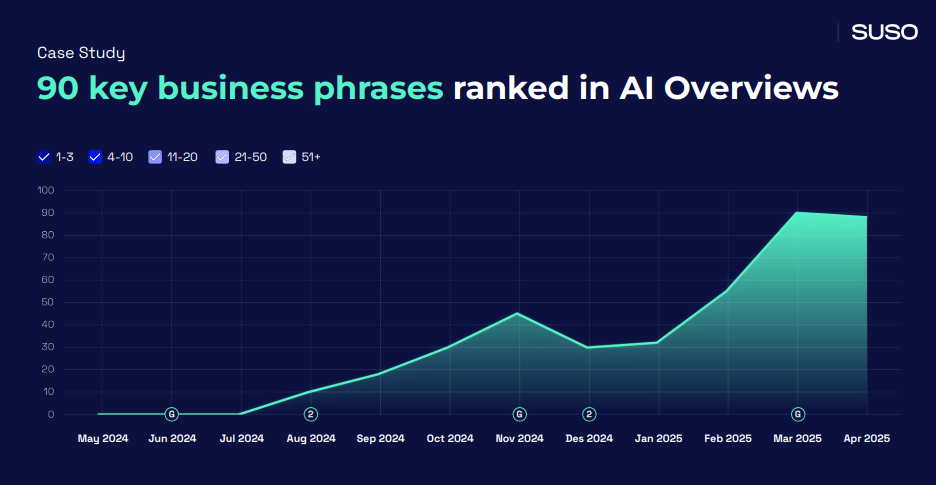
Introducing the AI SEO Service
When the AI wave started, we were hit with hard, specific questions from CMOs, founders, and growth leads. Not any basic strategic or technical SEO questions, but:
- “What’s ChatGPT saying about our brand?”
- “Are we being mentioned when customers ask Gemini about our space?”
- “Can we influence what shows up in the answers?”
- “And if we can — how do we know it’s working?”
So we built our AI SEO service to answer. Let me break it down:
#1 What is AI saying about me and my competitors?
This is where it starts. Visibility doesn’t begin with your own content anymore. It begins with how you’re being described, cited, and compared across the ecosystem of content that models are trained on.
So we measure it. Directly.
We run visibility diagnostics across the major engines — ChatGPT, Gemini, Copilot, Perplexity. We test high-intent queries, benchmark inclusion frequency, analyse sentiment, and compare it all to your top competitors.
#2 Can AI access my existing content?
Your content might look great to humans, but to an LLM, it could be unreadable.
We’ve found again and again: bloated websites, vague messaging, buried value props, no schema, slow load speeds — they all create invisibility by design. The model hits a timeout, fails to parse, or simply decides the page isn’t useful.
So we restructure it.
We optimise your content architecture, add schema, surface the key information, and build in clarity so your pages feed the model answers — instead of confusing it.
#3 Can I seed content and answers?
With a good strategy, you can.
Because once you understand that AI models are trained on the open web, you realise something powerful: you can shape the information they train on.
We do this through a mix of digital PR, structured content placement, and authoritative publishing. We identify the domains models tend to trust, then work with your brand to get cited in them. Think: product comparisons, expert lists, explainers — all written to be scrapable, summary-friendly, and strategically placed.
Over time, this tips the balance. Your brand becomes the answer.
#4 What are the business outcomes?
This is where it all comes together — because visibility without impact is just noise.
Attribution in this space is messy, yes. But it’s not unworkable. We’re building hybrid models: monitoring branded query volume post-campaign, running qualitative AI answer testing, and triangulating where your inclusion rates move the needle.
And more importantly — we’re treating AI visibility as a performance channel. One you can measure, iterate on, and invest in.
Looking Ahead: The Future of SEO Is Generative
AI search is changing how people interact with the internet. That means it’s changing how they interact with your brand. You can wait until the effects show up in your analytics… or you can start shaping your presence now, while it still makes a difference.
We’re helping clients and agency partners do the latter across every sector and in every market.
If you want to know what AI models think about your brand and what to do about it, start with our free AI visibility report. We’ll show you the landscape. No jargon. No fluff.
Just a real look at where you stand — and how to move forward.