
You’ve got the traffic. Your SEO strategy is delivering results – search rankings are climbing, organic sessions are up, and it feels like you’re playing an attacking game deep in the opponent’s half. But despite all that pressure, conversions remain stuck at nil-nil.
Sound familiar?
Welcome to the gap between visibility and value – where SEO’s dazzling footwork brings in the crowds, but your conversion rate fails to convert fans into paying supporters. In football terms: you’ve got the best midfield in the league, but no one’s finishing in front of the goal.
This is where the real match begins.
In today’s competitive digital arena, getting visitors through the virtual door is only half the battle. If those visitors aren’t converting – submitting a lead form, making a purchase, or signing up for a demo – then even the slickest SEO campaign is only a winning possession, not the game.
To truly help clients grow, SEO has to do more than just drive traffic. It must work seamlessly with Conversion Rate Optimisation (CRO), User Experience (UX), and – most critically – search intent. That’s how you turn sessions into sales, rankings into revenue, and browsers into buyers.
In this article, we’ll explore exactly how SEO professionals can become conversion catalysts, by:
- Analysing user behaviour to uncover conversion roadblocks
- Optimising UX to reduce friction and build trust
- Aligning keyword targeting with search intent to attract high-converting traffic
- Supporting business goals with SEO strategies that score on the bottom line
Whether you run a full-service agency, lead an in-house marketing team, or advise clients on performance strategy, this playbook will show you how to transform SEO from a traffic-driving technician to a conversion-winning tactician.
Let’s kick off.
SEO and CRO – A Winning Team
SEO and CRO are often treated like players from rival clubs – talented in their own right, but rarely seen on the pitch together. In reality, they should be the dream duo, passing seamlessly between each other to create real business results. Think of De Bruyne and Haaland: one setting up the play, and the other finishing it off in style.
At their core, SEO (Search Engine Optimisation) and CRO (Conversion Rate Optimisation) serve different purposes – SEO brings users in, while CRO guides them to take meaningful action. But when aligned, they form a powerful strategy that not only drives qualified traffic but turns that traffic into leads, customers, and revenue.
SEO: The Playmaker
SEO’s job is to increase visibility in search engines, attract the right audience, and match user intent with high-quality, relevant content. It’s the roaming playmaker – mapping out opportunities, delivering pinpoint keyword passes, and creating space for users to explore your site. But it doesn’t score the goal on its own.
Without CRO, that well-earned traffic can become just another vanity metric. People arrive, browse, and bounce – no enquiry, no sign-up, no sale. That’s like watching a team dominate possession without a single shot on target. It’s basically Russell Martin’s Southampton.
CRO: The Striker
CRO steps in as the clinical finisher. It’s focused on analysing user journeys, identifying friction points, and making small but impactful changes that lead to more conversions. This includes tweaking landing pages, refining Calls-To-Action (CTAs), simplifying forms, and building trust through UX improvements.
While SEO brings in users based on what they’re searching for, CRO ensures that the on-site experience matches those expectations and makes it simple to take action.
The Stats That Matter
Here’s the kicker: you don’t need more traffic to grow revenue. You need better performance from the traffic you already have. That’s the sweet spot where SEO and CRO shine together.
Aligning both disciplines will lead to:
- Improved SEO metrics (lower bounce rates, longer session durations, and better engagement);
- Higher conversion rates (more form fills, demo bookings, purchases);
- More efficient ROI from your marketing spend (less wasted traffic, more value per visitor).
One Game Plan, One Goal
The best marketing teams – and agencies that clients love – treat SEO and CRO as parts of a unified game plan. That means:
- Prioritising traffic quality over raw volume;
- Designing content and site experiences with the user journey in mind;
- Collaborating across SEO, UX, and performance teams to optimise every stage of the funnel.
When SEO and CRO play as a team, you don’t just increase rankings – you convert them into results that matter. And in the eyes of your clients, that’s the only league table worth topping.

Analysing User Behaviour to Find Conversion Roadblocks
You wouldn’t field a team without reviewing match footage, right?
The same logic applies to your website. Before you start tweaking pages or rewriting CTAs, you need to understand where and why users are dropping off. That’s where behavioural analysis comes in – your version of watching the replays, identifying the missed passes, and fixing the weak spots in your formation.
Conversion roadblocks don’t always scream for attention. Sometimes they’re as subtle as a misaligned headline, an unclickable button on mobile, or a form field too many. The good news? Your users leave behind a detailed trail of clues. You just need to read the game.
Start with the Data: Where Are You Losing the Ball?
Begin by diving into your analytics suite – Google Analytics 4 is your central command, but tools like Hotjar, Microsoft Clarity, or Smartlook can give you deeper insight into user behaviour.
4 key metrics to watch:
- Bounce rate: Is your traffic leaving without interacting? This can indicate a mismatch between user expectations (based on the search query) and what the page delivers.
- Time on page / session duration: Are users engaging with the content, or exiting after a quick skim?
- Exit pages: Identify which pages users most commonly leave from – especially high-traffic ones that should be converting.
- Conversion paths and funnel visualisation: These show where users drop off in multi-step journeys (e.g. contact forms, checkouts, sign-ups).
If your product page is getting loads of traffic but few add-to-carts, something’s not clicking. If users start your sign-up form but don’t complete it, the issue might be friction in the form itself – or doubt about what happens next.
Heatmaps, Scrollmaps & Session Replays: The Tactical Breakdown
Quantitative data tells you what is happening. Behavioural tools show you why. Use:
- Heatmaps to see where users click (and where they don’t);
- Scrollmaps to understand how far they scroll (do they even reach your CTA?);
- Session replays to watch real user journeys unfold in real-time.
You might discover that users ignore your main CTA because it blends into the design. Or that they’re rage-clicking a non-clickable element they think is a button. These moments are conversion killers – subtle UX fouls that the referee (your analytics) won’t catch unless you review the tape.
Diagnosing Friction: What’s Slowing Down the Play?
When you spot a roadblock, don’t rush into fixing it. Hypothesise why it’s happening:
- Does the page fail to match the user’s search intent? (Content mismatch)
- Is the CTA too vague or buried too far down? (Lack of direction)
- Is the load time too long, especially on mobile? (Technical frustration)
- Does the user journey lack trust signals, clarity, or incentive to act? (Psychological friction)
In essence, you’re identifying the moments when the user loses momentum. The perfect through-ball was delivered (via SEO), but they hesitated in the box. Why?
Segment Your Insights
Not all users behave the same. Segment your data to look for patterns across:
- Device types (Mobile users often face more friction);
- Traffic sources (Organic vs paid vs referral – SEO traffic should be carefully analysed for intent);
- Geography or user type (If B2B, are new visitors behaving differently from returning ones?).
These insights allow you to prioritise fixes that matter – rather than guessing at the issue, you’re fixing what’s actually breaking the flow.
Before you change colours, shuffle CTAs, or rewrite headlines, take the time to analyse behaviour like a seasoned coach. Watch the replays, look at the metrics, and understand the plays that didn’t quite come off.
That’s how you turn guesswork into strategy – and friction into fluidity.
Optimising User Experience (UX) for Higher Conversions
Think of your website as the home stadium. SEO gets the crowd through the gates – fans excited, seats filling up, eyes on the pitch. But once they’re in, it’s the experience that determines whether they stay, cheer, and become lifelong supporters.
If navigation is confusing, the design is clunky, or the site takes forever to load – excitement fizzles fast. Poor user experience turns a promising matchday into a forgettable one – no engagement, no action, no conversion.
UX is the difference between spectators leaving at half-time and sticking around to watch your team lift the cup. When done right, it keeps the game flowing, builds trust with the audience, and sets up clear scoring opportunities.
Here’s how to fine-tune your UX so your site doesn’t just attract traffic – but converts it with flair.
Site Speed and Performance
Page Speed isn’t just a Google ranking factor – it’s a conversion catalyst. A slow site is the equivalent of a striker stuck in quicksand. Even the best content can’t save a sluggish experience.
Our years of SEO experience show that every second of load time can cost you conversions, especially on mobile. Users won’t wait for your masterpiece to render – they’ll bounce and look for a competitor who loads faster than you can say “Core Web Vitals.”
5 quick wins for speed optimisation:
- Compress and properly size images (use modern formats like WebP)
- Minify CSS, JavaScript, and HTML
- Enable browser caching and use a reliable CDN
- Audit third-party scripts (too many tracking pixels can be conversion killers)
- Leverage lazy loading where appropriate
Use tools like Google PageSpeed Insights, Lighthouse, or GTmetrix to diagnose and improve load times. Prioritise the pages with the highest traffic and conversion potential.
Mobile-Friendly Design & Navigation
With mobile traffic dominating many sectors, your mobile UX can make or break conversions. Yet too many sites still treat mobile as an afterthought – a benchwarmer, rather than a star striker.
Your site must not only look good on mobile – it needs to be intuitive, functional, and friction-free. Navigation, in particular, should feel like a well-drilled formation: everything in the right place, easy to follow, with no guesswork required.
5 essentials for mobile UX:
- Use a responsive design that adapts seamlessly to screen sizes
- Avoid oversized elements or fonts that require zooming or scrolling
- Ensure buttons and CTAs are thumb-friendly
- Minimise pop-ups that obscure content
- Keep navigation clean and accessible from any page
Test your site across multiple devices and use mobile usability reports in Google Search Console to flag issues.
Clear CTAs and Conversion Elements
A user lands on your page. They’re interested. They’re scrolling. They’re ready. But – what’s the next step? If your Call-To-Action (CTA) is unclear, uninspiring, or hidden below the fold, you’ve just missed a sitter.
A great CTA is clear, compelling, and easy to act on.
Position it where it’s visible without effort. Use action-oriented copy (“Start Your Free Trial,” “Get My Proposal,” “Download Now”) that focuses on value, not just action. Don’t rely on a single CTA; reinforce it at logical points throughout the user journey.
4 tips to improve CTAs:
- Contrast colours so buttons stand out
- Use benefit-led language (“Grow my traffic” vs “Submit”)
- Repeat CTAs at key scroll points (e.g. after explaining a feature or benefit)
- Use directional cues or design hierarchy to guide attention
Test variations through A/B testing tools like VWO to fine-tune what works best.
Simplified Forms & Checkout Process
Forms are often the final hurdle before conversion – and where most users stumble. Whether it’s signing up for a newsletter or completing a checkout, the golden rule applies: the fewer obstacles, the better.
Long, complicated forms feel like playing through a crowded midfield. Users get overwhelmed, distracted, or confused – and drop out before completing the action.
6 ways to simplify forms and boost completion rates:
- Reduce the number of fields – stick to essentials
- Use single-column layouts (they’re easier to scan)
- Pre-fill data where possible (for logged-in users or repeat visitors)
- Add progress indicators for multi-step forms
- Show error messages clearly and immediately (not after submission)
- Use trust signals (secure payment badges, GDPR compliance notes, etc.)
If it’s an e-commerce website, ensure the checkout process is sleek, mobile-friendly, and includes guest checkout options. Nothing kills a purchase like being forced to create an account first.
Trust and Credibility
You can have the fastest site, the best design, and a killer CTA – but if users don’t trust you, they won’t convert. Trust is the glue that holds the user experience together. It’s like team cohesion. Without it, your whole strategy crumbles like a poorly defended corner.
5 ways to build trust through UX:
- Showcase social proof: Testimonials, client logos, reviews, and ratings
- Display clear policies: Returns, shipping, privacy, and terms
- Include contact info and company details (bonus points for live chat)
- Use secure site signals: HTTPS, security badges, and privacy statements
- Avoid overuse of dark patterns, aggressive pop-ups, or bait-and-switch tactics
Trust is especially important for first-time visitors. They may not know you yet, but your site can reassure them that they’re in safe hands.
Great UX doesn’t just look nice. It earns trust, removes friction, and gently nudges users to convert. And when every element – from page load to checkout – works in harmony, you don’t just have a beautiful website. You have a conversion engine that plays like a title-winning side.
Matching Content to Search Intent (Keyword Strategy for Conversions)
You wouldn’t send a target man to play on the left wing, right? Every player has a role – just like every piece of content must serve a clear purpose in your conversion funnel.
When it comes to SEO and conversions, search intent is your tactical blueprint. Nail it, and you’re setting up your visitors for a clean shot on goal. Miss it, and you’re just hoofing the ball into the stands.
Search intent is what the user really wants when they type a query into Google. Understanding and matching that intent is what separates high-bounce-rate pages from high-converting ones. It’s the difference between ranking for traffic’s sake and ranking to win business.
| Search Intent | User Goal | Example Query | Your Play |
|---|---|---|---|
| Informational | Learn something | “How does SEO affect conversion rates?” | Educational content that builds trust; guide to a soft CTA like a newsletter sign-up or downloadable guide. |
| Navigational | Reach a specific brand/site | “HubSpot blog SEO tips” | Ensure brand visibility; dominate branded SERPs; provide clarity, trust, and easy paths to key actions. |
| Commercial Investigation | Compare options or research solutions | “Best CRO tools for agencies” | Create comparison pages, reviews, use cases, and feature breakdowns; include strong CTAs for demo requests or contacting sales. |
| Transactional | Ready to take action | “Buy SEO audit service” | Use optimized landing/product pages and pricing breakdowns; include frictionless CTAs and persuasive, action-driven copy. |
Mapping your content to these intents ensures you meet users where they are in the journey – and guide them step-by-step toward conversion.
Use SERP analysis to determine the intent behind a keyword. If the top results are all how-to guides, it’s informational. If they’re all product pages, it’s transactional. That’s your cue.
Focus on High-Intent, Conversion-Ready Keywords
Ranking for “what is SEO” might bring traffic, but ranking for “affordable SEO services for small businesses” brings revenue. That’s the magic of aligning SEO with conversions – optimising not just for clicks, but for qualified leads.
Here’s how to shift toward conversion-focused keywords:
- Prioritise long-tail keywords with commercial or transactional signals (e.g. “compare SEO agencies London” or “best CRO tools 2025”);
- Look for modifiers like buy, hire, services, pricing, tools, review, near me, best, top, etc. – these often indicate bottom-of-funnel intent;
- Use Google Ads’ Search Terms Report, GA4 conversion data, or CRM insights to reverse-engineer keywords that have historically led to leads or sales;
- Filter by keyword conversion rate, not just search volume – smaller traffic, bigger impact.
Align Content Format With User Expectations
If your target keyword is “SEO audit checklist,” don’t deliver a generic blog post – it should be a skimmable, downloadable, checklist-style resource. If the keyword is “book SEO consultation,” your page should get straight to the point: credentials, outcomes, pricing, and a “Book Now” CTA.
The format of your content should match what users expect to find. This reduces bounce rate, increases engagement, and nudges users closer to converting.
3 quick wins:
- Use dedicated landing pages for high-intent keywords instead of lumping everything into a blog;
- Structure blog content to match featured snippets, People Also Ask boxes, or comparisons when targeting informational/commercial intent;
- Embed CTAs that match the funnel stage – don’t ask for the sale too soon, but don’t forget to ask for it at all.
Internal Linking: The Hidden Assist
Internal links are your silent water carriers – they move users down the funnel without forcing them to take action. From an SEO point of view, they distribute link equity. From a UX point of view, they act like guided paths toward the goal.
2 examples:
- From a blog post on “Benefits of SEO for Startups,” link to a service page: “See how our startup SEO packages work.”
- From a feature comparison, link to case studies, demos, or pricing pages.
Each link is an opportunity to advance the play, helping users go from curious readers to conversion-ready prospects.
Map Keywords to the Buyer’s Journey
Think of your content as your starting XI. Each piece has a role, depending on where the user is in the buying cycle:
- Top-of-funnel (Awareness): Blogs, guides, explainers
- Mid-funnel (Consideration): Comparisons, FAQs, feature highlights
- Bottom-of-funnel (Decision): Landing pages, case studies, contact/demo CTAs
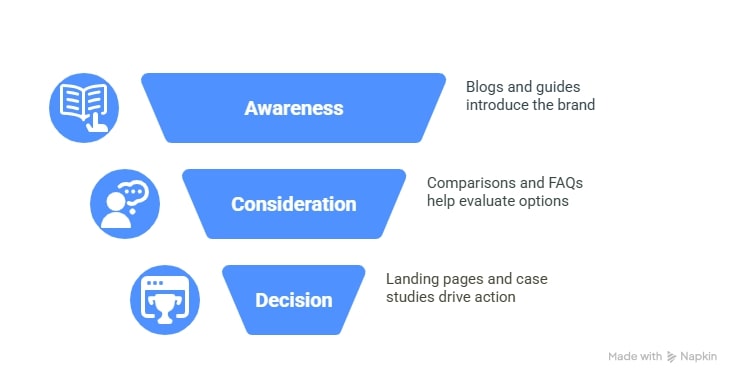
By assigning keywords to each funnel stage, you ensure that no user is left stranded – each query leads them to the next logical step.
When your keyword strategy focuses on intent, not just impressions, your content stops being a volume game and starts being a conversion machine. SEO isn’t about showing up for every match – it’s about showing up when it matters most.
Match the intent, deliver the right content, and watch your conversion rate soar like a last-minute header into the top corner.
Aligning SEO Strategies with Business Goals
At the end of the season, no one brags about ball possession – they brag about trophies.
In the world of digital marketing, the same rule applies: traffic, rankings, and impressions are great, but if they don’t move the needle on real business outcomes, it’s just passing for passing’s sake.
To deliver true value, SEO strategy must align tightly with your client’s business goals – whether that’s generating qualified leads, increasing product sales, driving trial sign-ups, or building brand authority in a competitive space. It’s not about chasing keywords for the sake of it; it’s about chasing impact.
From Vanity Metrics to Victory Metrics
Traditional SEO metrics – rankings, organic sessions, click-through rates – are valuable, but they’re means, not ends. To win buy-in and deliver results that matter, you need to connect your SEO work to business-critical KPIs.
5 examples of business-aligned SEO goals:
- Increase leads from organic traffic by 25% in Q2
- Improve conversion rate on top landing pages to 5%
- Rank in the top 3 for bottom-funnel commercial terms (e.g. “best [service] provider UK”)
- Grow email list by 2,000 qualified sign-ups through blog-led lead magnets
- Increase organic revenue from non-branded keywords by 30% year-on-year
Every SEO task – be it content creation, technical fixes, or link building – should ladder up to one or more of these goals. This alignment ensures your strategy isn’t just “busy,” it’s productive.
Track Conversions from Organic Traffic
You can’t improve what you don’t measure. That’s why setting up proper conversion tracking is crucial – not just for the site as a whole, but specifically for organic sessions.
Use GA4 or your preferred analytics platform to track:
- Form submissions
- Newsletter sign-ups
- Demo or trial requests
- Phone clicks or chatbot engagements
- E-commerce sales (if applicable)
- Scroll depth or video views (for micro-conversions)
Segment this data by source/medium to see how organic traffic contributes to each goal. Then dig deeper – which keywords, pages, and user flows are driving conversions? This insight lets you double down on what’s working.
Combine data from Google Search Console, GA4, and even CRM platforms (like HubSpot or Salesforce) to get a full picture of SEO’s impact on pipeline and revenue.
Collaborate Across Teams: SEO, CRO, and Beyond
Aligning SEO with business goals isn’t a solo effort – it’s a team sport. Your content strategist, CRO specialist, UX designer, and paid media manager all need to follow the same playbook.
Here’s what that looks like in practice:
- Content & SEO: Prioritise topics that address business pain points, customer objections, or key decision-making criteria.
- SEO & CRO: Share insights – what pages are attracting high-intent traffic but underperforming on conversion? What CRO changes have lifted conversion rates that could inform new landing pages?
- SEO & Paid Media: Use organic performance to inform PPC strategy (e.g. bid on high-converting organic keywords to dominate SERPs).
- SEO & Sales: Identify which search queries lead to the best leads (e.g. higher deal values, faster sales cycles).
This integrated approach ensures your SEO doesn’t just operate in a silo – it becomes a growth driver that’s accountable, measurable, and collaborative.
Strategy Before Tactics: Prioritise Efforts Based on Impact
It’s tempting to chase every technical audit point or optimise every blog post. But when you’re aligning with business goals, not all SEO tasks are created equal.
Ask yourself:
- Will this task directly support a conversion goal?
- Will it improve a high-value journey or funnel?
- Does it address a page or keyword tied to a commercial priority?
Sometimes, fixing one underperforming service page can deliver more ROI than publishing five new blog posts. Strategic SEO means making every move count.
When you align SEO with business goals, you move from being a keyword jockey to a strategic growth partner. You’re no longer playing for pageviews – you’re playing for the win.
And in the eyes of your clients or stakeholders, that’s the only scoreboard that matters.
Conclusion
SEO alone doesn’t win the match – it’s how you play the ball forward that counts. Driving traffic is only the opening move. Converting that traffic into leads, customers, and revenue is where the real victory lies.
By aligning SEO with user experience, search intent, and business goals, you’re no longer just generating visibility – you’re engineering results. You’re building digital journeys that resonate, engage, and convert. From spotting roadblocks in the user journey to refining CTAs and mapping keywords to intent, every optimisation becomes a calculated pass toward the back of the net.
So, whether you’re guiding clients through a full-site SEO overhaul or refining landing pages with surgical precision, remember: the goal isn’t more traffic. The goal is more of the right traffic that converts.
Because when SEO and CRO work together like a well-oiled side, you don’t just compete – you dominate the league.
Now’s your move: audit your top-performing pages, analyse where users drop off, and start turning clicks into conversions. The crowd is cheering, the scoreboard’s waiting.
👉 Need a little help combining CRO with SEO? Work with SUSO today and skyrocket your conversion rates.